
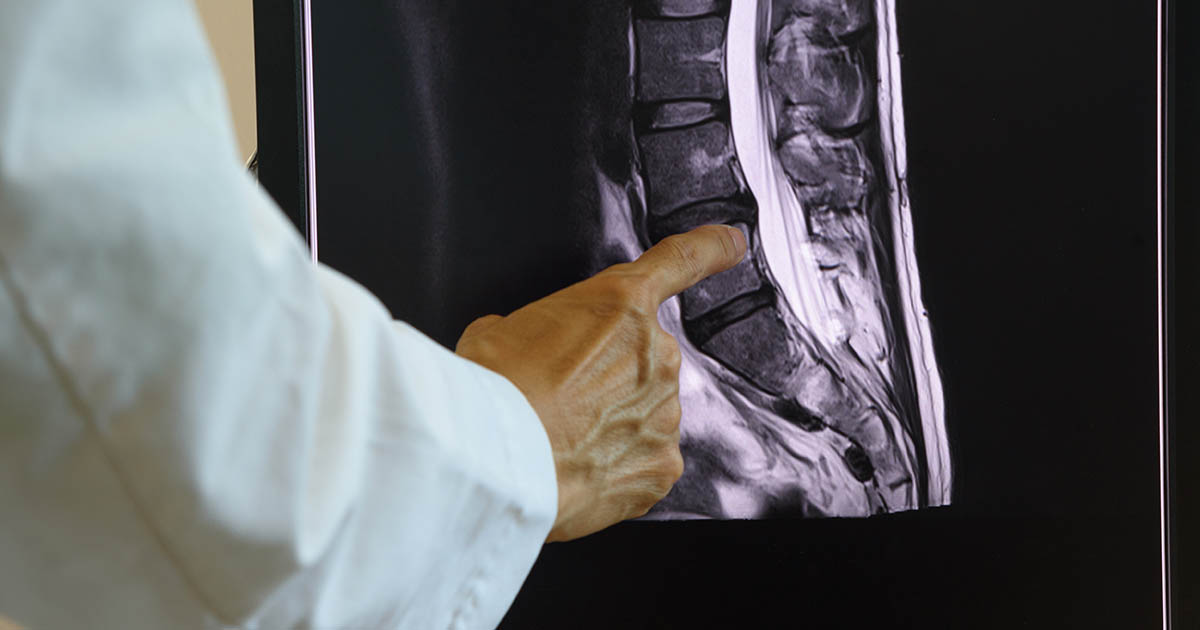
When sciatica hits hard, most patients assume the first step is imaging. It makes sense: something is pressing on a nerve, and an MRI will show exactly what it is. But ordering an MRI before the clinical picture has had time to develop is often premature, occasionally misleading, and in most straightforward cases, it does not change what happens in the first several weeks of care.
This does not mean imaging is unimportant. It means that the decision to image should follow specific clinical reasoning, not just a patient's (understandable) urgency to get answers. Here is the framework we use at our Lakewood Ranch clinic to think through sciatica imaging decisions with patients.
Why Most Sciatica Does Not Need Imaging in the First Several Weeks
True sciatica is nerve root compression: a structure (most commonly a herniated disc) pressing on the L4, L5, or S1 nerve root as it exits the lumbar spine, causing pain, numbness, or weakness that radiates into the buttock, leg, and sometimes the foot. The nerve knows where it is being compressed, and the clinical exam picks up most of that information without a scan.
A careful physical exam identifies which nerve root is irritated based on:
- Dermatomal distribution (where the pain and numbness travel)
- Motor testing (which muscle groups show weakness)
- Reflex testing (which deep tendon reflexes are diminished)
- Straight-leg raise and other provocative tests (which movements reproduce or relieve the symptom)
When those findings are consistent and there are no neurological red flags, the clinical picture is informative enough to start treatment. An MRI at that point would almost certainly confirm a disc herniation at the clinically suspected level. The question is whether confirming it on film changes the treatment plan, and in many early-stage cases, it does not.
Research on acute disc herniation supports this. Studies consistently show that a substantial proportion of disc herniations begin to resorb spontaneously within 6 to 12 weeks, particularly in younger patients. The disc material is recognized as foreign by the immune system and gradually broken down. Imaging at week one captures peak inflammatory swelling, not the final anatomy. The image you get today may look considerably different from the image you would get in eight weeks.
The MRI is a photograph, not a diagnosis. The diagnosis comes from matching the image to the patient who is sitting in the room. A finding without a corresponding clinical presentation is background noise.
The Red Flags That Change the Imaging Timeline
This is the part that matters most. There is a subset of presentations where waiting for imaging is the wrong call, and knowing those situations is non-negotiable. Some require an ER visit immediately. Others require imaging within days. A provider who does not screen for these flags on every sciatica case is not practicing safely.
Get to an emergency room now (do not wait for a clinic appointment)
- Saddle anesthesia: numbness or loss of sensation in the inner thighs, perineum, or genitals. This is a cauda equina syndrome warning sign. Cauda equina syndrome is a surgical emergency, and delays of even hours can lead to permanent bladder, bowel, and sexual dysfunction.
- Loss of bladder or bowel control: new-onset inability to urinate or unexpected incontinence. Combined with sciatica, this is cauda equina until proven otherwise.
- Rapidly progressive motor deficit: severe foot drop that developed in hours or overnight, or sudden inability to flex the hip. Not general weakness but acute, rapid deterioration.
If any of those are present, stop reading and go to an ER. Not urgent care. An emergency room with MRI capability.
Accelerated imaging (days, not weeks)
- History of cancer: any sciatica in a patient with a known or prior malignancy needs imaging promptly to rule out vertebral metastasis or epidural cord compression. This is not a disc herniation scenario until proven otherwise.
- Fever plus back or leg pain: discitis, vertebral osteomyelitis, and epidural abscess can all mimic sciatica. Infection can destroy a disc in days. Imaging plus labs are urgent.
- Recent significant trauma: a fall, a high-speed impact, a compression event. Fracture must be ruled out before any manual therapy is appropriate.
- Age over 70 with new-onset sciatica: spinal stenosis, pathological fracture, and tumor are more common in older adults. Imaging threshold is lower.
- No improvement after 4 to 6 weeks of active conservative care: if a patient is doing everything right (decompression, mobilization, nerve care, activity modification) and the neurological picture is not improving or is worsening, imaging should happen.
- Progressive neurological deficit across visits: if motor testing or reflexes are getting worse over two or three visits, not better, imaging moves up regardless of how early in the course you are.
- Bilateral symptoms: sciatica in both legs at the same time suggests central canal stenosis or a large central disc herniation rather than a simple lateral herniation. That presentation warrants imaging sooner.
If none of these flags are present, conservative care for four to six weeks is both appropriate and consistent with clinical guidelines from the American College of Physicians and most spine-focused professional bodies.
What an MRI Actually Shows (And What It Does Not)
MRI is genuinely excellent technology. For spine pathology specifically, it provides soft-tissue detail that X-ray and CT cannot match:
- Disc herniations: location (lateral vs. central vs. foraminal), type (protrusion vs. extrusion vs. sequestration), level (L3-4, L4-5, L5-S1)
- Foraminal stenosis: narrowing of the canal through which the nerve exits
- Central canal stenosis: overall narrowing of the spinal canal
- Facet joint arthropathy
- Nerve root signal changes (edema, compression)
- Bone marrow changes (edema, metastasis)
- Soft tissue masses, infections, and cord or conus pathology
What MRI does not tell you:
- Whether the finding is the one causing your symptoms. Studies on asymptomatic adults consistently find disc herniations, stenosis, and degeneration on MRI in people who have no pain whatsoever. The prevalence increases with age: by age 50, the majority of asymptomatic adults have some finding on lumbar MRI. The image must be correlated with the clinical exam to mean anything.
- The degree of nerve inflammation. MRI shows structural compression. It does not directly measure how irritated or inflamed the nerve root is. Two patients can have identically sized herniations at the same level with completely different pain presentations.
- What the disc will look like in six weeks. The image is a snapshot. Disc herniations, particularly extrusions, have documented spontaneous regression rates. The MRI tells you where things stand today.
The 4-6 Week Window and Why Timing Matters
The four-to-six-week threshold before routine imaging is not arbitrary. It reflects the natural history of acute disc herniation and the evidence on conservative care outcomes.
In the acute phase (first two to four weeks), the disc herniation is at its most inflammatory. The nucleus pulposus that has extruded into the canal contains proteins that provoke a strong immune and inflammatory response. This is partly responsible for the severity of early sciatica. Anti-inflammatory physiological processes also ramp up during this window, including macrophage activity aimed at reabsorbing the disc material.
If conservative care is being delivered correctly during this window, the clinical picture typically improves. The nerve root has more room. The inflammatory cascade begins to quiet. Pain and neurological symptoms reduce. An MRI at the end of this period, if still indicated, reflects a more stable state of the disc and is more informative for planning the next phase of care.
This is also why active conservative care during the waiting period matters. Bed rest is not the answer. Movement, targeted decompression, and nerve care during the first four to six weeks can meaningfully influence how much nerve root compromise resolves and how much becomes chronic.
How Imaging Actually Changes the Treatment Plan
When imaging is ordered, it serves specific clinical purposes. Understanding those purposes helps patients understand why the timing matters.
Surgical consultation threshold: If progressive motor deficit is not responding to conservative care, a surgical consultation requires imaging. No spine surgeon will evaluate a patient for possible discectomy or laminectomy without an MRI. Getting imaging is part of the referral process, not an alternative to it.
Injection targeting: Epidural steroid injections and transforaminal nerve root blocks are fluoroscopy-guided procedures that require knowing the target level. An MRI identifying the herniation level is the roadmap for those procedures.
Decompression protocol targeting: At our clinic, spinal decompression protocols are adjusted based on the disc level and the nature of the herniation. A large L5-S1 extrusion is managed differently than a moderate L4-5 protrusion with foraminal stenosis. When imaging is available, it directly informs the angle, force, and pattern of the decompression program. The clinical outcome of decompression for disc-related conditions is generally better when the protocol is level-specific.
Ruling out non-disc causes: When the presentation is atypical (no improvement across multiple visits, constitutional symptoms, bilateral involvement), imaging rules in or out the causes that need to be ruled out before continuing conservative care.
Conservative Care While You Wait and After
The four-to-six-week "window" is not passive waiting. It is an active treatment phase. What we do during that period shapes both the recovery trajectory and the clinical picture if imaging does become necessary.
A structured conservative care program for sciatica typically includes:
- Chiropractic evaluation and targeted mobilization: Assessment of lumbar mechanics, pelvic alignment, and hip function. Mobilization and manipulative therapy where appropriate (not aggressive rotational manipulation into an acute disc herniation, but careful, level-specific approaches).
- Spinal decompression for disc-driven cases: Computer-guided traction creates negative intradiscal pressure, which reduces the compressive force on the herniated disc and promotes nutrient exchange into the disc tissue. For patients with disc-driven sciatica, decompression often produces measurable reduction in radicular symptoms within the first three to five weeks.
- Class IV laser for nerve inflammation: Photobiomodulation at therapeutic depths can reduce inflammatory mediators around the nerve root and in the surrounding soft tissue. This is part of the nerve care component of the program.
- Nerve rehabilitation protocols: When numbness or weakness is present, peripheral nerve stimulation techniques help maintain nerve conduction and reduce central sensitization.
- Activity modification guidance: Most sciatica patients make it worse in specific ways: prolonged sitting, heavy flexion-based lifting, Valsalva maneuvers. Early education on this reduces the likelihood of re-injury during the treatment window.
- Monitoring at every visit for red flag development: The flags described above can develop at any point. The treatment relationship is also the monitoring relationship.
Patients who go through structured active care during the early window typically need less intervention overall. Those who rest passively for four to six weeks and then image tend to find that their clinical picture is similar but their functional baseline has dropped from deconditioning.
A Note on Imaging in Auto Injury and Workers' Compensation Cases
The clinical reasoning above applies to patients whose sciatica developed without a documented injury event. When there is a mechanism of injury (a car accident, a workplace injury), the imaging calculus shifts for reasons that are partly clinical and partly legal.
In Florida auto injury cases, documenting a disc herniation via MRI within a reasonable window of the accident is important for establishing causation. Waiting three or four months before imaging makes the causal connection more difficult to argue. If you developed sciatica after a car accident and are working with an attorney, your provider should be thinking about imaging timing as part of the documentation strategy, not only as a clinical decision.
Workers' compensation cases in Florida similarly require documented imaging for authorization of many treatment modalities. In those cases, imaging is often not optional regardless of the conservative-care-first framework above.
For more on the auto injury care pathway, including how we coordinate with personal injury attorneys, see our auto injury care page or the post on why whiplash symptoms show up days later.
Putting It Together: The Practical Decision Tree
For a patient who walks in with new-onset sciatica and no neurological red flags, here is the practical decision framework:
- Screen for red flags first. Cauda equina signs, fever, cancer history, recent trauma, progressive deficit, bilateral presentation. Any of those present: imaging now, or ER immediately.
- Clinical exam to establish the pattern. Dermatome, motor, reflex, provocative testing. Document the baseline neurological status.
- Begin active conservative care. Decompression where indicated, mobilization, nerve care, activity guidance. Set a four-to-six-week functional milestone.
- Monitor at every visit. Any new red flag development or progressive neurological loss moves imaging up immediately.
- Re-evaluate at week four to six. If improving: continue treatment and image if the plan requires it (for injection, surgery consult, or decompression targeting). If not improving: image, reassess, adjust the plan.
This is not a rigid protocol. It is a framework that gets adjusted for the individual patient. Age, general health status, the nature of their work, whether they have a legal case, and the specific clinical findings all shape how quickly imaging is indicated.
If you are dealing with sciatica and wondering whether a scan is the right next step, bring those questions to a provider who can do a thorough neurological exam first. The exam will often tell you more about what is happening than you expect, and it will tell your provider what imaging will and will not add to the clinical picture.