
Bulging disc? It's the early stage, and it responds well to care.
A bulging disc is when a spinal disc pushes past its normal border while its tough outer ring stays intact. Many bulges cause no pain at all. When one does, it's usually because it's pressing on a nearby nerve, and that pressure often eases with non-surgical, decompression-first care. Serving Lakewood Ranch, Bradenton, and Sarasota.
- Non-surgicaldecompression-first care
- Often silentmany bulges are painless
- 23+ yrsDr. Banman's experience
Bulging disc vs. herniated disc, what's the difference?
These words get used interchangeably, but they describe different stages. Knowing which one you have clarifies what to expect, and a bulge is usually the more forgiving of the two.
Bulging disc (contained)
The disc pushes outward but the outer ring (the annulus fibrosus) is still intact and the soft inner core is contained, just displaced. Many bulges are completely silent and only show up incidentally on an MRI. A bulge usually causes symptoms only when it presses directly into a nerve root or the spinal canal. Because the disc is still whole, conservative care, including spinal decompression and chiropractic adjustments, tends to handle bulges well.
Herniated disc (the next stage)
When the outer ring tears and the inner core pushes through, a bulge becomes a herniated disc. It is generally more painful because the escaped material both presses on and chemically irritates the nerve. The reassuring part: even herniations often improve with conservative care, so a contained bulge has an even better outlook.
Where it happens
Bulging discs are most common in the lower back (lumbar spine), where they can cause back pain or sciatica down the leg, and in the neck (cervical spine), where they can refer pain, numbness, or tingling into the shoulder and arm. The location of your symptoms often points to the level involved.
Why discs bulge.
A bulge rarely comes from one moment. The disc was usually already weakening, and a normal day finally exposed it.
Years of compression
Sitting, bending, and repetitive flexion gradually weaken the outer ring of the disc, letting it push past its normal border.
Disc dehydration with age
Discs lose water content over time. A drier disc is flatter and bulges more easily, which is why bulges become more common with age.
Poor posture & prolonged sitting
Long hours at a desk or in the car, common around Lakewood Ranch and the I-75 commute, keep the lower back in flexion and load the back of the disc.
Lifting & bending
Lifting from a bent-forward position, especially with a twist, spikes pressure inside the disc and can push a weakened disc outward.
Excess body weight
Extra load through the spine increases day-to-day disc pressure and accelerates the wear that leads to bulging.
Genetics
Some people inherit weaker disc collagen and develop bulges earlier, often at more than one level.
Decompression-first, layered care.
The plan is built around the disc: take pressure off it, calm the irritated nerve, restore motion to the joints around it, and rebuild the support that keeps the bulge quiet.
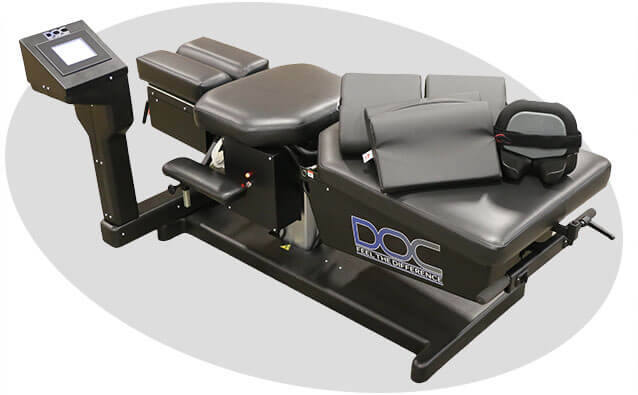
Spinal Decompression
Gentle, targeted traction that may reduce pressure inside the disc, helping a contained bulge ease off the nerve.
Learn more →Chiropractic Adjustments
Restores motion to the joints above and below the bulging level so the disc isn't taking all the load.
Learn more →Class IV Laser
Targets inflammation around the irritated nerve and the surrounding soft tissue.
Learn more →EMS & rehab
Activates the deep stabilizing muscles that protect the disc through daily life, so improvement holds.
Learn more →Quick answers.
Can a bulging disc heal on its own?
Often, yes. Because the outer ring of the disc is still intact, many bulging discs settle with conservative care and time as inflammation calms and the disc rehydrates. Spinal decompression, adjustments, and activity modification are the conservative cornerstones, and surgery is rarely needed for a true bulge.
What is the difference between a bulging disc and a herniated disc?
A bulging disc pushes outward but the tough outer ring is still intact and the soft center is contained. A herniated disc is when that ring tears and the inner material pushes through. A bulge is generally the earlier, milder stage and tends to respond very well to non-surgical care.
Is a bulging disc serious?
Many bulging discs are painless and found incidentally on imaging. A bulge becomes a problem mainly when it presses on a nerve root or the spinal canal, producing pain, numbness, or weakness. Most symptomatic bulges improve with conservative care; red-flag symptoms are uncommon but should be evaluated promptly.
Is spinal decompression good for a bulging disc?
Spinal decompression uses gentle, targeted traction that may reduce pressure inside the disc, which can help a contained bulge ease off an irritated nerve. It is non-surgical and is one of the cornerstones of how we treat bulging discs, after a thorough exam confirms it is appropriate.
What should I avoid with a bulging disc?
In the irritated phase, avoid heavy lifting from a bent-forward position, repeated bending and twisting at the waist, and long stretches of slouched sitting, all of which load the back of the disc. Gentle walking and frequent position changes usually help. We tailor specific guidance to your case.
Do I need an MRI?
Not always. Dr. Banman's exam can usually identify a disc-related pattern. We order imaging when the findings would change the plan, when red-flag symptoms are present, or when conservative care has not produced expected change. Many people have disc bulges on MRI with no symptoms at all, so imaging is interpreted alongside the exam, never on its own.
Insurance?
Chiropractic adjustments may be covered. Spinal decompression is typically not covered by insurance. HSA/FSA accepted. Payment options →
When to come in sooner.
Most bulging discs are a "let's get a plan" problem, not an emergency. But a few symptoms mean same-day evaluation.
Loss of bowel or bladder control
This is a true emergency and a sign of cauda equina compression. Go to the emergency room first, then call us.
Progressive weakness
If a leg or arm is getting weaker over days rather than stronger, that warrants quick evaluation. Earlier care protects function.
Saddle numbness
Numbness in the area that would touch a bicycle seat is another cauda equina warning sign. Emergency department first.
Pain not improving after 2+ weeks
Back pain or sciatica that hasn't changed at all in two weeks is a sign the body needs help. A structured plan usually moves the needle.
Fever or unexplained weight loss
Uncommon with a simple bulge, but it changes the workup. We coordinate with your primary care if that picture is present.
History of cancer
New back pain in someone with a cancer history warrants imaging before a treatment plan. We do not skip that step.
Let's take the pressure off before it becomes a herniation.
An honest exam, an honest plan. The quickest path is a phone call.