
Degenerative disc disease isn't a life sentence of pain.
Despite the scary name, degenerative disc disease isn't really a disease, and it doesn't always get worse. It describes the normal age-related wear of spinal discs as they lose water and height. The good news: the pain it causes can often be reduced substantially with non-surgical, decompression-first care. Serving Lakewood Ranch, Bradenton, and Sarasota.
- Non-surgicaldecompression-first care
- Manageablepain often improves a lot
- 23+ yrsDr. Banman's experience
What "degenerative disc disease" really means.
The name causes more fear than the condition deserves. Understanding it usually makes the path forward feel a lot less daunting.
It's wear, not a disease
Spinal discs are water-rich cushions between the vertebrae. With age they naturally lose hydration and flatten. That is degeneration, the same way hair grays. It is extremely common, and large numbers of people have it on imaging with little or no pain at all.
Why it hurts (when it does)
A flatter, drier disc cushions less and lets the segment move a little more than it should. That can irritate the disc itself, the small joints behind it, and nearby nerves, producing chronic low-grade pain with flares, often worse with prolonged sitting, bending, or first thing in the morning.
Why discs degenerate.
Some of it is simply time. But several factors speed it up, and a few of them are within your control.
Aging & dehydration
Discs lose water content with the years. A drier disc is thinner and more fragile, the single most common driver of DDD.
Genetics
Disc degeneration runs in families. Some people inherit discs that wear earlier and at more levels.
Repetitive load & sitting
Years of bending, lifting, and long hours seated, common with desk work and the I-75 commute, accelerate disc wear.
Smoking
Smoking reduces blood flow and nutrient delivery to the discs, which speeds degeneration. This one is very much modifiable.
Prior injury
An old accident or disc injury can start a segment degenerating earlier than the rest of the spine.
Excess body weight
More load through the spine each day increases disc pressure and the rate of wear.
Decompression-first, layered care.
We can't make a disc young again, but we can change how it feels and functions: offload the worn segment, restore motion, calm irritation, and rebuild support.
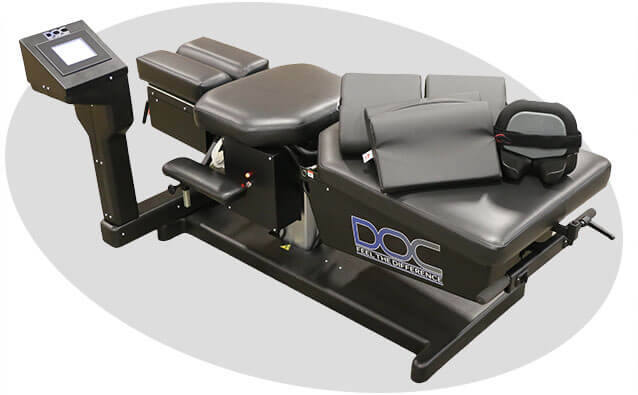
Spinal Decompression
Gentle traction that may offload the worn disc and encourage fluid and nutrient exchange in the segment.
Learn more →Chiropractic Adjustments
Restores motion and balance to the joints around the degenerated level so it isn't carrying all the load.
Learn more →Class IV Laser
Targets the inflammation that drives DDD flares in the disc and surrounding tissue.
Learn more →EMS & rehab
Strengthens the deep stabilizers that protect an aging segment, which is how improvement holds long-term.
Learn more →Quick answers.
Is degenerative disc disease actually a disease?
Not really. Despite the name, it is not a disease in the usual sense and it does not always get worse. It describes the normal age-related wear of spinal discs as they lose water and height. Many people have disc degeneration on imaging with little or no pain, and symptoms often respond well to conservative care.
Can degenerative disc disease be reversed?
The aging of a disc itself can't be undone, but the pain and dysfunction it causes can often be substantially reduced. Spinal decompression may help offload the disc and improve fluid exchange, while adjustments and rehab restore motion and support, so people frequently feel much better even though the disc is still aged.
Does spinal decompression help degenerative disc disease?
It can. Decompression uses gentle, targeted traction that may create negative pressure in the disc, easing load on the worn segment and encouraging fluid and nutrient flow. Combined with chiropractic care and rehab, it's one of the cornerstones of how we manage DDD non-surgically.
Will I eventually need surgery or a fusion?
Most people with degenerative disc disease never need surgery. Conservative care manages the large majority of cases. Surgery such as fusion is generally reserved for severe, progressive cases with instability or nerve compression that hasn't responded to a thorough non-surgical plan.
Is exercise good or bad for DDD?
Generally good. Gentle, regular movement, walking, and targeted core work keep the segment nourished and supported. The key is the right kind of loading, which we coach based on your exam. Total rest tends to make a degenerated back stiffer and weaker.
Do I need an MRI?
Not always. Disc degeneration is so common on imaging that an MRI rarely changes the plan by itself. Dr. Banman orders imaging when findings would change care, when red-flag symptoms are present, or when conservative care hasn't produced expected change. The exam leads; imaging supports it.
Insurance?
Chiropractic adjustments may be covered. Spinal decompression is typically not covered by insurance. HSA/FSA accepted. Payment options →
When to come in sooner.
DDD itself is a manage-it problem, not an emergency. But a few symptoms mean same-day evaluation.
Loss of bowel or bladder control
A true emergency and a sign of cauda equina compression. Go to the emergency room first, then call us.
Progressive weakness
A leg or arm getting weaker over days, not stronger, warrants quick evaluation. Earlier care protects function.
Saddle numbness
Numbness in the area that would touch a bicycle seat is another cauda equina warning sign. Emergency department first.
New, severe, or constant night pain
Pain that is worse at night and won't ease with position change is worth a prompt look, especially if it's new.
Fever or unexplained weight loss
Uncommon with DDD, but it changes the workup. We coordinate with your primary care if that picture is present.
History of cancer
New back pain in someone with a cancer history warrants imaging before a treatment plan. We don't skip that step.
Let's calm the flares and get you moving again.
An honest exam, an honest plan. The quickest path is a phone call.