

Back pain is the most common injury in recreational and professional golf. Estimates across studies place the lifetime prevalence of back pain in golfers somewhere between 25% and 55%, depending on the population and how "injury" is defined. For a sport often marketed as low-risk, those are striking numbers. And in Lakewood Ranch, where golf is woven into the fabric of communities from Lakewood Ranch Country Club to Esplanade, we see the consequences in our clinic regularly.
The core issue is that golf looks gentle but moves the lumbar spine in ways that accumulate stress very efficiently. A single well-executed swing takes the spine from a flexed, side-bent, and rotated starting position through a high-velocity rotation back through to a follow-through that reverses much of that motion. Do that 80 to 100 times in a round, and the cumulative load on discs and facet joints becomes significant. Add practice swings, range sessions, and the stiffening effect of walking in heat, and you have a recipe for chronic low back pain that most players initially dismiss as "normal soreness."
It is not normal. It is a signal worth understanding.
Why the Golf Swing Is Uniquely Demanding on the Lumbar Spine
The lumbar spine is designed primarily for sagittal-plane motion: flexion and extension. The discs, facet joints, and surrounding ligaments all perform best in forward and backward bending. What the lumbar spine handles poorly is combined loading: rotation plus compression, or rotation plus side bending, applied rapidly and repeatedly.
A full golf swing produces all of that simultaneously. At address, the golfer stands in slight hip and lumbar flexion. The backswing then loads the spine in rotation and side bending. At transition, the hips shift laterally and begin rotating before the upper body, which creates a brief but significant shear force across the lumbar discs. The downswing accelerates all of this, and impact adds a sharp compressive load as the club meets the ball. The follow-through reverses the rotation and extends the lumbar spine, sometimes into mild hyperextension depending on the player's flexibility and swing mechanics.
None of these motions individually is dangerous. The problem is the combination, the speed at which it happens, and the fact that it is repeated dozens of times per session over months or years without any specific corrective care between rounds.
Four Specific Loads a Single Swing Creates
Understanding the biomechanics helps explain why different structures fail in different golfers. Four distinct loads drive most golf-related back injuries:
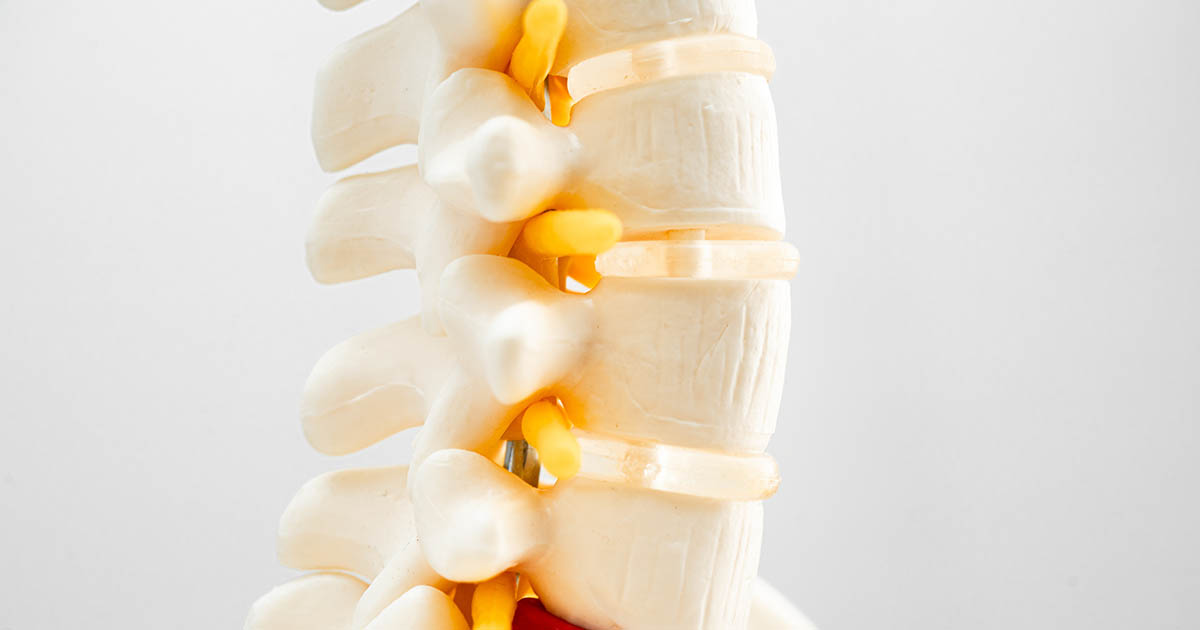
- Shear force across lumbar discs. The rotational lag between hips and shoulders during the downswing stretches the disc's annular fibers at an angle. Over time, repeated micro-tears can accumulate into a disc bulge or herniation, particularly at L4-L5 and L5-S1.
- Compressive loading of the facet joints. The facet joints on either side of each vertebra take significant compression during the follow-through, especially in players who hyperextend through impact. In golfers over 45, where some facet degeneration is common, this is often the primary pain driver.
- Lateral flexion stress on the lead side. The lead side (left side for a right-handed golfer) experiences a compressive and shear combination through impact. The SI joint on the lead side is particularly vulnerable to repetitive loading from this pattern.
- Paraspinal muscle fatigue and guarding. The muscles alongside the spine work continuously through the swing to stabilize the motion. When those muscles fatigue over a round, the deeper stabilizing muscles fail to engage properly, and the passive structures (discs, ligaments, joints) absorb more load than they should.
The Most Common Golf-Related Back Injuries
In our Lakewood Ranch practice, four injury patterns show up consistently in golfers who come in with back pain:
Lumbar disc injury
Disc injuries are the most structurally significant golf-related back problem. The annular fibers of the disc can develop micro-tears that accumulate gradually, so a patient often describes a history of "occasional tightness after golf" that over several months becomes persistent pain, and eventually pain that radiates into the buttock or leg. The disc does not usually fail all at once. It degrades over time under repeated rotational stress. By the time a player walks into our office describing sciatica after a round, the disc has typically been under abnormal load for a while.
For information on how disc injuries develop and what can be done about them, see our disc conditions page.
Facet joint irritation
The facet joints at L4-L5 and L5-S1 are often the primary pain generator in golfers over 50. Facet pain typically presents as a sharp, localized ache just to one or both sides of the spine at the beltline. It often worsens with extension, which is why finishing the follow-through or bending backward to pick up a ball can be particularly sharp. Unlike disc pain, facet pain usually does not radiate significantly below the knee.
Sacroiliac joint strain
The SI joint on the lead side (left in right-handed golfers) absorbs a substantial compressive load during the downswing as the hips drive forward. SI joint dysfunction produces a dull, aching pain just above the tailbone on one side, often felt when walking or rotating. It is frequently misidentified as disc pain because it can refer discomfort into the buttock and back of the thigh.
Paraspinal muscle strain and guarding
Acute muscle strain from a single swing, usually a poorly struck shot where the club catches the ground hard, is common and typically short-lived. More significant is the chronic guarding pattern: the paraspinal muscles on one side of the spine progressively tighten over weeks to protect an underlying irritated joint or disc. This produces the characteristic "can't straighten up fully" feeling that many golfers dismiss as stiffness but is actually protective splinting.
Warning Signs That Point to Something Structural
Not all golf-related back pain requires intervention. But several patterns suggest a structural problem that will not resolve with rest alone:
- Pain that persists more than 3 to 5 days after a round, even with no further golf.
- Pain that radiates below the knee, or that causes tingling or numbness in the foot or toes.
- Morning stiffness that takes more than 20 to 30 minutes to work out after a round.
- Pain that is worse on one specific side, or that locks up on the follow-through consistently.
- Pain that worsens over consecutive rounds rather than improving with rest between them.
- Any episode of back pain severe enough that you had to stop the round.
Pain that radiates into the leg, particularly below the knee or into the foot, is not a golf-related muscle issue. It is nerve compression, most often from a disc, and it should be evaluated properly rather than managed with ibuprofen and hoping it resolves before the next round.
Why Playing Through the Pain Usually Makes It Worse
This is the pattern we see most often in the clinic. A golfer develops low-level back pain during rounds. They take a few days off, it settles, they play again. It settles again, they play again. Over 6 to 12 months, the threshold for pain gets lower: it takes fewer holes to trigger symptoms, the recovery time lengthens, and eventually the pain starts showing up off the course, during daily activities like sitting in a car or getting out of a chair.
What is happening biologically is that each round loads a structure that has not had time to recover and reinforce. Disc tissue is avascular, meaning it gets its nutrition through diffusion rather than direct blood supply. Repeated loading without adequate recovery and hydration leaves the disc progressively less resilient. Facet joints, similarly, can develop inflammation that becomes chronic when the joint is repeatedly stressed before the acute phase has resolved.
Playing through pain is not toughness. It is borrowing against a structural budget that eventually runs out. The longer the interval between the onset of symptoms and a proper evaluation, the more difficult the recovery tends to be.
What a Good Evaluation Involves
When a golfer comes in with back pain, the first goal is to identify which structure is the primary driver. The clinical exam involves:
- Range-of-motion testing to identify which planes of movement are restricted or reproduce the pain. Golfers with facet problems typically hurt most in extension and rotation. Disc patients often hurt most in flexion under load.
- Orthopedic tests specific to the disc (straight-leg raise, slump test) and SI joint (FABER, compression/distraction) to differentiate the source.
- Neurological screen to check for radiculopathy: dermatomal sensation, deep tendon reflexes at the knee and ankle, and motor strength.
- Postural and movement assessment to identify compensatory patterns that are placing abnormal load on certain segments.
Imaging is ordered when the examination suggests disc herniation with radiculopathy, when there are neurological deficits, when symptoms have been present for more than 4 to 6 weeks without response to conservative care, or when a red flag is present (unexplained weight loss, fever, history of cancer, bowel or bladder changes). Most straightforward golf-related back pain can be diagnosed and treated without imaging, at least initially.
Treatment Options That Work for Golfers
Treatment depends on what the evaluation finds. For most golf-related back injuries, a structured conservative program works well, particularly when it is started before the injury becomes chronic:
Chiropractic adjustment and mobilization. Restoring normal segmental mobility to the lumbar spine is typically the first priority. A stiff or misaligned facet joint that is restricted in motion becomes irritated under repeated rotational stress. Adjusting the joint and restoring its normal range reduces the inflammatory load and allows the stabilizing muscles to engage properly again. See our chiropractic adjustments page for more on what this involves.
Spinal decompression for disc involvement. When the evaluation points to disc injury, particularly with any component of leg pain or nerve tension, spinal decompression is often the most efficient tool for addressing the disc. The computer-controlled traction creates negative intradiscal pressure, which draws disc material back toward center and facilitates rehydration of the disc. Golfers with disc-driven back pain who go through a proper decompression course typically report improved resilience over time, not just symptom reduction.
Class IV laser therapy. Soft-tissue inflammation from paraspinal muscle strain or facet joint irritation responds well to Class IV laser therapy. The photobiomodulation effect reduces inflammatory cytokines at the tissue level and accelerates cellular repair. We often use laser early in the acute phase to calm the inflammatory response before manual work begins.
Movement and swing-mechanics coaching. Treating the injury without addressing what in the swing caused it leads to recurrence. Once the acute phase is resolved and mobility is restored, we look at swing mechanics: ground engagement patterns, hip-to-shoulder sequence, and follow-through position. Many golfers are using their lumbar spine to generate rotation because their hips are restricted, and improving hip mobility dramatically reduces lumbar stress without changing the swing significantly.
Stabilization and core activation. The deep stabilizing muscles of the lumbar spine (multifidus, transversus abdominis) are inhibited by pain and can take weeks to recover even after pain resolves. Targeted activation exercises that restore deep-muscle function are an important part of the return-to-golf protocol, not generic "core work" but specific exercises that train the stabilizers to engage at the right moment in the swing sequence.
Getting Back on the Course and Staying There
The goal in treating golfers is not just resolving the current episode. It is building enough structural resilience that the spine can tolerate a full season without breaking down again. In our experience, golfers who go through a proper evaluation and a structured treatment program rather than managing symptoms with rest and anti-inflammatories are generally able to return to golf and maintain consistent play with far fewer flare-ups.
The Father's Day weekend rounds are coming up, and so is the full summer season at courses across Lakewood Ranch and Sarasota. If your back has been flaring during or after rounds, this is not the week to ignore it. Address it now, before the season is in full swing.
Call our Lakewood Ranch office at (727) 213-2982 or book online at celluron.janeapp.com. We typically have same-week availability for new patients and can give you a clear picture of what is happening after one visit.