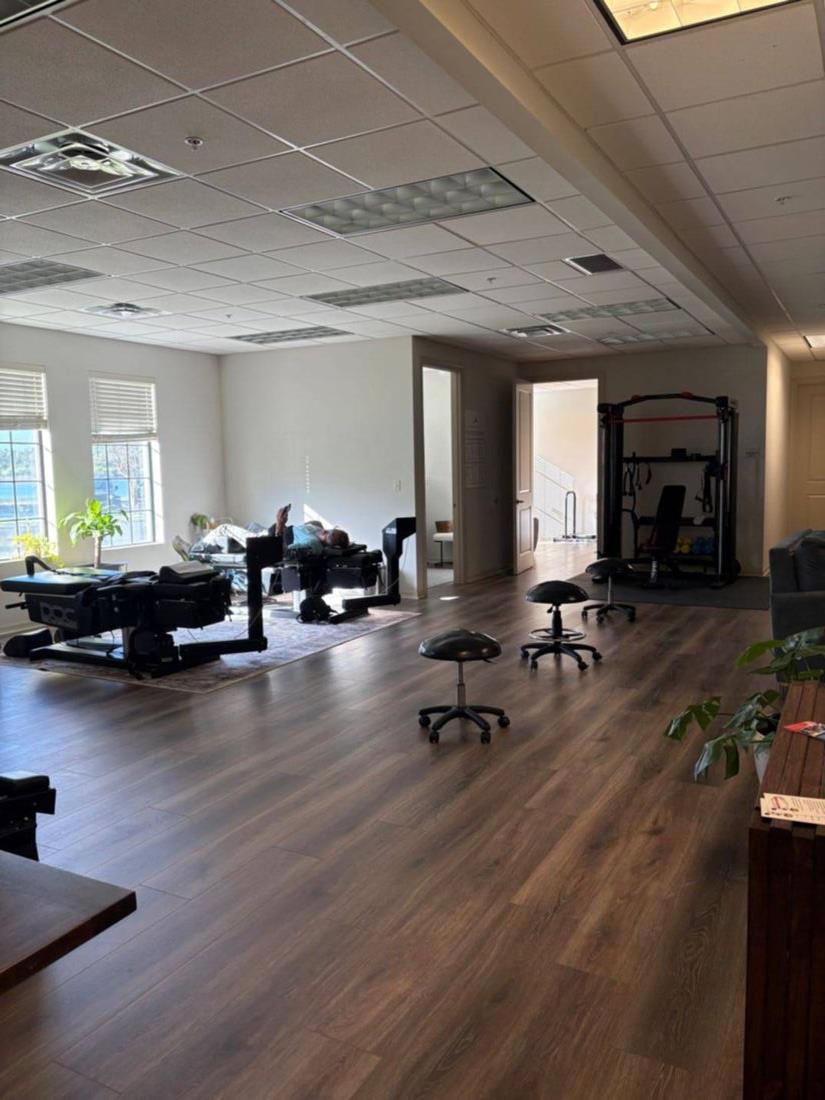


A lot of people hesitate before their first chiropractic appointment because they simply do not know what is going to happen. Will there be a lot of cracking? Will they put me in uncomfortable positions? Will I have to undress? Will I leave in more pain than I arrived?
These are fair questions. The honest answer is that a well-run first visit is much more like a diagnostic consultation than anything dramatic. The goal is not to start treating you in the first session. The goal is to find out exactly what is going on so that any treatment is actually aimed at the right thing.
Here is what happens at Spine and Wellness Center Lakewood Ranch, step by step.
Before You Walk In: What to Bring and Wear
The intake visit is thorough enough that it helps to come prepared. Bring anything that is relevant to the complaint you are coming in with:
- Any recent imaging: X-rays, MRIs, CT scans. Even if they are old (within 2-3 years), they are useful as a baseline.
- A list of current medications and supplements. Some medications affect nerve conduction and muscle tone in ways that are relevant to the exam.
- Your insurance card if you plan to use insurance. If you are unsure whether you want to use insurance or pay cash, see our cash pay vs. insurance comparison before you arrive.
- Any paperwork from a prior accident or injury, if the visit is related to an auto injury or workers' compensation claim.
For clothing: wear something comfortable that you can move around in. You will not need to fully undress. Loose pants and a t-shirt work well. If you are coming about a lower back or hip complaint, pants that you can roll to the knee help the exam go faster. If it is a neck or shoulder issue, a shirt you can easily lift and lower is fine.
If you speak Spanish and prefer to have this conversation in Spanish, Dr. Banman is fluent. You do not need to bring a translator. You can also read more about what to expect from our Spanish-speaking chiropractic care.
Step 1: The Intake Forms
You will fill out intake forms when you arrive (or we may send them electronically beforehand). They ask more than a standard medical intake because the structural history matters: previous injuries, surgeries, accidents, occupational habits, sleep positions, activity level, and the specific behavior of your current symptoms.
That last part is where most patients underestimate detail. "My back hurts" is a starting point, not a history. The forms ask things like:
- Where exactly does it hurt? Is it in one spot or does it radiate?
- When does it hurt most: morning, evening, after sitting, during activity, at rest?
- What makes it better? What makes it worse?
- Has this happened before? How did it resolve last time?
- What have you already tried: medication, physical therapy, massage, injections?
- On a scale of 0-10, what is the pain level right now versus at its worst?
These questions are not just intake paperwork. The pattern of your symptoms tells Dr. Banman a great deal before he even does a physical exam. A disc injury has a characteristic symptom fingerprint that is quite different from a muscle strain, a facet joint problem, or a referred nerve pattern. The history narrows the field considerably.
Step 2: The Consultation
Before any hands-on exam, Dr. Banman will sit with you and go through the history you filled out. This is the part most new patients do not expect: it is a real conversation, not a quick glance at a clipboard before someone presses on your spine.
He is listening for a few things:
- Chronology. How did this start? Was there a specific event, or did it come on gradually? Gradual onset without an obvious trigger often points to a structural or degenerative process.
- Behavior over time. Is it getting better, worse, or staying the same? Pain that has been consistently worsening for months without mechanical trigger is a different clinical picture from pain that flares and settles.
- Neurological clues. Any numbness, tingling, burning, weakness in the arms or legs? These symptoms indicate that a nerve root or peripheral nerve is involved, not just local muscle or joint tissue.
- Red flag screening. This is standard procedure: a short set of questions to rule out causes that require immediate referral rather than chiropractic care. These include things like unexplained weight loss, bowel or bladder changes, saddle area numbness, severe night pain that does not change with position, and symptoms after recent trauma with possible fracture risk. If any red flags come up, the right call is imaging or an ER visit first.
The consultation is where the exam actually starts. By the time we get to the table, I already have a working hypothesis. The physical exam is there to confirm, refine, or rule it out entirely. — Dr. Banman
Step 3: The Physical Examination
The physical exam at a chiropractic intake has several distinct components. Most patients go through all of them at the first visit, though the order and emphasis depend on what the history suggested.
Postural Analysis
Dr. Banman will observe how you stand and how you hold your head relative to your shoulders and hips. Postural deviations are not cosmetic observations: forward head posture, high shoulder, visible spinal curvature, or hip tilting all reflect what is happening in the underlying structure. A head that is carried 2-3 inches forward of the shoulders increases effective neck load significantly, which matters for anyone with cervical disc complaints, headaches, or arm numbness.
Range of Motion Testing
You will be asked to bend, rotate, and extend in various directions. The goal is not to see how flexible you are but to document where motion is restricted or painful and, just as importantly, whether restricting motion in one direction reproduces your symptoms. If rotating your neck to the right reproduces the tingling in your right hand, that is a meaningful clinical finding. Range of motion helps Dr. Banman determine which segments of the spine are involved.
Orthopedic and Neurological Testing
This is the part of the exam that separates a thorough intake from a superficial one. Specific tests are designed to load different structures to identify which one is the pain generator. A few examples:
- Straight-leg raise: A positive finding suggests sciatic nerve tension, often from an L4-L5 or L5-S1 disc.
- Spurling test: Loads the cervical nerve roots. Positive if it reproduces arm pain or tingling, suggesting cervical radiculopathy.
- Kemp test / lumbar extension loading: Positive for facet joint involvement or foraminal narrowing in the lumbar spine.
- Patrick / FABER test: Screens for hip joint pathology vs. lumbar or SI joint referred pain.
- Deep tendon reflexes: Absence or asymmetry in the knee or ankle reflex can indicate specific nerve root compression levels.
- Muscle strength grading: Weakness in specific muscle groups, combined with reflex findings, helps identify the nerve root or cord level involved.
None of these tests is 100% definitive on its own. They are assessed together with the history and posture findings to build a clinical picture. If the findings are consistent across multiple tests, that increases confidence in the working diagnosis. If they are contradictory, that flags the need for imaging before starting care.
Palpation
Hands-on assessment of the spine and surrounding musculature allows Dr. Banman to feel for segmental motion restriction, tenderness, and muscle guarding. Spinal joints that are restricted in motion (what chiropractors call "hypomobile segments") often correspond directly to the areas generating symptoms. Palpation also identifies the muscles that are chronically overloaded because they are compensating for structural dysfunction nearby.
Step 4: Diagnostic Imaging (X-rays)
Not everyone needs X-rays at the first visit. The decision depends on what the exam found. X-rays are ordered when:
- The history suggests possible fracture (recent trauma, osteoporosis risk, age over 50 with acute onset pain)
- The exam found significant or unexplained neurological signs
- Structural findings from the exam (significant postural deviation, suspected scoliosis, asymmetric findings) need to be quantified precisely
- The patient has not had recent imaging and the complaint is chronic or complex enough that treatment planning requires knowing the structural baseline
- Prior imaging is more than 2-3 years old and the condition has changed
If X-rays are taken, we take them in-office. Standard views for a lumbar complaint are weight-bearing AP and lateral views. Cervical complaints typically get AP, lateral, and open-mouth (dens) views. For scoliosis assessment, a full-spine standing view is taken. Dr. Banman reviews the films with you the same day and walks you through exactly what you are looking at.
If your complaint and exam findings are straightforward and recent imaging already exists, X-rays may not be needed at the first visit. The care plan may proceed based on clinical findings alone, with imaging held in reserve if the response to treatment is unexpected.
For complex structural cases, disc herniation with active neurological findings, or any situation where the X-ray does not give enough information, Dr. Banman will discuss MRI referral. We coordinate with local imaging centers and, for patients with active auto injury cases, with their attorneys to make sure imaging is documented properly for the claim. See our auto injury care page for how that process works.
Step 5: The Care Plan Conversation
Once the exam (and any imaging) is complete, Dr. Banman will explain what he found in plain language. This is not a five-minute overview with a treatment recommendation at the end. It is a structured explanation:
- What structure is involved and why he believes that to be the case, based on the history, exam findings, and any imaging.
- What that structure does and what happens mechanically when it is injured or degenerating, so you understand the mechanism behind your symptoms.
- What the options are. Depending on the finding, care options may include chiropractic adjustments, spinal decompression, laser therapy, shockwave or softwave therapy, EMS, whole-body vibration, or a combination. He will also tell you when his office is not the right fit and refer elsewhere when appropriate.
- What a realistic treatment course looks like. How many sessions, at what frequency, and what milestones he would expect to see at different points. He will be specific about this.
- What your role is. Chiropractic care works best when patients understand the home component: sleeping positions, movement habits, ergonomics, and anything else that either supports or undermines the in-office work.
You will be given time to ask questions. Patients who understand why they are doing something tend to follow through more consistently, and consistency matters more in structural recovery than almost anything else.
If the plan includes spinal decompression for a disc complaint, Dr. Banman will explain how the decompression table works, what it feels like during a session, and why it is mechanically different from traction or inversion tables. Same for any other therapy in the plan: you will understand what it does before it is done.
If you have questions about the chiropractic adjustments specifically: what they involve, whether they hurt, whether you can decline them in favor of other modalities, those questions are expected and welcome. The care plan is a conversation, not a prescription you are handed.
If They Find Something That Needs Immediate Attention
Occasionally an exam or imaging finding requires a referral rather than chiropractic care. This includes things like:
- Significant fracture or structural instability on imaging
- Severe or rapidly progressing neurological deficits suggesting cord compression
- Findings inconsistent with a mechanical musculoskeletal cause (which can indicate a need for further medical workup)
- Infection or tumor indicators (fever, unexplained weight loss, night sweats alongside spinal pain)
In those situations, the right answer is an immediate referral to a physician, neurologist, or the emergency department, not starting a chiropractic care plan. Dr. Banman will tell you clearly what he found and why he is referring you, and will coordinate with the receiving provider when possible. A chiropractor's job is to help when chiropractic is the right tool and to refer when it is not.
What Most Patients Tell Us Afterward
The most common feedback after a first visit at Spine and Wellness Center Lakewood Ranch is some version of: "I finally understand what is actually wrong." Many patients have been told "you have a herniated disc" or "it is just muscle tension" without any explanation of what that means for their day-to-day life, what drives it, or what the path forward is.
The intake visit is designed to close that gap. You leave knowing what structure is involved, why your symptoms behave the way they do, and what a reasonable path forward looks like. That clarity is what makes the rest of the care plan work.
We accept most major insurance plans, and for patients who are cash-pay or have high deductibles, we can walk you through exactly which services are covered and which are not before anything begins. Visit our new patient page for forms, directions, and parking information.