

I-75 is one of the busiest corridors in Southwest Florida. From the Sarasota and Lakewood Ranch area, it takes you north to Tampa and beyond, south to Naples, or straight to a connection point for a longer summer road trip. If you drive it regularly, you already know the feeling: you start the trip feeling fine, and somewhere around the second or third hour your lower back starts to lodge a complaint. By the time you park, getting out of the car takes a minute.
That is not a coincidence, and it is not just "getting older." There are specific structural reasons why prolonged highway driving loads the lumbar spine in a way that shorter trips or standing do not. Understanding what is happening gives you options before it becomes something that requires more than a stretch at the rest stop.
What Actually Happens Inside Your Disc During a Long Drive
The intervertebral discs between your lumbar vertebrae behave like pressurized hydraulic cushions. They are roughly 80 percent water when you are young and healthy, and they depend on movement to cycle fluids in and out. When you stand or walk, each step creates a mild pump that keeps the disc nourished and hydrated. When you sit in a fixed position for an extended period, that pumping action stops.
Research consistently shows that intradiscal pressure in the lumbar spine is higher during sitting than during standing. A sustained seated position, particularly with the hips flexed to roughly 90 degrees as they are in most car seats, applies a forward-bending load to the disc. The posterior portion of the disc, where most herniations begin, is under more stress in this position than when you are upright.
Over a two, three, or four hour drive with no movement, that sustained pressure gradually squeezes fluid out of the disc tissue. The disc loses a measurable fraction of its height. When you finally stand up, the disc is in a temporarily dehydrated, compressed state. This is one reason why standing up from a car seat after a long trip produces that familiar sharp protest at the base of your spine.
The disc does recover. Overnight recumbency and movement through the day allow it to rehydrate. The problem is when this pattern repeats regularly without the underlying structural issue being addressed, the disc accumulates small amounts of irreversible change over time.
The Four Load Mechanisms Specific to Highway Driving
Driving is not just static sitting. Four specific factors combine to make it harder on the lumbar spine than, say, sitting at a desk for the same duration.
1. Hip Flexor Shortening and Pelvic Tilt
The hip flexors, primarily the iliopsoas, attach from the lumbar vertebrae down through the pelvis and into the femur. When you sit for an extended period with your hips bent, these muscles adaptively shorten. Shortened hip flexors pull the pelvis into anterior tilt, which exaggerates the lumbar curve and loads the facet joints in the low back. After a long drive, many patients notice that their lower back aches and they cannot stand fully upright without it taking a few minutes of walking to loosen up. That is hip flexor adaptation at work.
2. Whole-Body Vibration from the Roadway
Highway driving subjects the spine to continuous low-frequency vibration transmitted through the car seat. Whole-body vibration in the range of 4 to 8 Hz sits close to the natural resonant frequency of the lumbar spine. Research in occupational health literature identifies prolonged exposure to this vibration range as a risk factor for disc degeneration and low back injury. I-75 is a well-maintained highway by Florida standards, but no highway eliminates the transmission of road surface vibration to the driver entirely. On long stretches with concrete expansion joints, the vibration can be more pronounced.
3. Static Muscle Guarding
Driving requires constant low-level muscle engagement. The core and paraspinal muscles maintain your upright posture against the car's acceleration, deceleration, and lateral movements. Unlike active exercise, where muscles contract and release rhythmically, driving involves sustained low-level contraction. After two or more hours, these muscles begin to fatigue. Fatigued paraspinal muscles do a worse job of protecting the disc and facet joints from load spikes, which is why the last stretch of a long drive often feels significantly worse than the first.
4. Constrained Posture Without Micro-Adjustments
In everyday life, your body rarely stays in one position for more than a few minutes. Even desk work involves shifts, reaches, and position changes that relieve pressure on specific spinal segments. In a car on a highway, the seatbelt, the steering wheel, and the need to keep eyes on the road constrain those natural micro-adjustments. Specific segments of the lumbar spine end up sustaining load in a single vector for much longer than they would in any other context.
Why the Pain Peaks After You Park (Not During the Drive)
One of the most common things patients tell us is that they felt okay during the drive but everything fell apart when they tried to get out of the car. This seems counterintuitive but makes mechanical sense.
During the drive, the sustained position creates a kind of temporary accommodation. Structures settle into the load pattern. The transition from seated to standing requires the disc, facet joints, and surrounding musculature to rapidly change their load-bearing configuration. For a spine that has been compressed and vibrated for three hours, that transition can produce a sharp protective muscle spasm or a sudden increase in pain.
The same phenomenon explains why symptoms can worsen over the following few hours or into the next morning. The disc that was compressed during the drive rehydrates as you move around, and that rehydration can cause a previously contained disc to push further into a space it was encroaching on. This is why many patients notice that sciatica-pattern leg symptoms come on in the evening or overnight after a long drive, even if they felt manageable during the trip itself. If you notice radiating leg symptoms following a drive, that is worth having evaluated rather than waiting to see if it resolves.
For more on how disc issues and sciatica interact, our disc issues page and back pain resource walk through the anatomy in more detail.
Who Feels This Most: Pre-Existing Disc Pathology
Not everyone who drives I-75 regularly ends up in our office. Some people have structurally sound discs with good hydration, flexible hip flexors, and no nerve root involvement, and they manage long drives without significant consequence. The patients who struggle most with highway driving tend to have one or more of the following:
- Existing disc bulge or herniation. A disc that is already compromised has less tolerance for sustained compression and vibration. The drive can push a marginally stable disc situation into a symptomatic one.
- Facet joint degeneration. When the cartilage in the facet joints has thinned, the sustained loading of a driving posture concentrates force through already-irritated surfaces.
- Prior history of acute disc episodes. Discs that have experienced prior injury, even if they feel recovered, often have reduced hydration capacity and are more sensitive to prolonged load.
- Dehydration during the drive. Florida summers make this especially relevant. Many drivers avoid drinking water on long trips to minimize rest stop frequency. Disc tissue that is already dehydrated from insufficient fluid intake is more vulnerable to the compressive loads of driving.
- Poor seat ergonomics. Rental cars, older vehicles without lumbar support, and long-haul truck driving positions all create sub-optimal lumbar alignment that magnifies every other factor on this list.
Warning Signs That Mean You Should Get Evaluated
Not every episode of post-drive stiffness requires a clinical evaluation. Many cases resolve with movement, rehydration, and a day's rest. The following signs suggest something more specific is going on and warrant a proper assessment:
- Radiating pain, numbness, or tingling that travels down one or both legs following a drive
- Pain that does not improve within 24 to 48 hours of normal activity
- A pattern where each long drive seems to leave you worse off than the last (progressive worsening)
- Back pain that is noticeably worse in the morning after a long drive the day before (overnight disc rehydration symptom)
- Any weakness in the legs, difficulty with foot dorsiflexion (lifting the foot), or bladder or bowel changes (these are red flags that warrant urgent evaluation, not routine chiropractic care)
- Pain that is exclusively on one side, concentrated in the buttock and leg, and not in the lumbar area at all (this pattern often points to piriformis or SI joint rather than disc, and the evaluation approach is different)
Bladder or bowel changes with low back pain are neurological red flags. If you experience these, please go to an emergency room rather than a chiropractic office.
What Actually Helps Before and During a Drive
These are practical strategies, not generic advice. They work because they directly address the four mechanisms described above.
Before the drive
- Hydrate well the evening before and morning of. Disc hydration is not something you can catch up on during the drive. Getting ahead of it matters more than any supplement or stretching routine.
- Do 5 to 10 minutes of hip flexor stretching. A standing lunge stretch that elongates the front of the hip for 30 to 60 seconds per side, done just before getting in the car, reduces the starting tension your hip flexors carry into the seated position.
- Adjust lumbar support before you leave the driveway. Many car seats have an adjustable lumbar insert. Use it. A properly positioned lumbar support maintains the natural inward curve of the low back and reduces posterior disc load throughout the drive.
During the drive
- Stop every 90 minutes. Get out, walk 5 to 10 minutes, and do a brief hip flexor stretch. This is the single most effective thing you can do. The rest stops on I-75 are placed at reasonable intervals for exactly this purpose.
- Shift position slightly every 20 to 30 minutes. You cannot change posture radically while driving, but you can move the seat angle, adjust lumbar support, and alternate which hand is on the wheel. These micro-changes redistribute pressure across different parts of the disc.
- Keep drinking water. If stopping is inconvenient, plan your hydration so it aligns with your planned rest stops rather than avoiding it entirely.
After the drive
- Do not sit down again immediately. The transition from the car to a couch or another chair extends the duration of the problematic position. Walk for at least 10 minutes before sitting again.
- Ice, not heat, for the first 24 hours if symptomatic. Heat feels good but promotes inflammation. Ice at 10 to 15 minutes on, 20 minutes off, helps manage any acute inflammatory response.
What We Do at the Clinic
When patients come in with driving-related back pain, the evaluation starts with understanding the pattern. Is this a disc issue that has been aggravated, or a facet-dominant presentation? Does the pain have a nerve root component? Is there piriformis involvement from the hip flexor imbalance that builds up over time?
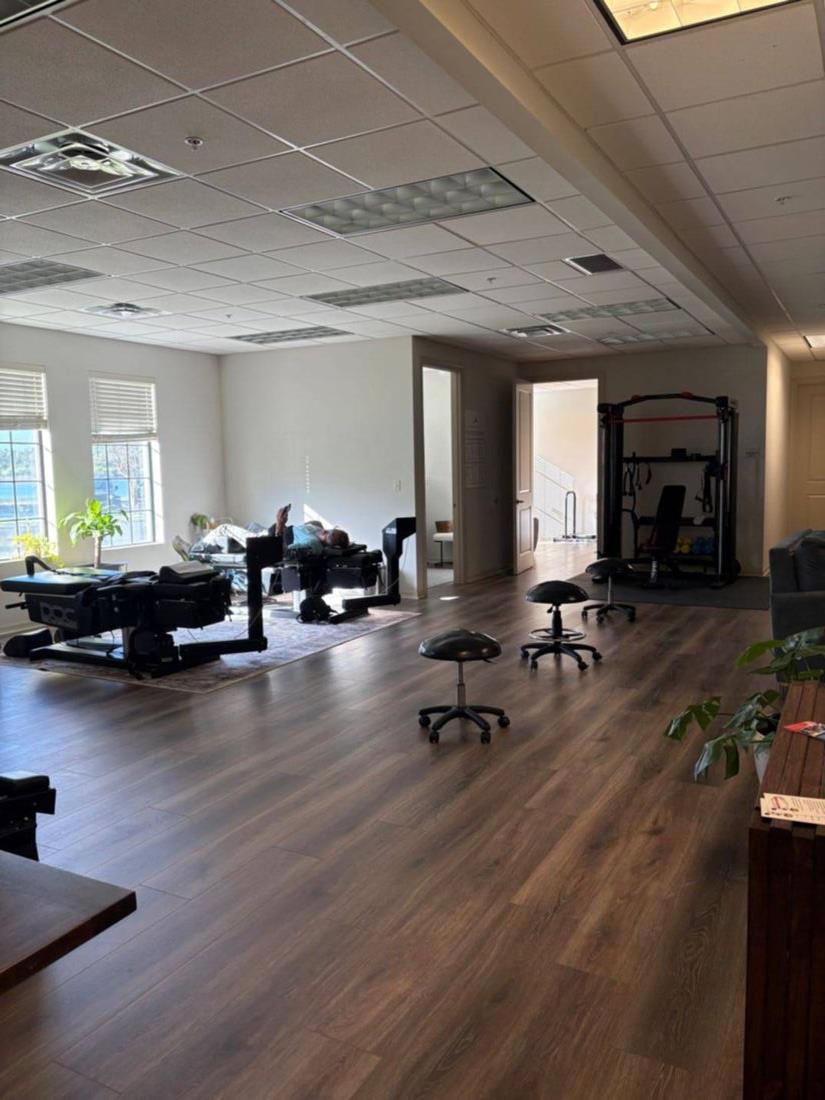
Depending on what the exam and history reveal, our approach may combine spinal decompression to restore disc height and reduce nerve root pressure, chiropractic adjustments to address facet joint restriction, and soft-tissue work for the hip flexor shortening that driving accelerates. Class IV laser can reduce inflammation in the posterior disc structures and the surrounding paraspinal muscles, which tend to be in a state of guarded contraction after repetitive long-distance driving.
The goal is not to talk you out of driving I-75. It is to make sure your spine is in a condition where doing so does not leave you sidelined for a day or two afterward. In our experience, patients who address the underlying disc or facet issue rather than managing it trip by trip find that long drives stop being a predictable trigger for pain episodes.
If you are local to Lakewood Ranch, Bradenton, or Sarasota and driving is consistently flaring your lower back, call us at (727) 213-2982. We will evaluate what is actually going on and give you a specific plan, not generic advice about taking breaks.