

One of the most common questions patients ask after a herniated disc diagnosis is some version of this: "How am I supposed to sleep?" It seems like a simple question. It is not. Sleep position directly affects disc pressure, nerve root irritation, and how inflamed the surrounding tissue becomes overnight. Getting it wrong eight hours a night adds up.
This article covers what we know about positioning, what the mechanics behind it are, and where the limits of positioning advice end. Because for a meaningful percentage of patients, sleep position is just one variable in a more complex problem.
Why Herniated Discs Hurt More After Sleep
If you regularly wake up stiffer or more painful than when you went to bed, you are not imagining it. A few things drive that pattern.
First, discs rehydrate overnight. When you lie down and unload the spine, the nucleus pulposus (the gel-like center of each disc) absorbs fluid from the surrounding tissue. That rehydration is healthy in general, but it also means a herniated disc is often at its largest first thing in the morning. More volume inside a disc that has already breached its outer ring means more pressure on adjacent nerve roots. That is why many patients with lumbar disc herniations report that sciatica-type symptoms are worst in the first 30-60 minutes after waking.
Second, you spend hours in a fixed position. Even a good sleep position becomes problematic if you hold it without movement for five or six hours. The muscles and connective tissue that support the spine shorten and tighten, and the joints that share load with the discs lose the small movements that keep them healthy. The combination creates a stiffness that feels like pain because, structurally, the body is braced and compressed.
Third, some positions actively load the disc and the nerve in ways that compound both of those issues. That is the part you can actually control.
What Happens to Disc Pressure When You Lie Down
Research on intradiscal pressure (the actual pressure measured inside spinal discs in different positions) gives us a useful framework, even though the numbers vary between individuals and injury types.
In general terms, standing upright produces moderate disc pressure. Sitting increases it, particularly in a slouched posture. Lying flat on your back with your legs extended drops disc pressure significantly, more than any seated or standing position. The problem is that lying completely flat is not neutral for most people with disc pathology, because the lumbar curve flattens against the mattress and the hip flexors pull the pelvis in a way that can increase tension on the posterior (back side) of the disc, which is the side where most herniations occur.
What you want to achieve is spinal decompression in a sustained way: reduce the compressive load on the disc, reduce tension on the nerve root, and allow the surrounding musculature to relax rather than guard.
"The goal overnight is to reduce compressive load on the disc without creating secondary tension on the posterior ligamentous structures or the nerve root. Position is one lever. It is not the only one."
The Three Sleep Positions: What Works and What Does Not
Side-Lying with a Pillow Between the Knees
For most patients with a lumbar herniation, side-lying with a firm pillow between the knees is the most useful default position. Here is why it works:
- The pillow keeps the pelvis level, which reduces rotational stress on the lower lumbar segments where most disc herniations occur (L4-L5 and L5-S1 are the two most common sites).
- The hips and knees being bent (fetal-adjacent, but not tightly curled) reduces tension on the sciatic nerve, which runs from the lumbar spine down through the piriformis and into the leg.
- The side-lying position naturally maintains more of the lumbar curve than lying flat on your back with your legs out straight.
A few practical notes: the pillow between the knees should be thick enough to keep the top knee from dropping toward the mattress. If the top knee drops, the pelvis rotates, and you have essentially recreated the torque you were trying to avoid. A standard bed pillow often works. Some patients do better with a contoured foam bolster designed for this purpose.
Which side to sleep on matters if you have a lateral herniation (one that presses toward one side rather than directly into the spinal canal). In those cases, sleeping with the painful side up often reduces nerve compression because it opens the foramen (the bony canal the nerve exits through) on the symptomatic side. Sleeping on the painful side does the opposite: it closes that foramen slightly. This is worth experimenting with, but the difference is subtle for many patients and should be discussed with whoever is managing your care.
Back-Sleeping with a Pillow Under the Knees
Lying on your back is a reasonable position for disc pain provided you place a firm pillow or a rolled towel under your knees. The pillow accomplishes two things: it takes the lumbar spine out of full extension, and it reduces the tension the hip flexors apply to the lumbar vertebrae when the legs are fully extended.
Without the pillow, many people with lumbar disc pathology find back-sleeping uncomfortable precisely because lying flat pulls the pelvis into anterior tilt and increases lordotic curve, which compresses the posterior disc and facet joints simultaneously.
Back-sleeping with knee support is often better for central or paracentral herniations (those pressing more toward the center of the spinal canal) than for lateral herniations, because it loads the spine more symmetrically.
Stomach-Sleeping: The One to Avoid
Prone (face-down) sleeping is consistently problematic for lumbar disc pathology, and especially for cervical disc issues. It forces the lumbar spine into full extension, compresses the facet joints, and requires the neck to be rotated to one side for the entire sleep period. The facet compression combines with the rehydrating disc to create morning stiffness that is worse than what either factor would produce alone.
If you are a habitual stomach sleeper, retraining the position takes time. Most people find that starting on their side with a body pillow in front of them (which physically prevents rolling forward) and one behind them (which prevents rolling back) is the most practical transition. Full retraining typically takes several weeks.
Pillow and Surface Details That Change the Outcome
Position is one variable. The surface you are sleeping on and what supports your head and neck add or subtract from whatever you gain with good positioning.
On pillows: for side-sleeping, the head pillow should fill the gap between your shoulder and your head so the cervical spine stays level. If the pillow is too thin, the head drops toward the mattress and the neck curves laterally, which can irritate cervical discs secondarily even when the primary complaint is lumbar. Too thick creates the opposite problem.
On mattresses: the research is less definitive here than the mattress industry would suggest. Medium-firm surfaces tend to perform better across a range of spinal complaints than very soft or very firm ones, primarily because a very soft surface allows the heavier parts of the body (the hips) to sink far enough that the spine adopts a sag rather than a neutral curve. Very firm surfaces do not allow the shoulder and hip to offload properly when side-sleeping, which creates pressure points that disrupt sleep and cause the person to shift into worse positions over the night. But the right surface depends on body weight, body proportion, and the specific nature of the disc problem.
One thing that does matter reliably: sleeping on a surface that is significantly worn out or that has visible sagging tends to worsen disc symptoms regardless of what position you attempt. If your mattress is more than eight years old and has visible body impressions, the position conversation is limited by the surface underneath it.
When Positioning Is Not Enough
Positioning adjustments help many people, and they are worth making. But they address the symptom environment, not the underlying disc mechanics. A herniated disc that is actively pressing on a nerve root at the L4-L5 or L5-S1 level will continue to irritate that nerve regardless of pillow placement if the disc material has not reduced or if the surrounding structures are inflamed and unstable.
The treatment options that address the disc directly include:
- Non-surgical spinal decompression: Uses computerized traction to create negative intradiscal pressure, which draws disc material back toward the nucleus and promotes rehydration and healing. This is different from manual traction and from inversion tables. For more on how that works, see our spinal decompression page.
- Chiropractic care: Targeted adjustments to the segments adjacent to the herniated level can reduce the compensatory patterns that often develop around disc injuries. Many patients guard and shift their movement in ways that load other segments and worsen the overall problem.
- Class IV laser therapy: Photobiomodulation reduces local inflammation in the disc and the surrounding tissue. It does not move disc material, but it does reduce the inflammatory component that amplifies nerve sensitivity.
- Exercise rehabilitation: Specific exercises (the composition varies by herniation type and level) progressively restore stability to the segments affected, reducing the mechanical vulnerability that made the disc herniate in the first place. Walking, in particular, is almost always appropriate and contributes to disc health through the pump mechanism that drives fluid exchange.
For a broader look at how disc injuries are approached clinically, our disc issues page covers the full range of what a structured evaluation involves.
Neurological Red Flags That Change the Urgency Level
Sleep position management and conservative care are appropriate for the majority of herniated disc presentations. There are situations where the urgency is higher and where more immediate evaluation is needed:
- Loss of bowel or bladder control, or difficulty starting urination. This pattern suggests cauda equina syndrome, a neurological emergency that requires same-day evaluation in an emergency setting.
- Progressive weakness in one or both legs over days or weeks. Some weakness is common with disc herniations; weakness that is getting worse on a clear trajectory warrants imaging and specialist evaluation.
- Saddle anesthesia: numbness or loss of sensation in the inner thighs, groin, or perineum.
- Pain that is clearly worsening on every night scale, with no position providing any relief, particularly after trauma.
If any of those are present, the sleep position conversation should wait. Get evaluated first.
For the much more common presentation, where the pain is real and limiting but the neurological flags above are absent, conservative care has a strong track record. The majority of lumbar disc herniations in patients without progressive neurology improve substantially with structured non-surgical care, and most do not require surgery. The key word is "structured." Rest, positioning adjustments, and hope do not constitute a care plan. They are components of one.
What Evaluation Looks Like at Our Clinic
When a patient comes in with suspected disc herniation, our evaluation begins with a detailed history of when and how the pain started, what positions worsen it, whether symptoms travel into the leg (and where exactly), and what has already been tried. We review any imaging that exists, and we order it if the clinical picture suggests we need it to guide care.
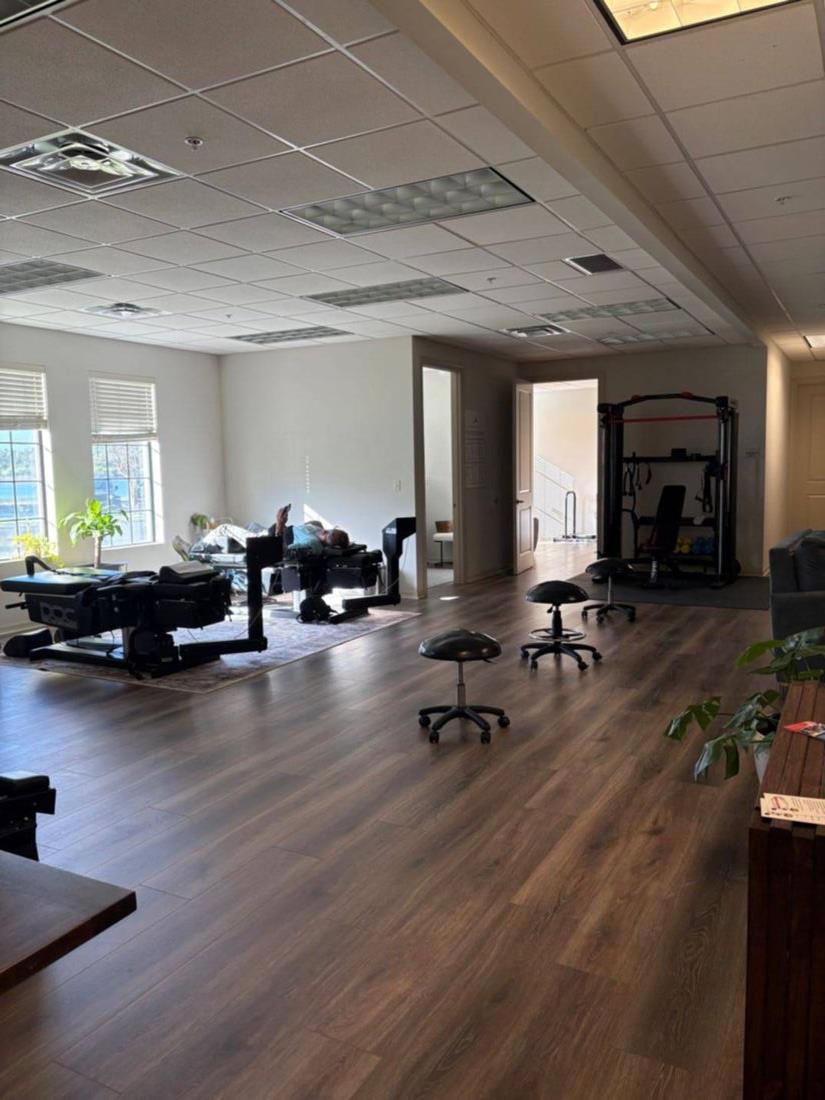
From there, the approach typically involves a combination of spinal decompression, chiropractic care, and modalities like Class IV laser or electrical muscle stimulation, assembled based on what the specific disc level, herniation direction, and patient presentation call for. Sleep positioning guidance is part of what we go through with every disc patient in the first visit, because the overnight hours are too long to waste in a configuration that is actively working against the treatment.
Our back pain page covers the full range of lumbar conditions we work with. If you have already been told you have a disc herniation and want to understand what the treatment options actually look like in practice, the herniated disc page goes deeper on that specifically.
The Practical Summary
If you are managing a herniated disc right now, here is what the evidence and clinical experience point to:
- Side-lying with a pillow between the knees is the most broadly useful position for lumbar herniations.
- Back-sleeping with a firm pillow under the knees is a good alternative, particularly for central herniations.
- Stomach-sleeping should be avoided. If you cannot stop doing it, transition gradually with the body-pillow method.
- Head pillow height matters. Neck position affects the whole spinal chain, even when the complaint is lumbar.
- Mattress quality sets the ceiling for what good positioning can achieve. A worn-out surface undermines everything else.
- Positioning is one component. A disc that is actively pressing on a nerve needs clinical attention beyond sleep hygiene.
Morning pain after a herniated disc is not inevitable. In many patients, addressing the sleep position significantly reduces how they feel in the first hour of the day, which changes the entire trajectory of recovery because it reduces the protective guarding they carry into the rest of their activities. But position alone rarely closes the loop on a herniated disc problem. If you are waking up in real pain and it has been weeks or months, there is more to evaluate.
To schedule an evaluation at our Lakewood Ranch office, call (727) 213-2982 or book online at celluron.janeapp.com. We work with disc patients every day and can tell you within the first visit whether the problem is mechanical, whether imaging is warranted, and what a realistic care plan looks like for your specific presentation.