

About 80 percent of people will experience significant back pain at some point in their lives. Gardening is consistently among the top seasonal triggers, and in Florida, where the yard demands attention from February through November, that window is nearly year-round. But the way most people think about gardening pain gets something fundamentally wrong.
They assume the garden caused the problem. In many cases, the problem was already there. A disc with some existing dehydration. A lumbar segment with reduced mobility. A posterior chain that has been chronically shortened by desk work, long commutes, or a sedentary routine. The garden just loaded that pre-existing vulnerability to the point where it became impossible to ignore.
That distinction determines whether a day of rest and some ibuprofen will resolve things, or whether you are two to three weeks away from radiating leg pain if you keep dismissing the signal your body is sending. Understanding it is the first step toward actually addressing the problem rather than managing a recurring cycle.
What Actually Happens to Your Spine When You Garden
The lower back does not like two things: sustained flexion and rotational loading under load, especially when combined. Gardening delivers both, repeatedly, across a session that can run two or three hours without a real break.
When you bend forward to pull a weed, transplant a flat of seedlings, or dig a hole for a new shrub, your lumbar spine goes into flexion. In that position, the anterior disc space narrows while the posterior disc space widens. The nucleus pulposus, the gel-like center of each disc, shifts slightly backward toward the nerve-rich outer annulus and, in more advanced cases, toward the spinal canal itself.
In a healthy, well-hydrated disc, this is manageable. The disc absorbs the load and recovers when you stand upright. In a disc that has been gradually dehydrating for years, that posterior shift increases the odds of annular irritation or, over time, a frank herniation. A single episode of gardening does not usually herniate a disc without warning. But it can push a disc that was already at the threshold past it.
Rotational loading compounds the problem. The classic twist-and-lift motion of turning to dump a wheelbarrow, pivoting to reach a tool behind you, or rotating to place a heavy pot while you are still in forward flexion is the single most consistent mechanism for lumbar disc injury. Rotation under axial load is exactly what spinal discs are least equipped to handle.
The Four Posture Patterns That Do the Most Damage
After evaluating patients who came in following gardening-related flares, four patterns come up consistently. Recognizing them in your own yard work is the most practical thing you can do this season.
1. Bending from the waist instead of hinging at the hips
The hip hinge, where you push your hips backward while keeping a neutral lumbar curve as you lower toward the ground, distributes the work across the hips, glutes, and hamstrings. Most gardeners default to bending at the waist instead, which loads the lumbar discs directly.
If you cannot hip hinge comfortably without rounding your lower back, the issue is usually hip mobility or a tight posterior chain, not a spine problem in isolation. But the spine pays the price for that limitation when you spend two hours reaching toward ground level with no variation in position.
2. Twisting while loaded
Pulling weeds with a sideways twist, turning with a full bag of mulch, or rotating to set down a heavy pot while remaining in a forward-flexed position all add rotational load to an already-stressed disc. This is the mechanism behind most acute gardening disc injuries.
The practical fix is to move your feet rather than just your torso. If you need to turn, step to face the direction you are heading rather than rotating your lumbar spine with your feet planted. It takes a conscious habit override initially, but it is one of the most protective changes a gardener with any history of lower back issues can make.
3. Extended sessions without position changes
Kneeling in a stationary position for 45 minutes, maintaining a sustained forward lean on one arm while weeding, or working for hours with no real break creates what researchers call creep in the spinal ligaments and discs. Creep is a gradual deformation of connective tissue under sustained low load. It reduces the spine's capacity to absorb additional load and significantly increases injury risk in the minutes and hours after you finally stand up.
Most gardening injuries do not happen at the moment of peak effort. They happen when you stand up after a long static position, or in the 12 hours following a prolonged session. The garden feels fine while you are in it. The injury presents later.
4. Working through early warning signals
A mild ache in the lower back that appears 20 to 30 minutes into the session is not ordinary tiredness. It is your lumbar extensor muscles communicating that they are working near their limit to protect a segment under stress. Continuing without a break turns a manageable situation into a multi-day recovery. Taking five minutes to walk upright and reset the lumbar position often lets you continue. Ignoring the signal rarely ends well.
Why Pain Shows Up Hours Later, Not at the Time
One of the most consistent patterns in gardening-related back pain is the delay between the activity and the onset of significant symptoms. Patients describe feeling fine on Saturday afternoon and then being barely able to get out of bed on Sunday morning. This is common enough that it has its own informal name among clinicians: the Sunday morning presentation.
Two mechanisms explain it. First, the inflammatory response to disc or soft tissue irritation peaks four to twelve hours after the mechanical stress, not at the moment it occurs. The body's initial response is protective muscle guarding, which you may not notice until it tightens overnight.
Second, the paravertebral muscles surrounding an irritated segment will often maintain protective contraction through the night. That contraction feels like extreme stiffness by morning and is what creates the inability to straighten fully when getting out of bed. The spasm itself is not the injury. It is your body's attempt to splint the area while the inflammatory process works through its cycle.
If you cannot stand fully upright after a night's sleep following heavy yard work, that is not routine muscle fatigue. It is a signal worth clinical evaluation, especially if there is any radiating pain, tingling, or numbness into the buttock or leg.
Muscle Soreness vs. Disc Involvement: How to Tell Them Apart
Not every ache after gardening requires a clinical visit. But the two presentations are meaningfully different, and misidentifying them leads to either unnecessary worry or, more commonly, too-long delays in getting appropriate care.
Muscle soreness (typically resolves with light activity over 48-72 hours):
- Usually symmetric, both sides of the lower back feel similar
- Improves with gentle walking and light movement
- Peaks around 24 to 48 hours, then clearly improves
- No radiating pain below the knee
- No tingling, numbness, or weakness in the legs
- Standing and walking are more comfortable than sitting
Disc involvement (warrants clinical assessment, especially if not improving):
- One-sided lower back or buttock pain, often with a clear localized focus
- Pain that radiates into the hip, outer thigh, calf, or foot
- Worsens with prolonged sitting, especially driving
- Worsens when coughing, sneezing, or bearing down
- Better with walking or lying down than with sitting or forward bending
- Tingling, numbness, or weakness in one leg or foot
- Pain that worsens over 48 to 72 hours rather than improving
Our sciatica page covers the nerve-root patterns that gardening can trigger when disc involvement is present. If the pain is running down your leg, that section is worth reading before deciding whether to wait it out.
Signs that warrant urgent evaluation (not just rest): progressive leg weakness, numbness in the saddle area (inner thighs and groin), or any loss of bladder or bowel control. These presentations are uncommon but require prompt medical evaluation, not a watchful wait.
What to Do in the First 48 Hours
For mild to moderate gardening-related back pain without radiating symptoms, the first two days are about managing the inflammatory response and preventing the muscle guarding from compounding into something more limiting.
- Ice before heat for the first 24 hours. Heat feels better in the moment but can increase early-stage inflammation. Ice wrapped in a cloth, 15 to 20 minutes up to three times per day, is the more appropriate early intervention.
- Keep moving, gently. Complete bed rest prolongs lower back pain in most cases. Short walks of 10 to 15 minutes every few hours maintain circulation and reduce the tendency for protective spasm to solidify into persistent stiffness.
- Avoid prolonged sitting. Sitting increases intradiscal pressure more than standing or walking. If you must sit, get up and move briefly every 20 to 30 minutes.
- Sleep in a position that reduces disc load. On your side with a pillow between your knees, or on your back with a pillow under your knees. Both reduce the lumbar extension that can aggravate posterior disc pressure.
- Do not ignore radiating symptoms. If pain starts moving into your leg, or if you develop tingling in your foot, move the timeline for evaluation up significantly. Waiting to see how disc-driven radiculopathy plays out is a common mistake with a predictable outcome.
Over-the-counter NSAIDs can reduce inflammation and make the early days more manageable. They do not address the underlying structural pattern if one exists, but they are reasonable for symptomatic management while you evaluate next steps.
What a Spine Evaluation Actually Looks At
Many patients who come in after a gardening flare are surprised by what the evaluation finds relative to what they reported. They describe "muscle pain from the garden" and the exam identifies reduced segmental mobility at L4-L5, increased nerve tension on straight-leg raise testing, or restricted hip mobility that has been loading the lumbar spine for months before the garden incident.
At Spine and Wellness Center Lakewood Ranch, Dr. Banman's intake protocol for new lower-back cases includes orthopedic and neurological screening, segmental motion assessment, and, when the patient has recent imaging, a review of those films in the context of current symptoms. The goal is not to order tests. It is to identify the structural pattern driving the pain and determine whether conservative care is the right first step and which approach within conservative care is most appropriate for that specific case.
For most gardening-related flares, the initial focus is addressing the acute phase with chiropractic adjustments and soft-tissue work, followed by a conversation about what underlying vulnerabilities were exposed and what changes in mechanics or activity would reduce the likelihood of a recurrence. Our full overview of how we approach lumbar complaints is on our back pain page.
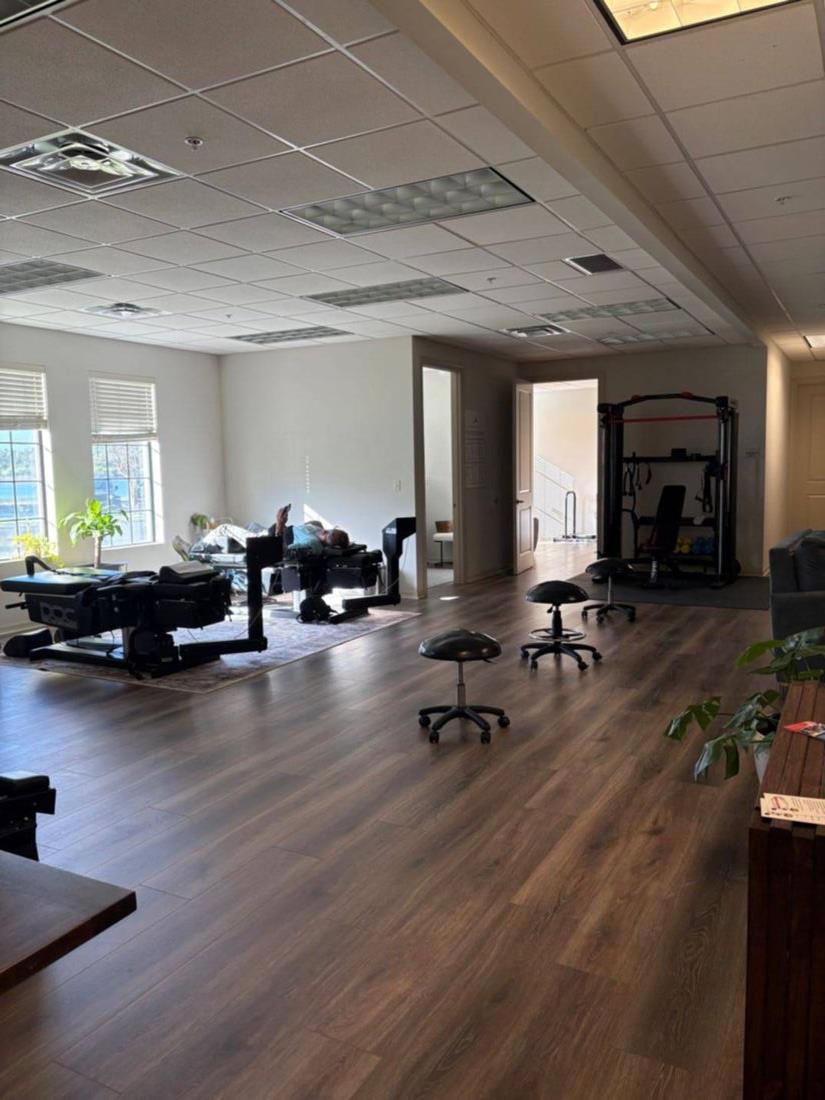
For patients where disc decompression is clinically indicated, typically those with confirmed disc involvement and nerve root symptoms, our spinal decompression program uses a computer-guided protocol to reduce intradiscal pressure at specific lumbar levels. It is not the right tool for every gardening-related case, but it is often the right tool when imaging confirms disc involvement and conservative manual care has not been sufficient on its own.
Prevention: Protecting Your Back Through the Season
If you have had a gardening-related back flare before, the odds of another one are elevated. Structural vulnerabilities do not resolve with a week of rest. They need to be addressed directly or, at minimum, worked around with smarter mechanics and better habits.
Technique changes that make a measurable difference:
- Hip hinge every time you reach below knee height. Practice the motion standing next to a wall before doing it in the garden: push your hips back toward the wall while keeping your chest up and lumbar curve neutral.
- Pivot with your feet when you change direction. The twist-and-lift is the most common mechanism for acute disc injury during outdoor work.
- Alternate task types every 20 to 30 minutes. Ten minutes of low bending, then a standing task, then back to bending. Sustained static positions over 30 minutes are where creep accumulates.
- Use long-handled tools wherever practical. A long-handled cultivator or weeder reduces the depth of forward lean required.
Equipment worth considering if you have recurring low-back issues:
- A gardening kneeling pad or a foam-seat gardening stool eliminates the sustained static kneeling-with-forward-lean position
- Raised planting beds are one of the most structurally protective changes a gardener with chronic lumbar complaints can make. They bring the work surface to a height that requires far less lumbar flexion.
- A lightweight garden cart or wheelbarrow with ergonomic handles eliminates most of the twist-and-carry motion for moving heavy materials.
Before you start each session:
- Five to ten minutes of walking and gentle hip circles before beginning any bending work prepares the lumbar discs for the load that is coming.
- Hydrate actively before and during. Spinal discs are largely water. Even mild dehydration, common in Florida's heat, reduces the disc's capacity to absorb compressive load. This is not a minor issue in an environment where outdoor temperatures regularly exceed 90 degrees through the summer months.
- Plan the session around the heat. Early morning or after 5 p.m. are safer windows than midday in late May through September. Heat stress alone changes how the body manages physical workload.
When to Get Evaluated
Scheduling a clinical evaluation sooner rather than later is the right call in these situations:
- Your back pain is not clearly improving after 72 hours of conservative home care
- You have radiating pain, tingling, or numbness running into a leg or foot
- You cannot stand fully upright even after a night's rest
- This is the second or third gardening-season flare in a row
- You are managing the pain with medication every day to function
- You have a known disc problem and the gardening session significantly worsened it
Waiting through six weeks of symptoms on the assumption that rest will eventually solve it is the most common mistake we see. In most cases, an evaluation in week one leads to a faster and more complete recovery than presenting in week five when protective muscle guarding has built into a secondary problem and the original disc irritation has had uninterrupted time to progress.
The garden will still be there after you are evaluated. The weeds grow back. The problem that drives the pain often does not resolve on its own without some structural attention to what is actually going on in the lumbar spine.