
You lace up, hit your stride, and somewhere around mile 2 or 3 the familiar ache settles into your lower back. By the time you cool down it is sharp enough to make you walk stiffly to the car. Rest helps. Until the next run.
If that cycle sounds familiar, you are not dealing with "tight muscles from running." You are almost certainly dealing with a disc problem that running loads repeatedly, and rest alone is not addressing it. Herniated and bulging disc injuries in Lakewood Ranch are among the most common drivers of this exact pattern, and identifying the disc as the actual source changes what treatment can realistically accomplish.
Here is what is happening inside the lumbar spine during a run, how to recognize which structure is involved, and what conservative care looks like for runners at this clinic.
Why running loads the lumbar spine differently than you think
Running is not high-impact the way most people picture it. It feels smooth. But each footfall sends a compressive force up the kinetic chain to the lumbar spine that is 2.5 to 3 times your body weight. For a 175-pound runner, that is 440 to 525 pounds of axial load hitting the lumbar discs with every single step.
Over a 3-mile run, with roughly 3,000 footfalls per mile, you are compressing the same lumbar disc segment 9,000 times in sequence. If the disc is already mildly dehydrated, slightly compromised, or sitting in a pelvis with restricted hip mobility, each of those cycles is a small stress event. The first 5,000 might be fine. The next 4,000 are when the pain starts.
Walking does not produce this. Sitting compresses discs, but that is a sustained load, not a rhythmic impact. Running specifically reveals existing disc pathology in a way that ordinary daily activity does not. Many people with mild disc issues have zero pain in daily life until they start a running program or ramp up distance.
The second factor is hip extension. Running requires full hip extension at toe-off. If the hip flexors are tight, and they are in most adults who sit during a workday, the lumbar spine compensates by hyperextending instead. That pattern compresses the posterior disc and the facet joints with every single stride. Over any meaningful distance, those structures will tell you.
The disc is almost always involved
Most runners assume their lower back pain is a muscle problem. They stretch, use heat, foam-roll the piriformis, and get some short-term relief. Then they go for a run and the pain is back at the same spot.
Muscle strain is real, but it typically resolves in 7 to 10 days with relative rest. Back pain that keeps returning to the same location after runs, that worsens with longer distances, that causes a "catching" sensation when you change direction, or that tracks into the glute or leg, is not muscle strain. It is almost certainly disc-related.
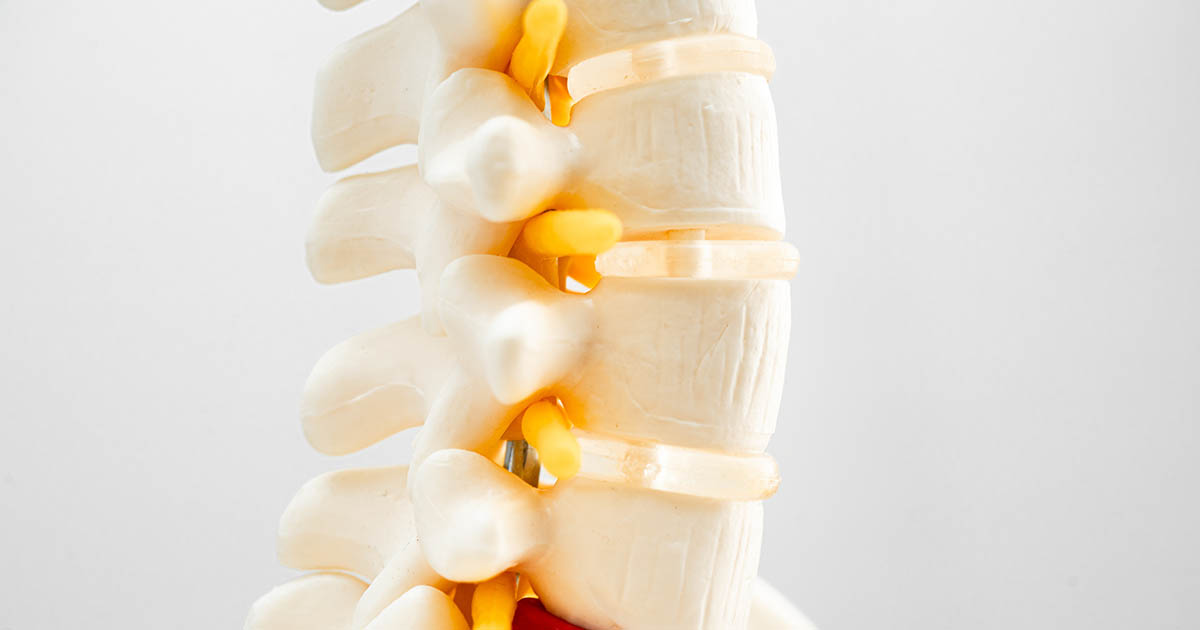
The lumbar disc is a hydraulic structure. Its outer ring (the annulus fibrosus) is built from concentric collagen fibers. Its gel core (the nucleus pulposus) absorbs and distributes compressive load. When the annulus develops micro-tears from repeated stress, the nucleus begins migrating toward the tear. This is a disc herniation in progress. It does not happen dramatically. It happens over thousands of repetitions.
For runners, the most vulnerable segments are L4-L5 and L5-S1. Those levels carry the most load during the running gait cycle. When either is compromised, the sciatic nerve root sits just adjacent. Inflammation from the disc irritates the nerve, and pain starts tracking into the glute, the back of the thigh, or down the leg. If you are already seeing that pattern, understanding whether you are dealing with a bulge or a herniation is worth doing before making care decisions.
Three patterns that point to the driver
Running-related lower back pain is not one problem. These three patterns give a reliable initial picture of which structure is involved before any imaging.
Pattern 1: Pain that starts at 15 to 20 minutes into a run and builds
This is the classic disc fatigue pattern. The disc handles load normally for the first several minutes. Then, as the nucleus migrates under repetitive compression, pain intensifies. Stopping or slowing to a walk removes the pressure and the pain eases within minutes. The leg is usually fine or mildly achy. You feel recovered enough to try again the next day. The cycle repeats.
Pattern 2: Pain that is worst the morning after a run, not during it
This is a disc imbibition failure pattern. Overnight, discs rehydrate and expand. When there is a small annular tear, the nucleus tries to migrate back through it during rehydration, and that process is painful. Patients describe this as "I felt fine on the run but woke up barely able to move." Stiffness that gradually loosens after 20 to 30 minutes of gentle movement is characteristic. The post on why back pain worsens after rest covers this mechanism in detail.
Pattern 3: Pain with a shooting or electric quality into the leg
If you feel sharp or burning pain that begins in the lower back and travels into the glute, back of the thigh, or calf during or after a run, a nerve root is almost certainly being compressed. This means the disc herniation or bulge is large enough to contact the nerve directly. This pattern needs evaluation before you continue training, not after.
The "it gets better when I stop" trap
Many runners interpret "the pain stops when I rest" as evidence that nothing serious is wrong. This is the trap. A disc does not heal from rest alone. Rest removes the load, the pain quiets, and you go back out. But the disc was already compromised when you stopped. The annular tear is still there. The nucleus is still under-supported.
Two or three weeks of relative rest, while welcome, does not produce the structural repair needed to handle another high-load training cycle. The pattern continues, often for months or years, before anyone actually evaluates the disc.
In our experience over 23 years of practice, the runners who engage conservative care at the first recurrence tend to do substantially better than those who wait until the pattern includes radiating leg pain. The disc is more responsive to intervention at the earlier stage. That is not a guarantee. It is a consistent pattern we see at this Lakewood Ranch clinic and across Sarasota and Bradenton.
The "rest and return" pattern also tells your clinician something useful: the disc is load-sensitive, which means it is at a stage where treatment can genuinely change the trajectory. Non-surgical spinal decompression in Lakewood Ranch creates negative intradiscal pressure at the specific compromised segment, which draws the nucleus back toward center and gives the annulus a chance to begin structural repair. That is a mechanism rest does not produce.
Red flags that mean get evaluated before the next run
Most running-related lower back pain is disc-related and responds well to conservative care. But some patterns point to something more serious and warrant prompt evaluation rather than a wait-and-see approach.
- Leg weakness that makes it difficult to lift the front of the foot while running (foot drop)
- Numbness or tingling in the groin or saddle area
- Any bladder or bowel changes after a long run
- Pain that continues worsening even after completely stopping running for two or more weeks
- Fever alongside the back pain
- Unexplained weight loss in parallel with the pain
Foot drop and saddle-area numbness are potential cauda equina warning signs. That is a rare but serious compression of the nerve roots at the base of the spinal cord, and it requires an emergency evaluation, not a chiropractic appointment. Do not wait on those two.
For everything else on that list, a conservative evaluation with exam and functional movement assessment is the right first step. Imaging is ordered when the clinical picture suggests nerve compression, or when four to six weeks of well-executed conservative care does not produce adequate improvement.
What conservative care for a runner's back looks like
At our Lakewood Ranch clinic, a runner presenting with this pattern goes through a structured evaluation before any treatment decisions are made.
The functional assessment comes first. Dr. Banman watches you move: hip extension range, pelvis position during forward flexion, single-leg balance, and a basic neurological screen. This tells us whether the primary driver is the disc, the facet joint, the SI joint, or a hip mobility restriction that is forcing the lumbar spine to compensate. These are meaningfully different problems with different care paths.
Imaging review follows if you have existing X-ray or MRI. If you do not, the functional picture guides early care decisions. MRI is ordered when the exam suggests nerve compression, or when the initial care window does not produce adequate improvement.
For runners whose exam points to disc involvement, back pain care at this clinic typically centers on our DOC-20 spinal decompression table. It creates computer-controlled negative pressure at the specific disc level identified on exam. Sessions run 20 to 30 minutes. Most patients with this pattern complete 16 to 24 sessions over eight to twelve weeks, with running load modified (not eliminated) during that window.
We rarely ask runners to stop entirely unless there is nerve compression requiring unloading. The approach is modification: shorter distance, softer surfaces, gait changes that reduce heel strike force. The goal is to manage disc load while the treatment works.
Getting back to your full training load: a realistic picture
The goal of conservative care is not just pain relief for the current training cycle. It is getting you back to the running you want to do with a disc that is not going to fail again at mile 2.
For most runners with disc-driven lower back pain, a realistic conservative timeline looks like this:
Weeks 1 to 3: Load reduction and early decompression sessions. Pain during running typically improves noticeably in this window. Most patients can continue easy running at reduced distance.
Weeks 4 to 8: Targeted decompression at the specific disc level. If the exam identified hip mobility deficits driving the lumbar compensation pattern, those are addressed in parallel. Longer runs are reintroduced with monitoring.
Weeks 8 to 12: Return to full training load with monthly maintenance sessions. We monitor load tolerance and address early warning signs before they become injuries again.
When the pattern includes nerve involvement, meaning leg pain or tingling in the leg during or after runs, the timeline extends. Class IV laser addresses the nerve inflammation component. EMS addresses the inhibition pattern in the paraspinal stabilizers that develops when the lumbar spine has been guarding. These tools work within the same care plan.
None of this is a guarantee of outcome. Disc injuries vary by severity, and some do require surgical consultation. That is a conversation worth having when conservative care has been well-executed and the clinical picture warrants it. In over 23 years of practice, Dr. Banman has found that runners who address disc involvement before it reaches the nerve-compression stage have a meaningfully better track record of returning to full training.
What to do if this sounds like your pattern
If you are running in or around Lakewood Ranch, Bradenton, or Sarasota and lower back pain is a regular part of your training experience, you do not have to accept that as the cost of being active. The evaluation takes about 60 minutes. You leave with a clear picture of what is actually driving your pain and whether spinal decompression, manual therapy, or a different approach fits your situation.
Call (727) 213-2982 or book online at the link below. Same-week appointments are typically available for new patients with running-related complaints.