
Every few weeks someone comes into our Lakewood Ranch office with a story that goes like this: the pain started during a rough stretch at work, intensified during a difficult month, and now it's there every morning when they wake up. They've tried rest, stretching, and a few rounds of ibuprofen. Nothing has cleared it.
The connection between stress and back pain is not vague or psychological. It is mechanical. Chronic psychological stress produces real, measurable changes in how much compressive load your spine carries. Understanding that connection is the first step toward addressing both problems at once, rather than chasing each one separately in circles.
Your muscles read stress as physical danger
The autonomic nervous system has one job during a threat: get your body ready to fight or run. That response was designed for threats you can physically do something about. It floods your bloodstream with cortisol and adrenaline, raises your heart rate, and recruits your postural muscles into a braced, protective posture.
The paraspinal muscles, the long columns of muscle running alongside your vertebrae from your sacrum up to your skull, are among the first responders. They contract to stiffen the spine, reducing the chance that a fast movement tears something. The upper trapezius pulls your shoulders toward your ears. The suboccipitals, the small muscles at the base of your skull, tighten to guard the upper cervical joints. The psoas and the quadratus lumborum brace the lumbar spine.
That protective bracing made excellent sense when the threat lasted seconds. It creates real problems when the threat is an overloaded inbox that lasts months.
Chronic low-grade stress keeps the sympathetic nervous system partially active around the clock. The muscles never fully release between episodes. The result is a baseline level of spinal loading that is measurably higher than it would be in a calm, rested state.
Three ways chronic stress physically loads your spine
The mechanism is not abstract. There are at least three concrete pathways through which sustained psychological pressure increases the load on your vertebrae and discs.
Sustained paraspinal muscle contraction
Muscles that are mildly but persistently contracted pull the vertebrae they attach to closer together. That compression reduces the disc space. Your intervertebral discs are fluid-filled shock absorbers: they are designed to tolerate compression under load and then recover when that load is removed. A disc that never fully gets to recover, because the surrounding musculature never fully lets go, gradually loses hydration and height. That narrowing increases the pressure on the facet joints at the back of each vertebral level, which generates its own pain signal.
In our office, we can palpate the paraspinal tone directly. In patients who are carrying heavy work stress, those muscles often feel ropey and resistant to passive pressure even during a resting exam. Many of them are unaware the tension is there at all.
Altered breathing mechanics
Stress shifts most people into shallow chest breathing. Instead of the diaphragm dropping on each inhale and generating gentle rhythmic movement in the lumbar spine, the breath stays in the upper chest. The accessory respiratory muscles, the scalenes and the sternocleidomastoid in the neck, work overtime. The diaphragm tightens rather than moving freely, which increases pressure in the abdominal cavity and compresses the lumbar spine from the front. This is a less-discussed pathway, but in practice, many patients with chronic low back pain also have restricted diaphragmatic movement. Restoring normal breathing mechanics is part of addressing the problem.
Sleep disruption and disc rehydration failure
Your intervertebral discs do most of their rehydration at night. When you lie down and the compressive load of gravity is removed, the discs absorb fluid back from the surrounding tissue. This process requires a genuinely relaxed state: the paraspinal muscles need to decompress, the disc needs to expand freely, and the body needs adequate time horizontal. Chronic stress disrupts sleep architecture, shortens the deep sleep phases, and keeps the nervous system partially aroused even during rest. The practical result is that the disc does not fully rehydrate overnight. You wake up with a spine that is already slightly compressed before the day has begun.
Where stress tends to show up first
Not everyone carries tension in the same place. But there are predictable patterns that show up again and again in clinical practice.
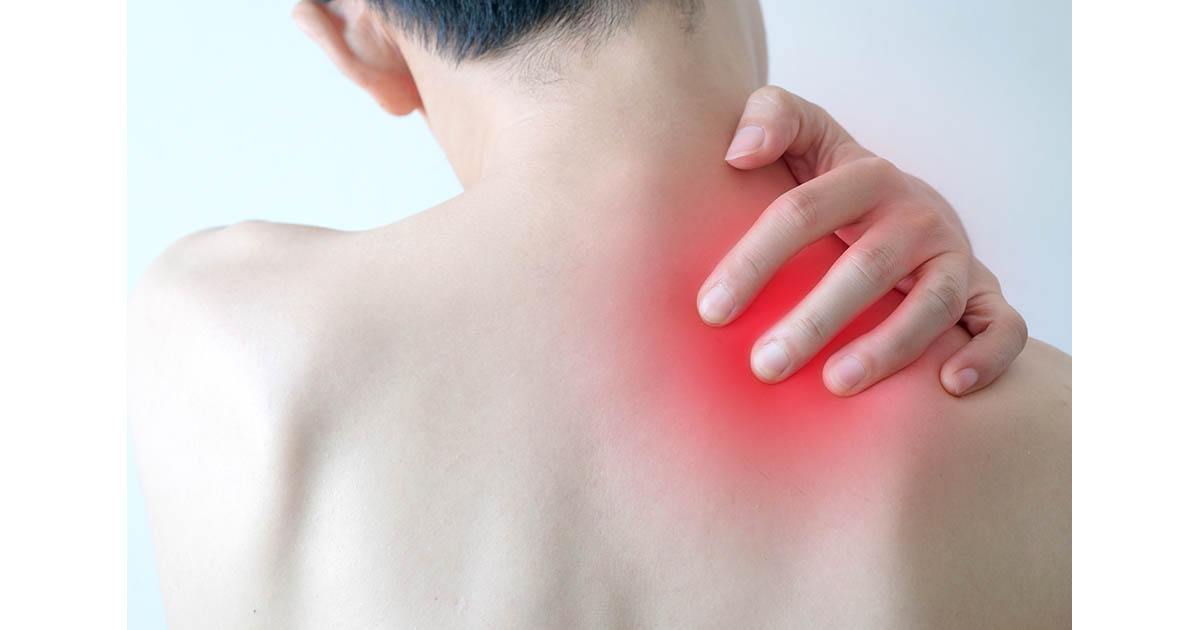
Cervical spine and upper trapezius (most common). The combination of forward head posture at a screen and elevated sympathetic tone in the upper trapezius creates compression at C4-C5 and C5-C6, the two most common cervical disc levels we see in practice. Patients often describe a dull ache between the shoulder blades, headaches that start at the base of the skull, or a feeling of tightness across the top of the shoulders that never fully goes away. Those neck pain and headaches complaints are almost always partly postural and partly tension-driven.
Lumbar-sacral junction. The psoas muscle crosses the lumbar spine from the front. When it tightens chronically, it pulls the lumbar vertebrae into extension and increases the load at L4-L5 and L5-S1, the two highest-stress disc levels in the lumbar spine. Many patients with stress-driven low back pain describe pain that is worst when transitioning from sitting to standing, or after a long day on their feet. That pattern fits a compressed L4-L5 or L5-S1 disc being repeatedly loaded without adequate recovery.
SI joints. The sacroiliac joints are the junction between the spine and the pelvis. They are stabilized by a network of ligaments and by the gluteal muscles. Chronic pelvic floor tension (another common stress response) can alter the mechanics of those joints and produce a deep, unilateral aching pain that many patients mistake for hip or sciatic pain. The pattern is different from disc-driven sciatica, but the two can coexist.
For a deeper look at the muscle knot aspect of this cycle, see our post on why muscle knots in the neck and shoulder keep coming back.
The pain-stress loop
Here is where the problem becomes self-reinforcing. Pain is itself a stressor. When you are in pain, your cortisol stays elevated. Your sleep gets worse. Your sympathetic nervous system stays partially activated. The muscles that are already braced brace harder. The disc that was already compressed gets less recovery time overnight.
This is why patients who started with what seemed like a straightforward work-stress episode can find themselves six months later with daily pain that no longer correlates neatly with work deadlines. The original trigger has faded, but the mechanical load is still there because the structural changes accumulated during that stressful period were never addressed.
Over-the-counter anti-inflammatories reduce the pain signal and give the sympathetic nervous system a partial break. That is useful short-term. But ibuprofen does not reduce paraspinal tone, does not restore disc height, and does not retrain your breathing mechanics. It reduces the symptom. The load stays.
What evaluation looks at
When someone comes in describing back or neck pain they attribute to stress, the evaluation has to answer two questions: how much of this is structural (disc compression, facet loading, postural changes that have accumulated over time), and how much is primarily tension-driven (elevated paraspinal tone without significant disc or joint pathology)?
The answer changes the treatment approach. Both benefit from chiropractic care that reduces joint restriction and restores motion to the affected segments. Cases with significant disc involvement also benefit from non-surgical spinal decompression, which applies a gentle distraction force to the disc and helps restore hydration and height over a course of treatment. Cases where the primary driver is tension benefit from addressing the breathing mechanics and nervous system regulation as part of the care plan.
In 23-plus years of practice, the patients who make the fastest progress with stress-driven back pain are the ones who understand that they are dealing with a structural problem that was triggered by a physiological stress response. That framing removes the guilt around "it's just stress" and gets the focus where it belongs: on the mechanical changes that need to be corrected.
What about the desk itself?
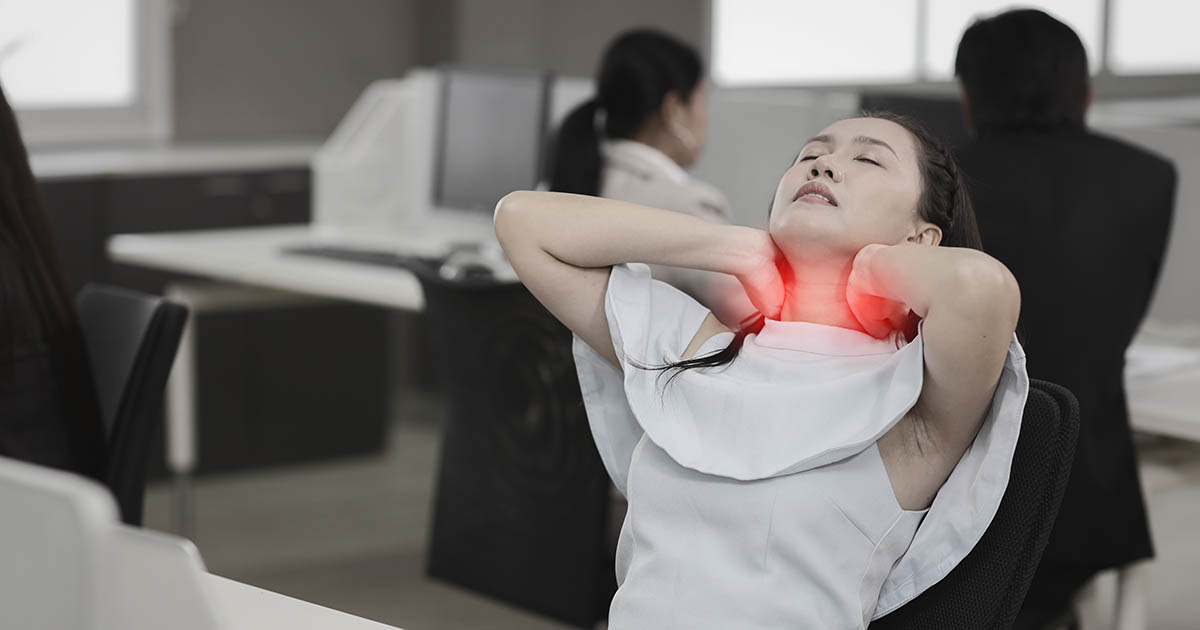
Stress does not act in isolation. It amplifies whatever postural loading is already happening. If you are sitting at a poorly set-up workstation for eight hours while under deadline pressure, you are combining two independent sources of spinal loading into one. The disc that would have tolerated either one alone gets both at once.
If work stress is part of your back pain story, it is worth reviewing your workstation posture as part of the solution. Our post on how sitting all day drives lower back pain covers the postural mechanics in detail. The short version: screen at eye level, lumbar support present, feet flat, hips at 90 degrees or slightly open, and a genuine standing break every 45-60 minutes. None of those changes will fully resolve structurally-driven pain on their own, but they reduce the daily load that the spine is accumulating on top of the tension.
Breaking the cycle: what actually helps
There is no single-point solution here. The most effective approaches address the physiological stress response, the structural accumulation, and the daily loading patterns in parallel.
- Structural correction: Chiropractic adjustment restores motion to restricted segments and reduces the joint irritation that is feeding the pain signal back into the nervous system. Spinal decompression, where indicated, addresses disc compression that will not resolve with adjustment alone.
- Paraspinal release: Instrument-assisted soft tissue work and myofascial techniques reduce the chronic holding patterns in the muscles that surround the affected joints. This gives the disc space room to recover between sessions.
- Breathing retraining: Restoring diaphragmatic breathing mechanics reduces the accessory muscle load on the cervical spine and helps down-regulate the sympathetic nervous system. It is often one of the more underutilized tools in a chiropractic care plan.
- Sleep prioritization: Disc recovery happens overnight. In many patients, addressing the structural pain directly also improves sleep quality, which then accelerates recovery. The loop works in both directions.
- Load management at work: Not stress elimination, which is rarely realistic, but identifying the highest-load positions and breaking them up. The spine tolerates stress better when it has recovery intervals built into the day.
Many patients in this situation report that once the structural compression is addressed, their perceived stress feels more manageable. That is not a coincidence. Chronic pain keeps the nervous system in a sensitized state. Reduce the pain load and the overall stress load decreases as well.
If your back or neck pain tracks closely with stressful periods and you are based in the Lakewood Ranch, Bradenton, or Sarasota area, the starting point is an evaluation that separates what is structural from what is tension-driven. Call our office at (727) 213-2982 or book directly at the link below. We aim to get new patients seen within 24 hours.