
When most people hear the word scoliosis, they picture a teenager getting screened in middle school. A nurse, a forward bend, a note sent home. That version of scoliosis (adolescent idiopathic scoliosis) is the one everyone knows about and the one most clinical guidelines were built around.
The version that walks into our Lakewood Ranch office is usually different. The patient is in their 50s, 60s, or 70s. They have new lower-back pain that did not used to be there. Maybe a leg starting to feel weak or numb. A primary-care doctor or orthopedist takes an X-ray and casually mentions a curve. Sometimes 15 degrees. Sometimes 35 or 40. The patient gets told it is "age-related" and to "watch it." No plan. No tools. No follow-up beyond annual imaging.
This is adult degenerative scoliosis, and it is not the same disease as the teenage version. The drivers are different, the prognosis is different, and the tools that work are different. Watch-and-wait fails most of these adults in exactly the same way it failed adolescents before bracing protocols got formalized.
Adolescent idiopathic scoliosis vs adult degenerative scoliosis
Adolescent idiopathic scoliosis (AIS) develops in a growing spine. The cause is not fully understood (that is what "idiopathic" means), but it is associated with rapid growth, genetics, and asymmetric neuromuscular development. The curve emerges in a structurally healthy spine. The discs, joints, and bone quality are all normal. The deformity is the disease.
Adult degenerative scoliosis (ADS) is the opposite. The curve emerges because the spine itself is breaking down. Discs collapse, often asymmetrically. Facet joints arthrose. Vertebral bodies lose height on one side faster than the other. Over years, the cumulative asymmetry tips the spine into a curve that did not exist when the patient was 30. By the time it is visible on an X-ray, the underlying degeneration has been progressing for a decade.
That distinction matters because the curve is a symptom in adults, not the primary problem. If you only address the curve and ignore the disc and joint degeneration driving it, the curve keeps progressing. If you only address the degeneration and ignore the postural collapse, the soft tissue stays overloaded on one side and the pain does not resolve.
What drives adult curve progression
Three forces push an adult scoliotic curve to keep getting worse:
- Asymmetric disc collapse. Once one side of a disc loses height faster than the other, the vertebra above tips into the low side. Now the next disc up takes uneven load and starts collapsing the same way. The cascade builds on itself.
- Muscle imbalance and postural drift. The paraspinal muscles on the convex side stretch and weaken; the concave side shortens and locks down. The longer that asymmetry runs, the harder it gets to recruit balanced support around the spine.
- Bone density loss in the curve. The concave side, under chronic compressive load, can actually lose bone faster. In postmenopausal women especially, this accelerates the collapse and the curve at the same time.
None of those three drivers self-correct with time. None of them are addressed by an over-the-counter back brace from a pharmacy. And none of them get better just because a patient is being "watched."
Why most adult patients have never been offered bracing
If you have adult scoliosis and you have never been offered a brace, you are not alone. There are a few reasons it almost never gets prescribed.
First, most chiropractors and physical therapists are not trained to fit adult-supportive bracing. It is a separate skill set with its own continuing education. The default training is built around adolescent scoliosis where the goal is to halt progression in a growing spine.
Second, most orthopedic surgeons think of bracing as a pre-surgical accessory, not a stand-alone treatment. If you are not a surgical candidate, they typically do not have an opinion on bracing for you one way or the other.
Our office offers adult scoliosis bracing, with a curve assessment by Dr. Banman first.
What an adult-supportive brace actually does
A modern adult scoliosis brace is not the thick plastic shell that adolescents wear 16 hours a day. The adult version is lower-profile, designed to be worn during specific activity windows, and built around four jobs:
1. Offload the concave side
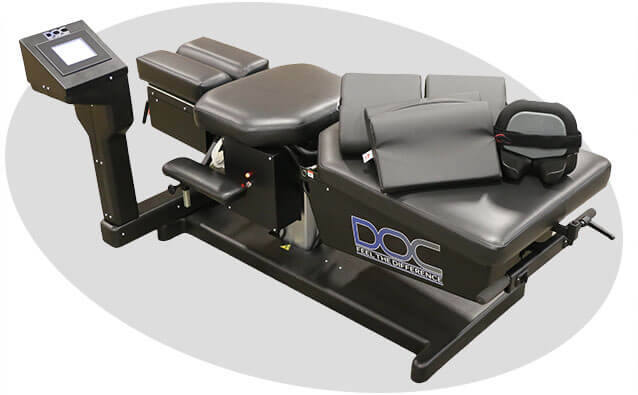
The brace applies targeted pressure that lifts compressive load off the side of the spine that is collapsing fastest. This is the closest thing to "decompression" you can carry around with you. It does not reverse the curve, but it slows the cascade of asymmetric disc loss.
2. Cue posture in real time
Adults with longstanding curves stop noticing how shifted they are. The brace provides a constant proprioceptive cue, so the patient can feel when they are drifting back into the curve and self-correct. Over months, that cueing trains a meaningfully better resting posture even out of the brace.
3. Reduce pain during high-load activity
Most adult scoliosis patients have one or two activities that reliably flare their pain (long walks, yard work, grocery shopping, standing at a counter to cook). Wearing the brace during those windows lets them keep doing the activity without paying for it for the next two days. That preserves function and mood, which matters as much as the X-ray.
4. Stabilize during conservative care
Bracing is not a stand-alone treatment. It works best as the structural piece of a broader plan that includes chiropractic adjustments to restore segmental motion and reduce facet irritation, and spinal decompression where the disc collapse is the dominant pain generator. The brace holds the gains between visits so the patient is not undoing the in-office work the moment they walk out.
What progression actually looks like, year over year
One of the hardest parts of having an adult curve is that the progression is slow enough that you do not notice it month to month. Most adult degenerative curves progress somewhere between half a degree and two degrees per year. That sounds small. Compounded over a decade, it is not small. A 15-degree curve at age 55 can be a 25 to 35-degree curve by 65, with proportionally more disc collapse, more facet wear, and more pain.
That slow drift is why "watch it" is such a poor plan. By the time the next X-ray confirms progression, another two or three years of degeneration have already happened. The goal of a real plan is to flatten that curve of progression: not to reverse the spine to where it was at 30 (we cannot), but to keep it close enough to where it is now that the patient does not lose functional capacity over the next decade.
How bracing fits with the rest of conservative care
Bracing alone is not the program. It is the structural piece. The other pieces matter just as much.
Targeted segmental adjustments restore motion at the levels above and below the curve so the curve apex does not have to do all the bending. Spinal decompression takes load off whichever segments are showing the most disc collapse, which is usually where the curve is steepest. Posture-specific exercise rebuilds the weakened convex-side musculature so the patient can hold a more neutral position when the brace is off. Pain modalities (laser, soft tissue work) keep flare-ups short so the patient stays in the active part of the program.
Sequenced correctly, all four pieces compound. The brace makes the in-office work hold longer between visits. The in-office work keeps the patient comfortable enough to wear the brace consistently. The exercise rebuilds the active stabilizers so the brace is doing less of the work over time. None of those pieces in isolation moves the needle on adult scoliosis the way the integrated plan does.
Who is a good candidate
Not every adult with a curve needs a brace. The patients who benefit most are usually the ones with measurable curve progression year-over-year, pain that flares with prolonged upright activity, or known asymmetric disc collapse on imaging. We also see strong results in patients who are not surgical candidates and are looking for a way to stay functional and out of the OR.
The first step is an honest evaluation: standing X-rays of the full spine, a curve measurement, an exam to identify which segments are doing the most work, and a conversation about goals. If bracing makes sense, we take the measurements in-office and the brace is custom-fabricated to spec.
If you are in Lakewood Ranch, Bradenton, or Sarasota and someone has told you that you have a curve and there is nothing to do about it, that is not the whole story. Get in touch. We will tell you straight whether bracing is appropriate for your spine, your pain, and your goals, and we will say so if it is not.