

Patients who walk into our Lakewood Ranch office for a decompression consultation almost always ask the same question: "Is this just like an inversion table?" Fair question. Both involve traction. Both are pitched as ways to relieve pressure on the spine. The marketing for each can sound similar.
The mechanics, the precision, and the clinical evidence are different in important ways. Here is the breakdown so you can decide whether one, the other, both, or neither makes sense for your case.
What each one actually does
Inversion table
You strap your ankles in, flip upside down, and hang. Gravity pulls your body weight toward the floor, which creates passive traction on the spine. The angle of inversion (60, 75, or fully 90 degrees) controls how much of your body weight pulls.
An inversion table is a one-size-fits-all device. It cannot focus on a specific spinal segment. It cannot adjust force during a session. It cannot hold a precise pull at a precise duration. It is gravity acting on you, full stop.
Spinal decompression (computer-guided)
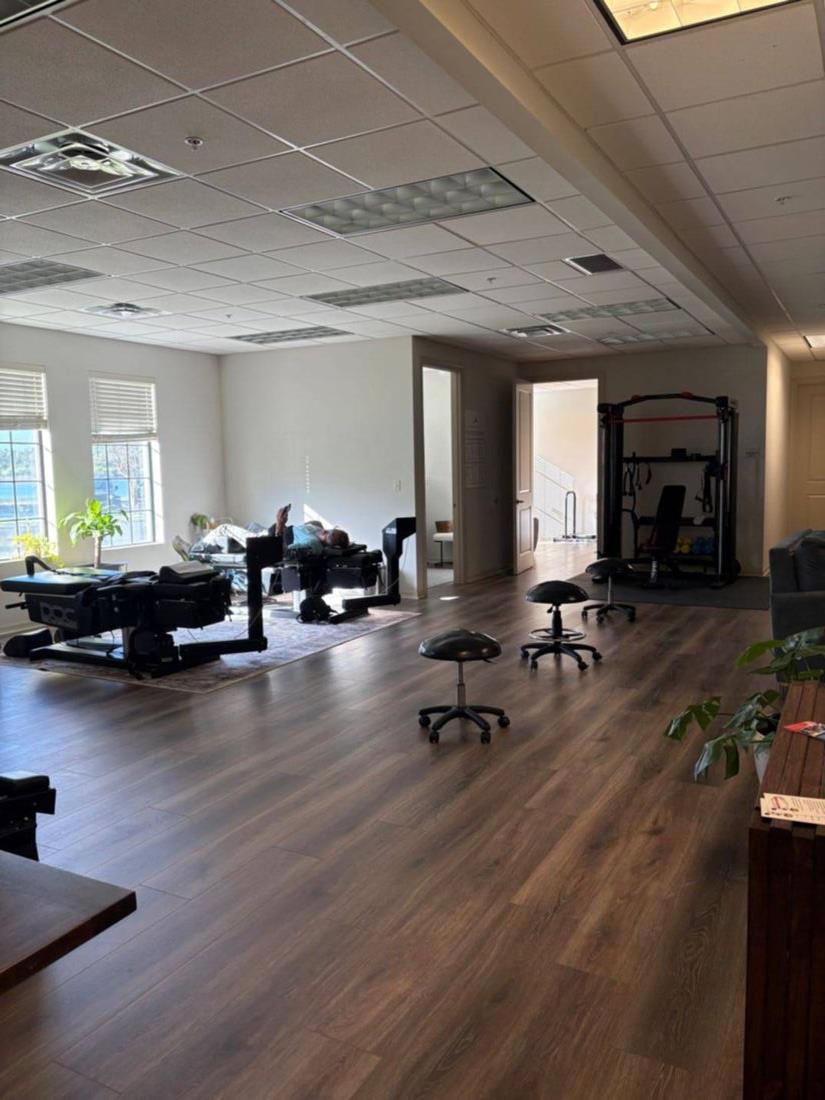
You lie on a specialized table (we use the DOC-20 system at Spine and Wellness Center). The therapist programs the machine for your specific case: target spinal segment (lumbar L4-L5, L5-S1, cervical C5-C6, etc), pull force calibrated to your body weight and pathology, angle of pull, and the cycle pattern (typically alternating tension and release over 20 to 30 minutes).
The machine pulls, holds, releases, pulls, holds, releases, in a precise rhythm designed to create negative pressure inside the targeted disc. That negative pressure is what coaxes herniated material back inside the disc and pulls fluid + nutrients into the disc to support healing.
Side by side
| Factor | Inversion table | Computer-guided decompression |
|---|---|---|
| Force control | Full body weight; cannot adjust | Calibrated in pounds; adjustable per session |
| Targeted segment | No; whole spine pulls | Yes; specific lumbar or cervical level |
| Pull pattern | Static (continuous pull) | Cyclical (intermittent pull + release) |
| Negative intradiscal pressure | Possibly mild | Yes; documented in research |
| Suitability for herniated disc | Limited evidence | Strong evidence base |
| Used for cervical (neck) | No | Yes |
| Contraindicated for high blood pressure, glaucoma, retinal detachment, recent stroke, hernia | Yes (multiple) | Far fewer contraindications |
| Cost structure | One-time consumer purchase (home use) | Clinical program presented after exam and imaging review |
| Supervision | You, alone in your basement | Trained team; doctor oversight |
When an inversion table can help
An inversion table is not useless. For mild, non-disc back stiffness or general decompression of the spine after a long day of sitting, hanging upside down for a few minutes can feel good. People with healthy spines who use inversion as part of a fitness routine often report it helps with posture and circulation.
Where inversion fails: actual disc pathology. If you have a herniated or bulging disc pressing on a nerve, gravity-only traction without precise targeting is not going to consistently move that herniation. Some people get temporary relief; many do not. And if you have any of the contraindications (uncontrolled blood pressure, eye conditions, recent ear surgery, hernia, advanced osteoporosis), inversion is risky.
When clinical decompression is the right call
Computer-guided decompression at a clinic is the appropriate next step when:
- You have an MRI-confirmed herniated or bulging disc
- You have radiating leg or arm pain consistent with nerve compression
- Conservative care (rest, ibuprofen, basic PT) has not resolved your symptoms after 4 to 6 weeks
- You want to avoid surgery
- You have failed inversion at home and need a more targeted approach
- You have a cervical (neck) disc problem (inversion does not address this at all)
A typical decompression program at our office runs 12 to 36 sessions over 6 to 12 weeks, depending on severity. Most patients feel meaningful change inside the first 2 weeks. Full recovery and structural improvement take the full program. We always pair decompression with Class IV laser therapy and progressive core strengthening so the disc has time to rehydrate and the muscles can take over the stabilization work.
The honest tradeoff
Inversion table: cheap, available now, no appointment. Limited efficacy for real disc pathology. Some safety concerns.
Clinical decompression: higher upfront cost, requires appointments. Strong evidence base for disc pathology. Targeted, supervised, calibrated. Often the difference between continued pain and actual recovery.
Most of our patients have already tried an inversion table by the time they walk through our door. It is rarely a "either-or" question for them; it is "the inversion table did not fix this, what is next?"
What to do if you are not sure
If your back or neck pain has lasted more than a month, the right next step is a real clinical exam, not buying another piece of home equipment. Our new-patient consultation includes the exam, X-rays if clinically indicated, AND an introductory decompression session so you can feel the modality before committing to anything. Book a consultation or call us at (727) 213-2982.
If you are local to Lakewood Ranch, Bradenton, or Sarasota, we are 12 to 25 minutes from most parts of the area. The drive is shorter than the next round of pain pills will last.