

About 40% of adults will deal with sciatica at some point in their lives. That sharp, electric pain running from the lower back into the buttock, down the back of the thigh, sometimes all the way to the calf or foot. It can show up after a workout, after a long drive, or for no obvious reason at all.
Almost every patient who walks into our Lakewood Ranch office with sciatica has already tried the same things: foam rolling the glutes, stretching the piriformis, hip openers from a yoga app, maybe a sports massage. Sometimes those help for a day. Usually they do not. The reason is simple. When sciatica is being driven by a disc, no amount of muscle work on the buttock or hip will fix it. You are treating the wrong structure.
Here is how to tell the difference, and what to do about it.
What the sciatic nerve actually is
The sciatic nerve is the largest nerve in your body. It is not a single nerve at all. It is a bundle formed by the nerve roots that exit your lumbar spine at L4, L5, S1, S2, and S3. Those five roots converge inside the pelvis, pass under (or through) the piriformis muscle in the buttock, then run down the back of the leg to the knee, where they branch into the tibial and peroneal nerves that supply the calf and foot.
That anatomy is why sciatic pain can come from so many different places. Compress the nerve at the spine and you feel it in the foot. Compress it in the buttock by a tight piriformis and you can feel a similar pain. Same nerve, two very different sources, two very different fixes.
The muscular version: piriformis syndrome and tight hips
The muscular form of sciatica is real. The piriformis is a small, deep buttock muscle that the sciatic nerve runs right next to (and in some people, right through). When the piriformis spasms or stays chronically tight, it can squeeze the nerve and produce buttock pain that radiates down the leg.
This version responds to muscle work. Foam rolling, deep hip stretches, glute strengthening, and occasionally dry needling will usually settle it down within a few weeks. If you have classic piriformis syndrome and you do the muscle work consistently, you should feel meaningfully better.
The trap: if you assume your sciatica is piriformis and it is actually the disc, you will spend months on stretches that are not helping. Worse, some of those deep hip flexion stretches make a herniated disc worse by loading it in exactly the wrong direction.
The disc-driven version: nerve root compression
When a lumbar disc bulges or herniates, the inner gel can press directly on one of the nerve roots that forms the sciatic nerve. Most often that is L4-L5 or L5-S1. The nerve root gets pinched, the surrounding tissue inflames, and you feel pain along the path of whichever root is compressed. This is what we mean by disc-driven sciatica.
It is also the version that most often gets misdiagnosed as muscle pain, because the leg pain dominates the experience. Patients tell us the back does not even hurt that much. The leg is what is killing them. That makes them assume the problem is in the leg or the hip, when it is actually in the spine.
For more on the underlying mechanics, we have a separate post on why most back pain is disc-related that covers what goes wrong with a disc and why.
5 signs your sciatica is disc-driven
1. Pain that runs past the knee, especially into the calf or foot
Piriformis pain almost always stops at the back of the thigh. When pain travels below the knee, especially into the outside of the calf, the top of the foot, or the big toe, you are dealing with nerve root compression. That distal pattern is one of the most reliable signs of an L5 or S1 disc problem.
2. Numbness or tingling in a specific pattern
Disc-driven sciatica often comes with numbness, tingling, or "pins and needles" along a specific stripe. Pure muscle compression rarely produces clean sensory loss like that. If you can outline the numb area with your finger, and especially if it matches a known dermatome (outer calf for L5, sole of foot for S1), the disc is the most likely culprit.
3. Sitting makes it worse, walking makes it better
Sitting loads a lumbar disc much harder than standing or walking. If your leg pain spikes during long drives, long flights, or long meetings, and eases off when you finally stand up and move, that is a textbook disc pattern. Piriformis pain often does the opposite. It feels better with sitting and worse with prolonged standing.
4. Pain that flares with coughing, sneezing, or straining
A cough or sneeze briefly spikes the pressure inside your spinal canal. If that spike sends a jolt of pain down your leg, the nerve root is irritated by something inside the canal, almost always a disc. This is called a positive cough impulse and it is one of the cleanest bedside indicators of disc involvement.
5. Foam rolling, stretching, and massage make no real dent
This is the practical one. If you have spent four to six weeks doing piriformis stretches, hip openers, and glute releases and the leg pain is roughly the same, the muscle theory is wrong. Discs do not respond to soft tissue work. They respond to decompression.
If three or more of those five signs sound like you, the odds heavily favor a disc.
Why timing on the leg pain matters more than the back pain
One pattern that catches people off guard: with disc-driven sciatica, the back pain often improves before the leg pain does. The disc starts to retract, the local back symptoms calm down, and the patient assumes they are mostly better. Meanwhile the inflamed nerve root is still angry, and the leg pain lags behind by weeks. That is normal nerve recovery. Nerves are slow tissue. They are also temperamental about reinjury during the recovery window.
The flip side of that timing matters too. If you have new leg pain after a lifting episode, do not wait three months hoping it walks itself off. The window where a freshly herniated disc retracts most easily is the first eight to twelve weeks. After that, the surrounding tissue starts to scar and stabilize around the bulge, and you are now treating a chronic geometry instead of an acute one. The treatment still works. It just takes more sessions.
Common things that quietly make it worse
While you are figuring out what is going on, three habits commonly aggravate a disc-driven sciatica without the patient realizing it. Deep forward-fold stretches (toe touches, seated hamstring stretches) load the disc in the exact direction it is already failing. Heavy lifting from the floor with a flexed lumbar spine spikes intradiscal pressure to its peak. And prolonged sitting at a soft, deep couch keeps the lumbar spine in flexion for hours, which is the worst position for an irritated disc. None of those will rupture a healthy disc. All of them can keep an already-compromised one inflamed and symptomatic.
Why decompression works for the disc version
The reason traditional approaches fail on disc-driven sciatica is that nothing they do takes pressure off the disc. Stretching elongates the surrounding muscle, but the herniated disc material is still touching the nerve root. Massage soothes the area but does not change the mechanics. Anti-inflammatories quiet the swelling for a few hours and then it comes back.
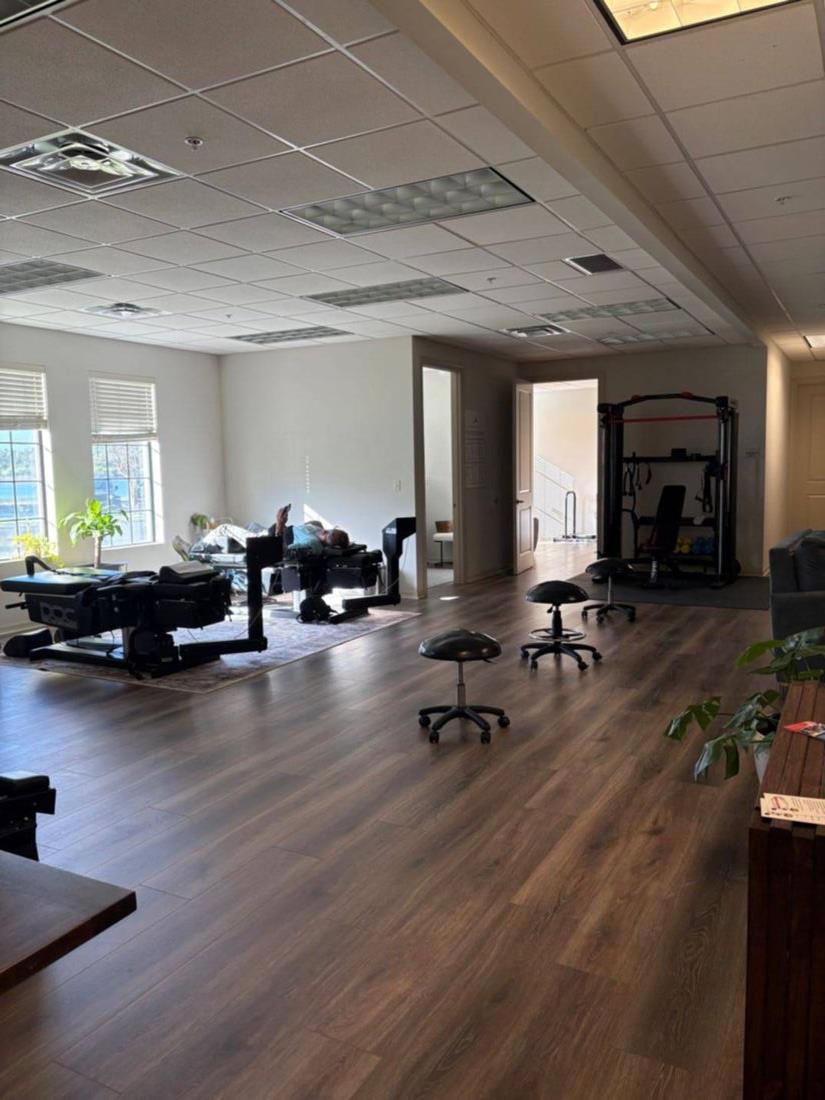
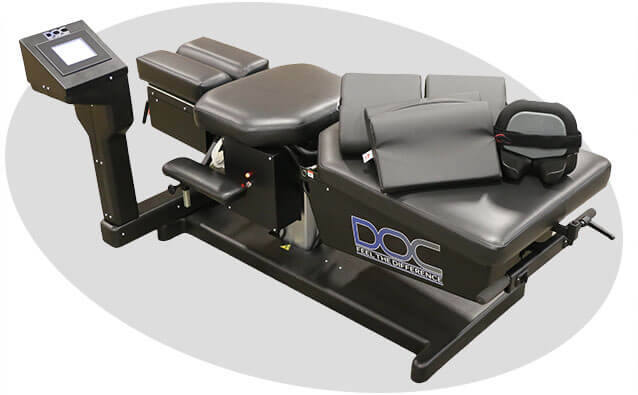
Spinal decompression is different. A computer-guided table applies precise, gentle traction to the lumbar spine in cycles. During the decompression phase of each cycle, the pressure inside the disc actually drops below zero. That negative pressure creates a small vacuum that draws the herniated material back inward, away from the nerve root. Over a series of sessions, the disc rehydrates, the bulge retracts, and the nerve compression resolves.
It is not a stretch. It is not an inversion table. It is targeted, segment-specific, repeated decompression at the exact spinal level that is compromised. We sequence it with laser therapy to calm the local inflammation and with stabilization work later in the program so the muscles around the segment can support the disc once it has decompressed.
When to skip the foam roller and see someone
If you check most of the boxes above, do not spend another month on hip stretches. Get evaluated. A proper sciatica workup includes a straight leg raise test, a slump test, dermatome and reflex testing, and (if indicated) imaging that shows the disc, not just the bone. X-rays alone will not tell you what the disc is doing. MRI will.
The faster a disc-driven sciatica gets the right care, the cleaner the recovery. Nerves that have been compressed for years can take longer to settle down even after the mechanical pressure is gone. The version we see come back fastest is the one caught within the first few months.
If you are in Lakewood Ranch, Bradenton, or Sarasota and your sciatica is not budging with the usual hip work, reach out. We can usually tell on Day 1 whether a disc is driving it and whether decompression is the right fit. Same-week appointments are typically available.