

The phone call goes something like this: "I think I have sciatica. My hip hurts and the pain goes down into my leg." We hear it several times a week. And honestly, that description fits at least four separate problems, only one of which is true sciatica.
Getting this wrong matters because the treatment for each one is different. Treating piriformis syndrome like a disc herniation, or treating an arthritic hip joint like a nerve-root problem, produces frustrating results and delays actual recovery. Here is a practical breakdown of what is most likely happening and how to tell the difference.
What "sciatica" actually means
Sciatica is not a diagnosis. It is a symptom description: pain that travels along the path of the sciatic nerve, typically from the lower back through the buttock and down the back or side of the leg, sometimes reaching the foot. The actual cause of that nerve irritation is what matters.
In true disc-driven sciatica, a herniated or bulging disc in the lumbar spine (most often at L4-L5 or L5-S1) puts mechanical pressure on one of the nerve roots that feeds into the sciatic nerve. The result is a very specific pattern: pain, numbness, tingling, or weakness that tracks a dermatome (a strip of skin and muscle supplied by that nerve root).
The problem is that several other structures can generate a pain pattern that feels almost identical to a patient but has nothing to do with a lumbar disc. Knowing which one you are dealing with is the starting point of any sensible treatment plan.
The four most common sources of hip-and-leg pain
1. Disc-driven lumbar radiculopathy (true sciatica)
This is what most people mean when they say "sciatica." A damaged disc leaks nucleus material that both compresses the nerve root and triggers a chemical inflammatory response around it. The inflammation is actually the bigger pain driver in many cases, which is why true radiculopathy can be brutally painful even when imaging shows only a modest-sized herniation.
Typical pattern: Pain originates in the lower back, travels through the buttock, and runs down the back or outside of the thigh and calf, often past the knee. Sitting and forward bending tend to increase pain (those positions load the disc). Lying down usually reduces it. Coughing or sneezing can send a sharp jolt through the leg.
Neurological findings: True radiculopathy often produces dermatomal numbness, reduced reflexes at the ankle or knee, and sometimes measurable weakness in specific muscles (foot drop at L5, weak calf push at S1). These findings help localize the level of compression.
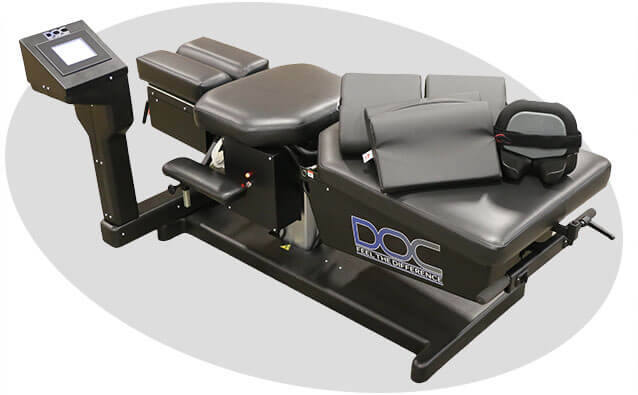
If you have had true radiculopathy for more than a few weeks without improvement, the disc compression is unlikely to resolve on its own. We use non-surgical spinal decompression specifically for this presentation, with the goal of reducing intradiscal pressure enough to allow the herniation to retract and the nerve to recover.
2. Piriformis syndrome
The piriformis is a small muscle deep in the buttock that externally rotates the hip. The sciatic nerve passes directly beneath it (and in about 15% of people, runs right through it). When the piriformis goes into spasm or becomes chronically tight, it can compress the sciatic nerve at that point, producing pain that runs down the leg in a pattern nearly identical to lumbar radiculopathy.
Typical pattern: Deep buttock pain, usually on one side, that can radiate down the back of the thigh. Pain is often worse with prolonged sitting (the piriformis is stretched in that position) and with activities that involve hip rotation: climbing stairs, getting in and out of cars, crossing the legs. Pain may be aggravated by direct pressure on the buttock.
Key difference from disc sciatica: In piriformis syndrome, the lower back itself usually does not hurt. The pain starts in the buttock, not the lumbar spine. Forward bending in a standing position (which loads the disc) typically does not reproduce it. A specific physical exam maneuver, resisted external hip rotation in a flexed position, often provokes the buttock pain. Imaging of the lumbar spine tends to be unremarkable or incidental.
This matters because the treatment is completely different. Piriformis syndrome responds well to targeted soft-tissue work on the piriformis itself, hip-opening stretches, and addressing whatever is driving the muscle into chronic spasm in the first place (often a gait asymmetry, leg-length discrepancy, or sustained sitting posture). Our piriformis syndrome care page covers how we approach it.
3. Sacroiliac joint dysfunction
The sacroiliac (SI) joint sits at the junction of the sacrum and the pelvis, on each side of the lower spine. It is one of the most commonly overlooked pain generators in the lower body. SI joint dysfunction produces pain in the lower back and buttock that radiates into the hip, groin, and sometimes down the back of the thigh, usually not past the knee.
Typical pattern: One-sided pain around the SI joint (roughly at the dimple above the buttock), sometimes into the groin, and often into the hip on the same side. Pain is typically worse with transitions: standing up from sitting, rolling over in bed, going up stairs. It is often aggravated by standing on one leg and better with lying still.
Key difference: SI joint pain rarely travels below the knee. If your leg pain stops mid-thigh or in the buttock, that is more consistent with SI dysfunction than with a lumbar disc herniation (which tends to produce symptoms all the way down to the foot or calf). A set of provocation tests (FABER, FADIR, distraction, compression) performed during a physical exam can reliably identify the SI joint as the pain source.
SI joint dysfunction is particularly common after a fall directly onto the buttock, during or after pregnancy, and in people with a leg-length difference that has been loading one side unevenly for years. Chiropractic care focused on restoring normal SI joint motion is usually the primary treatment approach.
4. Hip joint pathology (osteoarthritis, labral tear, impingement)
The hip joint itself can refer pain into the groin, buttock, and down the front of the thigh in a pattern that is often confused with nerve pain. Hip osteoarthritis, femoroacetabular impingement (FAI), and labral tears all present this way.
Typical pattern: Groin pain is the classic hip-joint referral, but many patients with hip pathology report more lateral hip pain or deep buttock pain. The pain tends to be worse with weight-bearing activities, end-range hip rotation, and prolonged walking. Morning stiffness that eases with movement is common with arthritic hip joints.
Key difference: Hip joint pain rarely travels below the knee. Range-of-motion testing at the hip (not the spine) reproduces the pain. An FABER test (hip flexion, abduction, and external rotation) that produces groin or lateral hip pain points to the hip joint rather than the SI joint or lumbar disc. Hip pathology often shows up clearly on X-ray (joint space narrowing, osteophytes) or MRI (labral tear, cartilage loss).
True radiculopathy produces dermatomal numbness and neurological changes. Hip joint pain and piriformis syndrome rarely cause measurable strength loss or altered reflexes. If a neurological exam is completely normal, the source is more likely local soft tissue or joint than a compressed nerve root.
Why getting the diagnosis right matters so much
Here is where this becomes more than academic. Each of these four conditions requires a meaningfully different treatment approach:
- Disc herniation with radiculopathy: Spinal decompression, lumbar stabilization work, reducing disc load. Piriformis stretches and SI belt bracing will not help the disc.
- Piriformis syndrome: Targeted soft-tissue release of the piriformis, hip rotator work, addressing postural and gait drivers. Spinal manipulation at L5-S1 may or may not help if the disc is not involved.
- SI joint dysfunction: Chiropractic manipulation or mobilization of the SI joint, temporary SI belt, addressing leg-length discrepancy. This does not require spinal decompression.
- Hip joint pathology: Depending on severity, conservative care includes class IV laser to reduce joint inflammation, movement retraining, and sometimes referral to orthopedics for a steroid injection or surgical consultation if conservative care stalls.
Applying a decompression protocol to someone with piriformis syndrome will produce zero benefit for the actual problem. Treating an arthritic hip with SI joint manipulation will not address the cartilage loss. The diagnosis drives the treatment, which is why we do not skip the exam.
When to get imaging
Not everyone with hip-and-leg pain needs an MRI right away. Here is a general framework:
Consider imaging sooner rather than later if:
- Neurological deficits are present: foot drop, loss of bladder or bowel control (this is an emergency), measurable muscle weakness, absent reflexes
- Symptoms are severe and not responding to 4 to 6 weeks of conservative care
- Pain wakes you from sleep consistently
- There is a history of cancer, significant trauma, or unexplained weight loss (red flags for non-musculoskeletal causes)
- Bilateral leg symptoms or saddle-area numbness (both suggest spinal canal compromise rather than a single nerve root)
Conservative care first is reasonable if:
- Neurological exam is normal
- Pain is localized and consistent with a mechanical pattern (better with rest, worse with specific positions)
- Symptoms are improving, even slowly
- The clinical exam points clearly to SI joint or piriformis syndrome rather than disc herniation
A clinical exam by a provider who knows what to look for is often more informative than imaging alone. MRI frequently shows disc herniations in people who have no symptoms at all (especially in people over 40), so a finding on imaging does not automatically mean that disc is responsible for the current pain. The exam and the imaging have to agree before treatment is directed at a specific structure.
What we look for at the first visit
When a patient comes in describing hip-and-leg pain, our first-visit exam covers several things before we settle on a working diagnosis:
- Pain location and radiation pattern: Does it stay in the buttock, or does it travel past the knee? Does it follow a dermatome?
- Provoking and relieving positions: Sitting, standing, walking, lying down. Disc pain has very specific position relationships; piriformis pain has different ones.
- Lumbar range of motion: Does forward bending reproduce the leg pain (disc)? Or is lumbar motion unrelated to the hip and buttock pain?
- Neurological screen: Reflexes at the knee and ankle, sensation testing along the dermatomes, strength testing at specific muscle groups (L4: tibialis anterior; L5: extensor hallucis longus; S1: gastrocnemius).
- Hip range of motion: Internal and external rotation, FABER, FADIR. Restricted and painful rotation at the hip suggests the joint itself.
- SI joint provocation: A set of standardized tests that load the SI joint specifically. Three or more positive tests is clinically significant.
- Piriformis provocation: Resisted external rotation in the prone or seated position. Reproduction of the buttock pain is a meaningful positive.
This takes 20 to 30 minutes and typically produces a working diagnosis with enough confidence to start care and monitor response. If the response to initial care does not match expectations, that tells us something too, and we adjust accordingly.
What treatment typically looks like for each pattern
Because patients often want to know what they are walking into, here is the broad outline:
Disc-driven sciatica: A structured spinal decompression program (typically 15 to 24 sessions over 6 to 8 weeks), combined with lumbar stabilization exercise and, when appropriate, class IV laser for the acute nerve inflammation. Many patients also benefit from whole-body vibration later in care to re-engage the deep spinal stabilizers that switched off during the painful phase. We covered this in detail in our post on 5 signs your sciatica is disc-driven.
Piriformis syndrome: Soft-tissue release of the piriformis and surrounding hip rotators, chiropractic adjustments to the lumbar spine and pelvis to normalize movement, and a specific home stretch program for the external hip rotators. Many cases resolve in 4 to 6 weeks with consistent care.
SI joint dysfunction: Targeted manipulation of the SI joint to restore normal motion, an SI belt for short-term stability during provocative activities, and assessment of contributing factors (leg-length discrepancy, gait pattern, one-sided work postures). Resolution typically takes 4 to 8 weeks.
Hip joint pathology: Class IV laser to reduce joint inflammation, movement and load management, and referral for orthopedic consultation if the conservative trial does not move the needle. Our class IV laser page covers how that modality works in a joint setting.
The key takeaway
Hip pain that feels like sciatica is not one problem. It is four common problems with overlapping symptom patterns and very different treatment needs. The distinction is almost never obvious from a phone call or a symptom description alone. It requires a structured clinical exam.
If you have been dealing with hip-and-leg pain for more than a few weeks, have seen some improvement but keep stalling, or have tried treatments that are not working, there is a reasonable chance the wrong structure is being targeted. A fresh exam with someone who looks at these patterns every day can clarify the picture quickly.