
Class IV laser helps a specific kind of case.
Deep tendon pain, plantar fasciitis, a nerve root that will not settle down: some of these respond well to Class IV laser and some do not. At Spine and Wellness Center Lakewood Ranch, your first visit is about figuring out which kind yours is. Dr. Banman examines the actual tissue, then tells you in plain language whether laser is the right tool for your case, how deep it would need to reach, and how it would fit with the rest of your care.
Not everyone with tendon or nerve pain is a candidate for Class IV laser. On your first visit we find out whether you are, and we say so straight if you're not.
- FDA-clearedClass IV, deep-tissue category
- 5 to 10 minutesessions, no needles, no medication
- Stacked into carepaired with decompression, chiropractic, or shockwave
Drag the depth slider to see what the beam is reaching.
A side-cut illustration of skin, fat, muscle, and deep periosteal tissue. Move the laser-beam line up or down to see what the Class IV beam treats at each depth.
Reaching superficial muscle.
At this depth the beam is calming surface muscle inflammation, settling minor strains, and supporting recovery from post-workout soreness or shallow trigger points.
Common conditions for Class IV laser.
Back & neck inflammation
Reduces inflammation around irritated joints and disc tissue.
Nerve pain & sciatica
Calms inflamed nerve roots so other treatments can hold.
Joint pain (knee, shoulder, ankle)
Tendinopathy, bursitis, post-injury joint pain.
Soft tissue strains
Pulled muscles, tight bands, post-surgical recovery.
Plantar fasciitis
Foot heel pain that hasn't responded to stretching alone.
Recovery support
Faster recovery from auto injury, sports injury, or post-decompression.
Quick, warm, easy.
Targeted setup
You expose the treatment area. The therapist puts safety glasses on you (and themselves), the laser is bright.
5 to 10 minute treatment
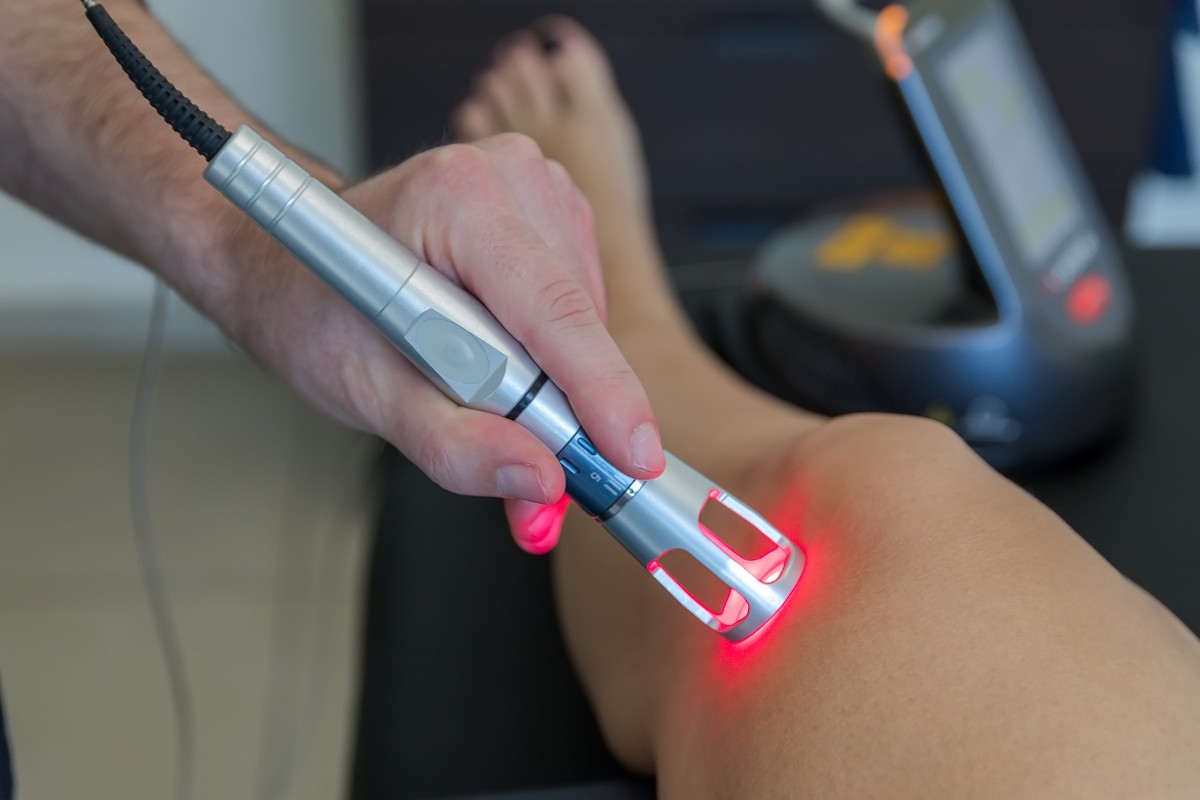
The laser head moves in slow circles over the treatment area. You'll feel a gentle warmth, no pain, no needles.
Cumulative effect
One session can help. Multiple sessions over days/weeks build the full anti-inflammatory benefit.
Pair with other care
Often combined with adjustments, decompression, or shockwave for a more complete recovery plan.
Quick answers.
Does it hurt?
No. Most patients describe the sensation as a gentle, deep warmth. We adjust the power if anything is too warm.
How is Class IV different from cold laser?
Class IV is higher-power and reaches deeper tissue than cold (Class III) laser, with shorter session times. Both are FDA-cleared categories, Class IV is the modern standard for deep-tissue clinical use.
How many sessions will I need?
It varies, Dr. Banman recommends a plan based on your condition. Most patients do a series over 2 to 6 weeks for full effect, paired with other care.
Are there side effects?
Class IV laser has an excellent safety profile. Some patients feel a mild aching for 24 hours as inflammation resolves, usually a sign it's working.
Will insurance cover it?
Class IV laser is rarely covered. HSA and FSA funds are widely accepted. See payment options →
Your first Class IV laser therapy visit at SWC Lakewood Ranch.
A walk-through so you know exactly what to expect when you come in.
Before the session
Wear comfortable clothing that lets you expose the treatment area easily, a knee, shoulder, lower back, or neck. Skip lotions, oils, or sunscreen on the area; they can interfere with how the laser energy is absorbed. There's no fasting, no needles, no medication, and no downtime to plan around. Most patients book Class IV laser therapy on a lunch break or right after work.
During the session
You and the therapist both wear protective glasses, the laser light is bright. Dr. Banman or a trained technician moves the laser handpiece in slow, sweeping circles over the target area for roughly 5 to 10 minutes. Most patients feel a gentle, deep warmth and many report it as one of the more relaxing parts of their visit. If anything ever feels too warm, the power is dialed back instantly.
After the session
You walk out and resume your day, there are no activity restrictions after Class IV laser therapy. Many patients report feeling looser within minutes; some notice a mild aching for a day as inflammation settles, which is generally a sign the tissue is responding. Studies have shown laser therapy can support tissue healing when delivered as a series, so Dr. Banman typically maps out 6 to 10 sessions for stubborn or chronic cases.
Why creams, anti-inflammatories, and cold laser keep missing the deep tissue.
The standard self-treatment ladder for chronic soft-tissue pain looks the same in almost every house in America. Start with a topical cream or a menthol patch. Move to ibuprofen or naproxen. If it still nags after a few weeks, try a heating pad, maybe a foam roller, maybe a massage. If it still has not let up, scroll the local map for a clinic that does "cold laser" and book a few sessions hoping for relief.
None of that is wrong. All of it is shallow. Topical anti-inflammatories work on the skin and the layer just below. Oral anti-inflammatories dampen the inflammatory signal everywhere in the body, kidneys and stomach lining included, without reaching the specific tissue that is irritated. Cold laser (Class III) is FDA-cleared and useful for surface conditions, but the power ceiling on a cold-laser device limits how deep the photons can drive before they scatter and lose effect. For a deep gluteal tendon, a chronically inflamed plantar fascia, or a nerve root sitting next to the vertebral body, it usually is not enough.
Class IV laser is a different category for a reason. The higher therapeutic power lets the beam reach those deeper tissues at clinically meaningful doses, in shorter session times, without burning the skin on the way through. It is not a stronger version of the same tool. It is the tool actually designed for the depth most chronic cases live in. That is the conversation we want to have on Day 1, before you spend another month on a cream that was never going to reach where it hurts.
How Class IV laser actually works.
The clinical term is photobiomodulation. Specific wavelengths of infrared light are absorbed by mitochondria inside cells, which respond by producing more ATP, the cellular energy currency that drives repair. The mechanism is well-published in the peer-reviewed literature.
Photobiomodulation, not heat
The therapeutic effect is the light itself being absorbed by mitochondria, not the warmth you feel. The warmth is a comfortable side effect. The actual work happens at the cellular level once the photons land.
Deep-tissue penetration
Class IV power lets the beam reach beyond skin and fat into muscle belly, fascia, tendon, and the connective tissue around nerve roots. That is the depth most chronic cases live in and the depth cold (Class III) laser struggles to cover.
Cellular energy (ATP) support
Cells in inflamed or injured tissue are working with depleted energy reserves. Published research documents measurable increases in mitochondrial ATP production after laser therapy, which supports the repair process the body is already trying to run.
Imaging-informed targeting
Dr. Banman sets the wavelength, power, and dwell time based on the tissue you actually need treated. A plantar fascia gets a different protocol than a cervical nerve root. The protocol is not generic, it is dialed to your case.
A laser stacked into real care, not a stand-alone gimmick.
Plenty of clinics own a Class IV laser. Most of them roll the handpiece out, run a five-minute session, charge a flat fee, and send you home. That works for a simple recovery case. It struggles with anything chronic or multi-layered, because the laser was never the only thing your case needed.
Spine and Wellness Center Lakewood Ranch is a multi-modality clinic by design. Inside one visit, your Class IV laser session can be paired with spinal decompression when an inflamed nerve root needs both the mechanical decompression and the cellular support, with chiropractic adjustments when the surrounding tissue needs to settle after the joint has been mobilized, with shockwave therapy when a stubborn tendon needs both the acoustic and the photobiomodulation effect, or with hyperbaric oxygen therapy when post-surgical or systemic-recovery cases need more oxygen at the healing site. The stacked plan is built into the program, not billed as add-ons.
- Dr. Mike personally runs your case. 23 plus years in practice. The doctor sees you on Day 1, presents the plan on Day 2, sets the laser protocol himself, and stays on your case through discharge.
- Imaging-informed targeting. If you have an MRI, X-ray, or ultrasound, bring it. We read it before we recommend anything. The laser dose is dialed to the actual tissue your imaging points to, not a generic preset.
- Bilingual care. The clinic operates in English and Spanish so families across Lakewood Ranch, Bradenton, Sarasota, and Parrish can get the same care without a language barrier.
- No upsell theater. If laser does not belong in your plan, we will tell you. Patients who get a clean "this is not your tool" answer on Day 1 are the patients who refer their families.
Day 1 is not a sales pitch. It is a consult, an exam, and a plain answer.
The biggest objection we hear is reasonable: "How do I know laser is going to do anything for my case before I commit to a series of sessions?" The answer is that you do not have to commit on Day 1. The first visit is built specifically to answer that question.
Day 1, consult and exam. You meet Dr. Banman. He goes through your history, your pain pattern, what you have already tried, and the imaging you have if any. He runs a focused orthopedic and neurologic exam on the affected area. Then he tells you, in plain language, whether Class IV laser is a clinical fit for your case, whether it should be stacked with another modality, or whether something else (decompression, shockwave, regenerative medicine, a referral) is the better first move.
Day 2, Report of Findings. Dr. Banman walks you through what your exam and any imaging show, what the working diagnosis is, and which combination of modalities the plan calls for. He presents the plan, then steps out, and our care coordinator walks you through scheduling and payment options. Investment is presented on Day 2 after the exam. You are never asked to decide in the room. You can take the plan home.
If the honest answer on Day 1 is that laser is not your tool, we will tell you that and point you somewhere it makes more sense. That conversation happens more often than you would expect, and it is the reason patients refer their families.
Book a Day-1 consult. Get an honest answer before you commit to a series.
The fastest path is a quick phone call. We answer your questions, ask about your imaging, quote the Day-1 consult fee on the spot, and get you booked. Day 1 is built to tell you whether Class IV laser belongs in your plan, alone or stacked with other care, before any program is on the table.