
Hyperbaric oxygen therapy, for the right case.
The first thing we do is figure out whether yours is one of them. Patients come to our Lakewood Ranch clinic looking at HBOT for recovery after injury or surgery, athletic recovery, nerve and neurological symptoms, and long-standing chronic conditions. On Day 1, Dr. Banman screens your history and your goals against what the research actually supports, then tells you honestly whether hyperbaric oxygen therapy belongs in your plan. How the therapy works, and what it does inside the body, is spelled out further down this page, once we have agreed it is a fit.
Not everyone is a candidate. Some cases are a clear fit for the chamber, some are not, and a few are not safe for HBOT at all. We tell you which one you are on the first visit, before you commit to a series.
- Comfortable sessioninside a pressurized chamber
- No drugs, no needlesbreathe and rest
- Cash-pay clearHSA/FSA accepted, no insurance games
Crank the pressure. Watch the cells absorb.
An analog gauge from 1.0 to 2.4 ATA, drag the needle around the dial like turning a real knob. As pressure rises, oxygen drives into the cells next to it.
Baseline saturation, oxygen reaches cells via blood only.
Why pressure matters.
At normal atmospheric pressure, the amount of oxygen your blood can carry is limited. Inside an HBOT chamber at increased pressure, oxygen dissolves directly into plasma and other body fluids, reaching tissues that don't get enough through circulation alone.
- Increased oxygen saturation in plasma and tissues
- Supports natural inflammation and recovery responses
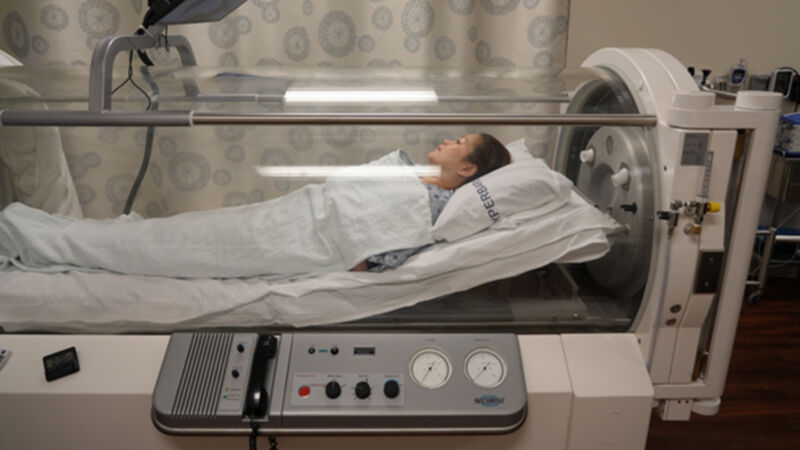
- Comfortable lie-down chamber, read, listen, or nap
- Single sessions or structured series available
Common reasons people book HBOT.
Recovery support
Post-surgical, post-injury, post-decompression, accelerated recovery support.
Athletic performance
Athletes use it to support training recovery and reduce inflammation.
Chronic inflammation
Long-standing tissue inflammation that hasn't fully resolved.
Neuropathy program
Added to some neuropathy program plans when Dr. Banman thinks it is reasonable. It is not a standard neuropathy treatment.
Energy & mental clarity
Many patients describe feeling clearer, more energized after sessions.
Overall wellness
Part of a broader wellness routine, especially around travel or stress.
What it's like inside the chamber.
Comfortable setup
You lie down in the chamber on your back. Bring a phone, book, or just relax.
Gradual pressurization
The chamber slowly pressurizes, you may feel a gentle ear pressure, similar to flying.
60 to 90 minutes at pressure
You breathe in oxygen-rich air. Most patients listen to music, read, or nap.
Slow decompression & out
The chamber slowly returns to normal pressure. You're up and back to your day immediately.
Quick answers.
Is HBOT safe?
Yes. HBOT has an excellent safety profile. We screen for the small list of contraindications and walk you through everything before your first session.
Will I feel claustrophobic?
Our chamber is a comfortable, transparent lie-down design. Most patients find it relaxing. If you have severe claustrophobia, mention it upfront, we'll talk through whether HBOT fits.
How many sessions does it take?
For a single recovery boost, one session can help. For chronic conditions or full programs, a structured series of sessions is more effective. Plans are explained upfront.
Will insurance cover it?
HBOT for non-FDA-approved indications is rarely covered by insurance. HSA/FSA accepted. Payment options →
Can I combine with other care?
Yes. It can be scheduled alongside Class IV laser or chiropractic care, and it is part of some neuropathy program plans.
What conditions can hyperbaric oxygen therapy help?
Patients ask us about hyperbaric oxygen therapy for many recovery and wellness goals. While HBOT is FDA-approved for a defined list of medical conditions, many patients use clinical-grade hyperbaric oxygen therapy off-label to support recovery, energy, and tissue healing in the situations below.
Recovery, training load, and post-procedure healing
Many patients add hyperbaric oxygen therapy to their recovery routine after demanding training, surgery, or a long flight. Studies suggest that the elevated oxygen partial pressure inside an HBOT chamber may help support fibroblast activity, collagen formation, and microcirculation, the same processes the body relies on for repair. Patients often pair HBOT with chiropractic, decompression, or laser sessions to compound the benefit.
What does hyperbaric oxygen therapy feel like?
The chamber is comfortable, well-lit, and roomy enough to lie back, read, scroll your phone, or nap. As the chamber pressurizes you'll feel mild ear pressure, similar to descent on an airplane, easy to clear with a yawn or swallow. Most patients describe an HBOT session as the most relaxing 60 minutes of their day. Many patients report feeling clear-headed and lighter through the rest of the afternoon, though responses do vary.
How many HBOT sessions do I need?
For wellness, recovery, and energy goals, many patients run a packaged course of hyperbaric oxygen therapy, often 10 to 20 sessions over four to eight weeks, and then drop to a lighter maintenance cadence. Studies suggest cumulative effects build with consistency rather than a single visit. Dr. Banman recommends a session count after reviewing your goals and history.
Who is HBOT not appropriate for?
Hyperbaric oxygen therapy isn't appropriate for everyone. We screen for conditions like untreated pneumothorax, certain ear and sinus issues, recent ear surgery, active upper-respiratory infections, and a small number of medications. Pregnant patients should clear HBOT with their OB. We do this screen during your evaluation, not over the phone, so we can answer questions specific to your case.
What to wear and bring
Loose, comfortable clothing is best, no synthetic fragrances, oils, or hair products. We provide everything you need; many patients bring a book, a downloaded podcast, or just close their eyes and rest. Eat something light before your hyperbaric oxygen therapy session; arriving fasted isn't recommended.
Insurance coverage is not the same as evidence.
The most common reason patients hesitate on HBOT is some version of, "If it really worked for that, would not insurance cover it?" It is a fair instinct, and it is also wrong. Insurance reimbursement is a financial decision made by individual payers based on a narrow list of UHMS-approved indications. It is not the same thing as a scientific consensus on what the therapy can support. Oxygen at elevated pressure is one of the most widely studied therapies in medicine. The published research extends well beyond the reimbursement list into areas like post-concussion recovery, post-surgical healing, athletic recovery, and complex chronic conditions. That is a coverage gap, not an evidence gap.
The second frame we run into is, "HBOT is for divers." That is historically how it entered the public conversation, and decompression sickness is on the approved indication list, but it is not the whole list. The same list also includes serious wound healing cases, carbon monoxide poisoning, certain infections, radiation tissue injury, and others, which is a long way from a scuba-only therapy.
We are not here to oversell what HBOT can do. We are here to give you an honest accounting of what the research supports, where it is still emerging, and whether your specific goals fit. That is the conversation we want to have on Day 1, before any session is on the table.
How HBOT actually works inside the body.
Four things happen when you breathe oxygen at elevated atmospheric pressure. Three are physical and well established. The fourth is biological and is where most of the off-label research lives.
Oxygen dissolves directly into plasma
At elevated pressure, oxygen no longer needs hemoglobin to reach tissue. It dissolves into plasma, cerebrospinal fluid, and other body fluids and gets delivered through diffusion, which lets it reach areas that compromised circulation has cut off.
Hypoxic tissue gets oxygen it could not otherwise reach
Swollen, inflamed, scarred, or post-surgical tissue is often oxygen-starved at the cellular level. Studies suggest that elevated-pressure oxygen supports the cellular machinery those tissues need to repair.
Inflammation and edema modulation
Research indexed in the UHMS literature suggests that HBOT influences the inflammatory cascade, supporting a more controlled and productive healing response rather than a chronic, stuck one.
Stem-cell and growth-factor support
Multiple published studies suggest that HBOT influences stem-cell mobilization and growth-factor expression. Findings are still emerging in many of these areas, and we say so plainly.
HBOT as part of a stacked plan, not a chamber in a strip mall.
HBOT-only studios have grown quickly across the country, and most of them have one offer, a chamber and a punch card. That works for general wellness. It is not enough for the patient who comes in with a real clinical picture. Spine and Wellness Center Lakewood Ranch was built around the opposite idea, that a chamber is most powerful when it is part of a plan a real doctor is actually managing.
Inside one visit at SWC, your HBOT session can be paired with Class IV deep-tissue laser for local tissue support, regenerative medicine if your case calls for it (Dr. Banman has worked with regenerative protocols since 2013), spinal decompression if a disc-driven driver is part of the recovery, chiropractic adjustments for the structural piece, or neuropathy care for nerve-symptom recovery. The chamber is a tool inside a plan, not the entire offer.
- Dr. Mike personally reads your case. 23 plus years in practice. He examines you on Day 1, presents the plan on Day 2, and stays on your case through any program. The financial conversation is handled separately so the clinical conversation stays clinical.
- Honest framing. We will tell you which of your goals have strong research behind them, which are emerging, and which are based mostly on patient-reported outcomes. If your case is one of the approved indications, we will say that too. If a different modality fits better, we will say that.
- Bilingual care. The clinic operates in English and Spanish so families across Lakewood Ranch, Bradenton, Sarasota, and Parrish can get the same care without a language barrier.
- No insurance theater. HBOT is rarely covered outside of the approved indication list, and we are upfront about that. HSA and FSA funds are accepted.
Day 1 is a goals conversation and a safety screen, not a sales pitch.
The fair question we hear before someone books is, "How do I know HBOT will do anything for what I am dealing with?" Day 1 is built to give an honest answer to that.
Day 1, the consult. You meet Dr. Banman. He goes through your history, the specific reason you are looking at HBOT (recovery, post-surgical, athletic, neurological, complex chronic, or general wellness), what you have already tried, and any medications or conditions that matter for chamber safety. He runs a focused exam if your case has a clinical driver, and he screens for HBOT-specific contraindications (certain ear and sinus issues, certain lung conditions, certain medications, untreated pneumothorax history, and others). By the end of the visit you have an honest answer.
Day 2, the Report of Findings. Dr. Banman walks you through the plan. He explains the recommended session count, the pressure protocol, which other therapies pair with HBOT for your specific case, and what the published research does and does not say about your indication. He presents the plan, then steps out, and our care coordinator walks you through scheduling and payment options. Investment is presented on Day 2 after the exam. You are never pressured to decide in the room.
If the answer on Day 1 is that HBOT is not the right fit (for safety reasons or because a different therapy is a better match) we will tell you, and we will point you to the right tool.
Book a Day-1 consult. Get an honest read before you commit to a series.
The fastest path is a quick call. We will answer your questions, ask about your goals, screen for safety, quote the Day-1 consult fee on the spot, and get you booked. Day 1 is a focused conversation with Dr. Banman so you know whether HBOT is the right tool, and on which protocol, before anything else is on the table.