
Scoliosis treatment in Lakewood Ranch starts with a straight answer.
A sideways curve in the spine. Some people had theirs flagged in a school screening at twelve; others meet it at sixty, as a low back that aches and leans by mid-afternoon. The honest part: an X-ray can put a Cobb angle on the curve, but a number on a film doesn't prove the curve is what's driving the pain you feel. So the first visit is a forward-bend screen, a scoliometer, and a plain conversation about what's really going on, then a call on what fits, if anything we offer does. Not always. Plenty of people with scoliosis do better watching the curve than treating it, and if that's you, Dr. Banman will say so.
- Master-levelscoliosis certification
- Teens + adultsboth curves welcome
- 23+ yrsDr. Banman, DC
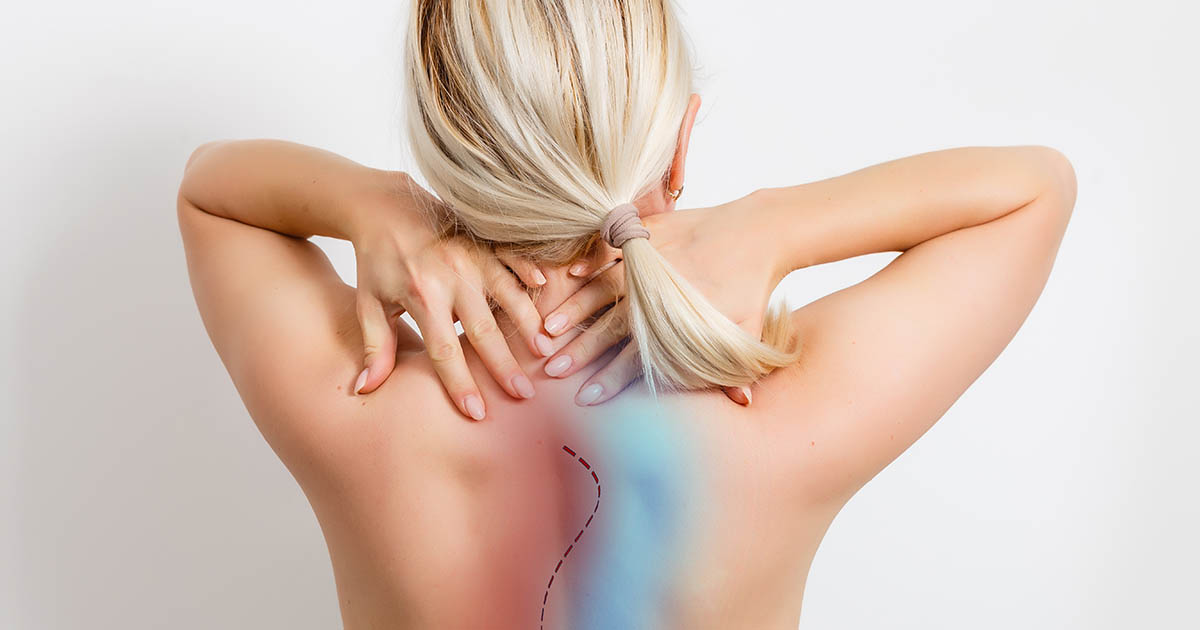
Scoliosis is measured, not guessed.
On a standing X-ray, the curve gets a number called the Cobb angle. Anything over 10 degrees counts as scoliosis. Where your number lands is what decides whether we watch, treat, brace, or refer.
Mild
Often no pain at all. In a still-growing teen we re-measure on a schedule. In adults we keep the spine moving and watch for drift.
Moderate
The range where bracing usually enters the conversation for a growing child, and where adults tend to notice muscle fatigue on the long side of the curve.
Severe
Larger curves are more likely to keep progressing and are where a surgical opinion belongs in the picture, alongside conservative comfort care.
Trunk rotation
The scoliometer reading from a forward bend. Above this, Dr. Banman moves you to a standing X-ray to get the true Cobb angle.
These ranges are general guides. Your actual plan depends on your age, whether you are still growing, and how the curve behaves over time.
Where most scoliosis cases begin.
Scoliosis Bracing
Custom Spinal Technology braces, fit in-office by one of few authorized chiropractors.
See bracing →Chiropractic Adjustments
Keep the spine moving and calm the muscle pain that builds on the convex side.
See adjustments →Spinal Decompression
Eases pressure when degenerative scoliosis is pinching a nerve in the lower back.
See decompression →All Conditions
Scoliosis often travels with disc and nerve issues. See what else we evaluate.
Browse all →What scoliosis actually is.
Look at a healthy spine from behind and it runs in a straight vertical line. Scoliosis is when that line bends to one side and usually twists at the same time, so the ribs and waist follow it out of square. It is not poor posture and it is not from carrying a heavy backpack, two ideas that get repeated a lot and are wrong. A curve has to measure more than 10 degrees on X-ray before it earns the name. Below that, it is just a spine with a little asymmetry, which nearly everyone has.
The most useful thing to know early is that scoliosis is not one condition. The plan for a thirteen-year-old whose curve was caught at a checkup looks nothing like the plan for a retiree whose curve crept in as the discs wore down. So before talking about treatment, Dr. Banman wants to know which kind you have.
The types we see most
Adolescent idiopathic scoliosis. This is the common one, showing up in kids roughly ten to seventeen as they hit their growth spurt. "Idiopathic" is the honest medical word for "we don't know the cause," and that is genuinely the case for most of these. The thing that makes it different from adult curves is growth. A spine that is still growing can change fast, for better or worse, which is why a young person gets watched closely and re-measured often.
Adult idiopathic scoliosis. Some adults have a curve that was actually there in their teens and simply never got diagnosed or treated. The bone is set now, so the curve does not grow the way a child's does, but the muscles working around it can complain, and the spine ages a little differently because of the shape it holds.
Degenerative scoliosis. This one starts in adulthood, often after fifty, and it is a wear-and-tear story. As the discs flatten and the small joints of the lower back stiffen with arthritis, the spine can lean and rotate. People with degenerative scoliosis usually come in for the back pain, leg symptoms, or the feeling of leaning to one side, not for the curve itself, which they often did not know they had.
What it feels like
Scoliosis is sneaky in teens because it rarely hurts. The signs are visual instead. A parent notices one shoulder sitting higher, a shoulder blade that sticks out more on one side, a waist that looks uneven, or pant legs that never seem to hang the same. When the child bends forward to touch their toes, one side of the back rides up into a small hump. That forward-bend look is the classic tell.
Adults are the opposite. With degenerative scoliosis the curve announces itself through symptoms: a low back that tires by afternoon, muscle ache that sits on the longer side of the curve, sometimes sciatica or numbness down a leg if the curve is also crowding a nerve. Many people are surprised to learn the ache they have lived with for years has a sideways curve behind it.
How Dr. Banman evaluates it
The first visit is mostly looking and measuring. Dr. Banman runs a forward-bend screen, watching for that rib or waist asymmetry, and uses a scoliometer, a small leveling tool laid across the back, to measure how much the trunk has rotated. A reading past about 5 to 7 degrees is the cue to confirm things with imaging rather than guess.
The confirmation is a standing full-spine X-ray. On that film the curve is given its Cobb angle, the formal measurement taken between the most tilted vertebrae at the top and bottom of the curve. That single number does a lot of work: it tells us mild from moderate from severe, it sets the baseline we compare future films against, and in a child it helps gauge how much growing is left. We only image when it will actually change the plan, and we explain what the film shows in plain language before talking about what to do.
Conservative care, honestly framed
Here is the part where some clinics oversell. A fully formed bony curve in an adult does not straighten out with adjustments, and anyone who promises otherwise is not being straight with you. What conservative care can do is real and worth doing. We work to keep the spine and ribs moving freely, calm the muscle pain that piles up on the convex side of the curve, and help you stay strong and active around the shape your spine holds. For growing teens, the goal shifts to slowing how fast a curve worsens during the years of fastest growth.
When a curve in a still-growing child reaches the range where it is likely to keep climbing, bracing becomes the tool that actually changes the trajectory. That is its own subject, and Dr. Banman is one of few chiropractors authorized by Spinal Technology, Inc. to fit their custom braces in-office. If a brace is the right call, read more about scoliosis bracing and how the fitting works. Day-to-day, chiropractic adjustments handle the stiffness and discomfort that ride along with a curve. The right mix depends entirely on your age, your number, and where the curve sits.
Why early matters
Scoliosis is a progressive condition, which is a careful way of saying it can get worse if left alone, especially during a child's growth years and especially with degenerative curves in older adults. Catching a curve while it is still small gives the most room to manage it without surgery. That is the whole reason school screenings exist, and the whole reason we would rather see a curve at 18 degrees than meet it later at 35. If something looks off in the mirror, or an old ache has a pattern you cannot shake, an evaluation now beats waiting.
When to have a curve looked at.
A scoliosis evaluation is straightforward and worth doing earlier rather than later, for both teens and adults.
Something looks uneven
A shoulder, shoulder blade, or waist that sits higher on one side, or a back that rides up on one side when bending forward. In kids these visual signs usually show up before any pain does.
A known curve, growing child
If a screening already flagged a curve and your child is still growing, repeat measurement on a schedule is how we catch progression while there is still time to act. Bracing is decided by the numbers, not by guesswork.
Adult back pain that leans
Low back pain with a sense of leaning to one side, muscle fatigue on one side, or leg symptoms can point to degenerative scoliosis. A standing X-ray and exam tell us whether a curve is part of the picture.
Quick answers.
Can chiropractic care straighten a scoliosis curve?
No honest provider can promise to straighten a curve. A fully formed bony curve in an adult does not reverse with adjustments. What conservative care can work toward is keeping the spine moving well, calming the muscle pain that builds on the convex side, and in growing teens, slowing how fast a curve worsens. Dr. Banman is upfront about what is realistic at your specific Cobb angle.
How is scoliosis diagnosed?
It usually starts with a forward-bend screening, where Dr. Banman looks for a rib hump or uneven trunk and measures trunk rotation with a scoliometer. A standing full-spine X-ray confirms it. The Cobb angle is measured between the most tilted vertebrae, and a curve over 10 degrees is scoliosis. The X-ray also shows where the curve sits and whether the spine is still growing.
Does adult scoliosis get worse over time?
It can. Degenerative scoliosis tends to progress slowly as discs and joints wear, often a degree or so per year, though it varies a lot from person to person. That slow drift is exactly why we re-measure at intervals instead of guessing. Catching a change early gives you more room to manage it without surgery.
My teenager has a mild curve. Do we need a brace right away?
Not always. Smaller curves in a still-growing teen are often watched with repeat exams every few months rather than braced immediately. Bracing usually enters the conversation as a curve climbs and the child still has growing to do. Dr. Banman holds master-level scoliosis certification and is one of few chiropractors authorized to fit Spinal Technology braces in-office, so monitoring and bracing happen under one roof.
Will scoliosis treatment in Lakewood Ranch involve surgery?
Surgery is reserved for large or rapidly worsening curves, and it is not where we start. Most people who walk in with scoliosis are managed conservatively with monitoring, movement, hands-on care, and bracing when the numbers call for it. If your curve ever does cross into surgical territory, we will tell you plainly and help you find the right surgeon.
Let's measure the curve and find what's really going on.
One visit tells us where the curve stands and what it needs next: watching, hands-on care, a brace, or a surgeon if it's past what we do. Quickest path is a phone call.