
Spinal stenosis: the canal is narrow. The real question is what's causing your symptoms.
Stenosis means the canal that shields your spinal cord and nerve roots has narrowed. But a scan can read 'severe narrowing at L4-L5' next to a person who strolls the mall fine, while a milder-looking canal is the one buckling someone's legs after a single block. The narrowing on the film and the pain in your day are not the same story. So the first visit maps what actually flares when you stand up straight and settles when you lean on a cart, and only then do we decide what fits. Not every narrow canal responds to what we do here. Some cases belong in a surgeon's office, and if yours is one, we say so on day one. No stringing you along.
- Non-surgicalconservative-first care
- Decompression+ adjustments work
- 23+ yrsDr. Banman's experience
What stenosis actually looks like.
Stenosis is the slow narrowing of the canal that shields your spinal cord and nerve roots. It tends to cluster in two regions, and it crowds in from several directions at once. Tap each marker to see where it happens, and why it produces the symptoms it does.

Cervical stenosis (neck)Narrowing up high presses on the nerves heading to your arms and hands, causing tingling, weakness, and sometimes balance or fine-motor changes. It is more time-sensitive than lumbar stenosis.
A bulging disc crowds inA degenerating or bulging disc, often at L4-L5, pushes into the canal from the front and leaves the cord and exiting nerves less room to pass.
Lumbar stenosis (low back)By far the most common site. The hallmark is leg pain, heaviness, or cramping that builds with standing and walking and eases the moment you sit or lean forward.
Spurs & thickened ligamentArthritic bone spurs and a thickened ligamentum flavum close in from the back and sides. In lumbar stenosis this is often the single biggest contributor.
Tap a marker to explore
Standing tall, walking upright → worse
Extension closes the canal and the foramina. Symptoms ramp up after just a few minutes of standing or walking.
Leaning forward, sitting down → relief
Flexion opens the canal. The shopping-cart lean, kitchen-counter rest, and seated rest all give immediate relief.
What narrows the canal.
Stenosis usually develops slowly through normal wear, not from a single injury. Five things tend to crowd into the space.
Osteoarthritis & bone spurs
Years of joint wear lead to bony overgrowth around the facet joints. Those spurs can grow directly into the canal.
Disc bulge or degeneration
A bulging disc at any level adds another structure pressing into the canal. Common at L4-L5.
Thickened ligamentum flavum
The ligament along the back of the canal can thicken with age. This is often the biggest contributor in lumbar stenosis.
Facet joint hypertrophy
The facet joints behind each disc enlarge with arthritis and push into the canal from the sides.
Spondylolisthesis
One vertebra slipping forward on the next narrows the canal where the slip occurs. Common at L4-L5 in older adults.
Congenital narrow canal
Some people are born with a slightly narrow canal. Same degenerative changes will produce symptoms earlier than average.
Conservative care, layered for the long game.
The goal is to create more functional room for the nerves, reduce the inflammation, restore motion, and rebuild the support that keeps you upright comfortably.
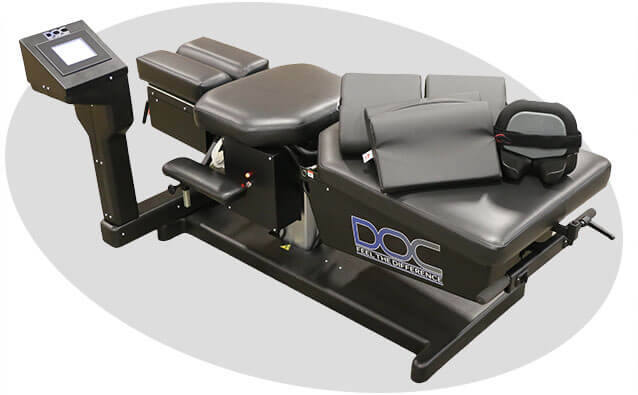
Spinal Decompression
Gentle traction may help open the canal and foramina, taking direct pressure off compressed nerves.
Learn more →Chiropractic Adjustments
Restores motion at the involved segments and the levels above and below.
Learn more →Class IV Laser
Calms inflammation in the soft tissue around the compressed nerve roots.
Learn more →Vibration & rehab
Flexion-biased core work and circulation support, the daily-life maintenance plan.
Learn more →Lumbar vs cervical, and what each feels like.
Stenosis can occur anywhere in the spine, but it tends to cluster in two regions. The symptoms differ by location.
Lumbar stenosis (low back)
By far the most common location. Classic presentation is neurogenic claudication: pain, heaviness, or cramping in the legs that comes on after a few minutes of walking or standing, eases when you sit down or lean forward, and starts over again when you stand back up. Many patients describe the shopping-cart trick, leaning on a cart in the grocery store feels fine, but walking the same distance outside without anything to lean on is brutal. Treatment for lumbar stenosis centers on spinal decompression, flexion-based rehab, and modalities that calm the surrounding inflammation.
Cervical stenosis (neck)
Narrowing in the neck affects the nerves heading down to the arms and, in more advanced cases, the spinal cord itself. Symptoms include arm pain, numbness, tingling, weakness, and sometimes balance problems or fine-motor changes (buttoning a shirt, handwriting). Cervical stenosis is more time-sensitive than lumbar, particularly when there are signs of cord involvement. We evaluate carefully and coordinate imaging when the picture warrants. Adjustments are tailored, and we screen for any reason gentle decompression of the neck would not be appropriate.
Foraminal stenosis (the side-door narrowing)
Sometimes the canal itself looks open but the small foramen, where a single nerve root exits, has narrowed. This often presents as a single-nerve pattern: a clear band of pain, numbness, or weakness in one arm or one leg, rather than the diffuse "everything's tight when I walk" pattern of central canal stenosis. Foraminal stenosis often responds particularly well to decompression because the goal is restoring height at a single segment.
Quick answers.
What is the best treatment for spinal stenosis?
Conservative, non-surgical care is the first-line treatment for most stenosis cases. A typical plan combines spinal decompression to take pressure off the compressed nerves, chiropractic adjustments to restore motion, laser therapy for inflammation, and a flexion-based rehab program that opens the canal during daily activity. Most patients improve substantially without surgery.
Why does stenosis feel better when I lean on a shopping cart?
Leaning forward, whether on a cart, walker, or kitchen counter, mechanically opens the spinal canal and the foramina where nerves exit. That extra space immediately relieves the nerve compression, which is why grocery-store walking feels easier than walking upright outdoors. It is a useful clinical clue and also a hint for what positions help during a flare.
Will I need surgery for spinal stenosis?
Most patients with spinal stenosis do not need surgery. Conservative care relieves symptoms in the majority of cases. Surgery is generally reserved for progressive weakness, loss of bowel or bladder function, severe arm dysfunction with cervical cord involvement, or stenosis that has failed a structured non-surgical plan. We are honest if your case is one of the few that genuinely needs the surgical conversation.
Can spinal stenosis be reversed?
The structural narrowing itself usually cannot be fully reversed once it has developed, the bone spurs, thickened ligaments, and degenerated discs do not undo themselves. But the symptoms it produces often can. Targeted care that decompresses the nerves, improves spinal mobility, and strengthens the supporting muscles can dramatically reduce or even eliminate the pain pattern even when the imaging still looks narrow.
Will it keep getting worse?
Untreated stenosis tends to slowly progress with age. But the functional picture (what you can comfortably do) and the structural picture (what an MRI shows) are not the same thing. Many patients live well with stenosis for decades by staying active, doing the right kind of strength work, and addressing flares promptly.
What exercises help spinal stenosis?
Flexion-based work, the kind that opens the canal, is usually best tolerated. Stationary biking (which lets you lean forward), pool walking, recumbent bike, and core work that does not extend the low back are common starting points. We give you specific drills based on your exam, because the wrong extension-heavy exercise can flare a stenosis case quickly.
Is walking good or bad for stenosis?
It depends on the form. Upright walking outdoors can flare lumbar stenosis fast. Walking while leaning forward on a cart, walker, or treadmill at an incline often feels great. Pool walking is usually excellent. We help you find the version that builds endurance without setting off the symptom cycle.
Insurance?
Chiropractic adjustments may be covered. Spinal decompression is typically not. HSA/FSA accepted. Payment options →
When to come in soon.
Stenosis is usually a slow burn, but a small set of changes calls for prompt evaluation.
Loss of bowel or bladder control
Cauda equina warning sign. Go to the emergency room first, then call us.
Saddle numbness
Numbness across the seat-of-pants area is another cauda equina red flag. ER first.
Progressive leg weakness
A leg that is steadily losing strength, week over week, rather than just hurting more, should be evaluated quickly.
New hand clumsiness with neck pain
Dropping things, struggling with buttons, or balance changes alongside neck pain can indicate cervical cord involvement. Time-sensitive.
Walking distance dropping fast
If the comfortable walking distance is shrinking week by week, the case needs an updated plan.
Fever or unexplained weight loss with stenosis pain
Uncommon, but changes the workup. We coordinate with your primary care if that picture is present.
Let's find what's actually causing it.
A real exam, then a plan built around what we find, not a label on a scan. No pressure either way. Quickest path is a phone call.