Full-body red light, if it fits your recovery.
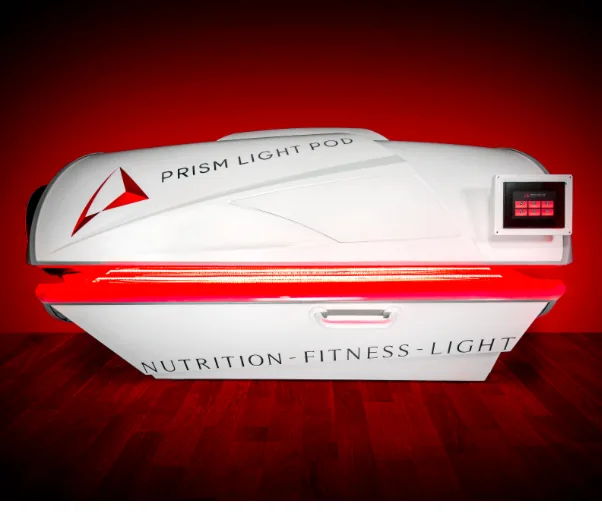
Most clinics that offer red light hand you a small panel for one body part. We have a full-body Prism Light Pod with 14,000 red and near-infrared LEDs: you recline, and light reaches you head to toe in one session. Some goals are a great fit for it and some are not. At Spine and Wellness Center Lakewood Ranch, Dr. Banman tells you in plain language whether the pod belongs in your plan, what it can realistically support, and how it stacks with the rest of your care.
Red light is a wellness and recovery tool, not a cure for any condition, and results vary from person to person. On your first visit we tell you honestly whether it makes sense for you.
- Full bodyPrism Light Pod, not a handheld panel
- 15 minutesrecline, relax, no needles, no medication
- Membershipaffordable monthly access, HSA and FSA welcome
Drag from red to near-infrared to see how deep the light reaches.
The pod delivers a range of wavelengths. Shorter, visible red light works near the surface. Longer, invisible near-infrared reaches deeper into muscle and joint tissue. Move the slider to see the difference on the body.
Working near the surface.
Visible red light is absorbed close to the skin. This is the band people associate with skin, collagen, and surface circulation, often used as part of a skin and recovery routine. Results vary from person to person.
A simplified illustration for education. Actual penetration depends on the tissue, the device settings, and the person. Dr. Banman sets the approach for your case.
Where full-body red light tends to fit.
Red and near-infrared light are used as supportive, drug-free tools alongside a care plan. These are common goals, not guaranteed outcomes, and every person responds differently.
Recovery & soreness
Supporting the body between visits, after workouts, and after treatment.
Circulation support
Red and near-infrared light are associated with local blood circulation.
Muscle & joint comfort
A supportive layer for everyday aches, used as part of a plan.
Skin & collagen
Visible red light is commonly used for skin tone and surface care.
Relaxation & wellness
A calm, warm 15 minutes many people build into their routine.
Part of a bigger plan
Often stacked with decompression, chiropractic, or the neuropathy program.
Recline, relax, and let the light do the work.
Settle into the pod
You lie down inside the Prism Light Pod. We provide eye protection, and you stay comfortable the whole time.
15 minutes, full body
14,000 red and near-infrared LEDs surround you head to toe. No needles, no medication, and most people find it deeply relaxing.
Back to your day
There is no downtime. You get up and carry on. Many people pair it with the rest of their visit.
Consistency over time
Light therapy is cumulative. A few sessions per week as part of a routine is where people tend to notice the most, and it is available as a membership.
Quick answers.
What does red light therapy feel like?
Most people describe it as warm and relaxing. You recline inside the Prism Light Pod while red and near-infrared LEDs surround you. There are no needles and no medication, and many patients say it is one of the calmer parts of their visit.
What is the difference between red and near-infrared light?
Red light is visible and is absorbed closer to the surface, which is why it is associated with skin and surface circulation. Near-infrared light is invisible to the eye and penetrates further into muscle and joint tissue, which is why it is used for deeper recovery. The Prism Light Pod delivers both.
How often should I use the red light pod?
It varies by person and goal. Many people use it a few times per week as part of a recovery and wellness routine. Dr. Banman will recommend a cadence based on your plan, and it is available as a monthly membership.
Is red light therapy safe?
Red and near-infrared light therapy has a strong safety profile and is non-invasive and drug-free. We provide eye protection, and we screen for the small number of situations where it is not appropriate. Results vary from person to person.
Does insurance cover red light therapy?
Red light therapy is generally not covered by insurance. HSA and FSA funds are widely accepted at Spine and Wellness Center Lakewood Ranch, and it is available as an affordable monthly membership. See payment options →
Your first red light session at SWC Lakewood Ranch.
So you know exactly what to expect when you come in.
Before the session
Wear comfortable clothing. For skin and surface goals, exposed skin absorbs more light, so people often wear less over the target area. Skip heavy lotions or sunscreen right before, since they can sit on the skin. There is no fasting, no needles, and no downtime to plan around. Most people book red light on a lunch break or right after their adjustment.
During the session
You recline inside the Prism Light Pod with eye protection on. Red and near-infrared LEDs surround you for roughly 10 to 15 minutes. You will feel a gentle, even warmth. Most people relax completely, and some use the time to rest or breathe. If anything ever feels too warm, we adjust it right away.
After the session
You get up and go, with no activity restrictions. Light therapy is cumulative rather than a one-time fix, so Dr. Banman usually recommends a regular cadence as part of your plan for the goals you and he discussed. The membership is built for exactly that kind of consistent, ongoing use.
How red light therapy actually works.
The clinical term is photobiomodulation. Specific wavelengths of red and near-infrared light are absorbed by mitochondria inside cells, which can respond by producing more ATP, the cellular energy that drives repair. The mechanism is described in the peer-reviewed literature.
Light, absorbed by cells
The effect comes from the light itself being absorbed at the cellular level, not from the warmth you feel. The warmth is a comfortable side effect. The proposed mechanisms center on the mitochondria.
Red vs near-infrared depth
Visible red light is absorbed nearer the surface, which is why it is linked with skin and surface circulation. Near-infrared reaches deeper into muscle and joint tissue. The pod uses both, which is what the wavelength slider above illustrates.
Cellular energy (ATP) support
Cells in tired or stressed tissue are working with lower energy reserves. Research documents measurable changes in mitochondrial energy production after light therapy, which may support the recovery the body is already trying to run.
Whole-body, not one spot
A handheld panel treats a patch at a time. The Prism Light Pod surrounds you with 14,000 red and near-infrared LEDs head to toe in one 15-minute session, so it is not limited to a single body part.
Red light stacked into real care, not a stand-alone gimmick.
Red light panels are everywhere now, from gyms to med spas to boxes on the internet. Most of them treat one small area at a time, with no one reading your case and no plan around them. That is fine for a general wellness habit. It struggles to do much for anything specific, because the light was never connected to the rest of your care.
Spine and Wellness Center Lakewood Ranch is a multi-modality clinic by design. Your full-body red light session can sit inside a real plan, paired with chiropractic adjustments so the surrounding tissue settles after the joint is mobilized, with spinal decompression as a recovery layer between sessions, with the neuropathy program as one supportive piece of a broader approach, or with hyperbaric oxygen therapy for people focused on recovery. The pod is part of the program, not an upsell bolted on at the counter.
- A full-body pod, not a handheld panel. The Prism Light Pod treats head to toe in one 15-minute session. Most clinics in the Lakewood Ranch area do not have a full-body pod.
- Dr. Mike reads your case. 23 plus years in practice. He tells you honestly whether red light belongs in your plan and what it can realistically support, and he says so straight if it does not.
- Membership that makes consistency affordable. Light therapy works best used regularly. The monthly membership is built for that, and HSA and FSA funds are widely accepted.
- Bilingual care. The clinic operates in English and Spanish so families across Lakewood Ranch, Bradenton, Sarasota, and Parrish get the same care without a language barrier.
Day 1 is a consult and an honest answer, not a sales pitch.
A fair question about any wellness therapy is: "Is this actually going to do something for me, or is it just a nice 15 minutes?" The honest answer is that it depends on your goal, and the first visit is built to sort that out before you commit to anything.
Day 1, consult and exam. You meet Dr. Banman. He goes through what you are dealing with, what you are hoping red light will help, and how it fits with the rest of your body and your goals. Then he tells you plainly whether the pod is a good fit, whether it should be paired with another part of your care, or whether something else is the better first move.
Day 2, Report of Findings. For clinical cases, Dr. Banman walks you through what your exam shows and which combination of care the plan calls for. Membership and any program pricing are presented after the exam, so you can take the plan home and decide without pressure.
If red light is really just a nice-to-have for your situation, we will tell you that too. Setting honest expectations is the reason patients here refer their families.
Sources
- Photobiomodulation, Underlying Mechanism and Clinical Applications (PMC, peer-reviewed review).
- Proposed Mechanisms of Photobiomodulation or Low-Level Light Therapy (PMC).
- Low-level laser (light) therapy increases mitochondrial membrane potential and ATP synthesis (PubMed).
Red and near-infrared light therapy is a supportive wellness tool. It is not a treatment or cure for any specific disease, and individual results vary. Talk with Dr. Banman about whether it is appropriate for you.
Book a visit and get a straight answer about full-body red light.
The fastest path is a quick phone call. We answer your questions about the Prism Light Pod, the membership, and how it would fit with the rest of your care, and we get you booked. If it is not the right tool for your goal, we will tell you that too.