
A pinched nerve is a symptom. The real question is what's pressing on it.
You feel it in your arm or down your leg, but that's rarely where the trouble starts. A pinched nerve is a spinal nerve getting compressed, and the ache lands downstream from the spot where it's actually being squeezed. Here's the catch with imaging: plenty of people carry a bulging disc on their MRI and feel nothing at all, so a scan by itself rarely proves which level is pinching your nerve. The Discovery Consult is where we map the pain back to the exact nerve root, then walk through your options. Serving Lakewood Ranch, Bradenton, and Sarasota.
Decompression and adjustments work well when a disc or narrowing is doing the pinching, and less well for some other causes. The exam is how we find out which camp you're in, and if it's the second, we say so and point you somewhere better.
- Non-surgicaldecompression-first care
- Find the sourcewe treat the cause, not just the pain
- 23+ yrsDr. Banman's experience
What a pinched nerve actually is.
"Pinched nerve" is a plain-language term for nerve compression. The key is that the symptoms travel along the nerve, which is what points us to the real source.
The symptoms travel
Unlike a simple muscle ache that stays put, a pinched nerve sends sharp or burning pain, pins and needles, numbness, or weakness along the path of the nerve. That radiating pattern is the signature, and where it travels tells us which nerve and which level are involved.
Lower back vs. neck
A nerve pinched in the lower back commonly causes sciatica, pain running down the buttock and leg. A nerve pinched in the neck (cervical radiculopathy) sends symptoms into the shoulder, arm, or hand. Both are nerve-root problems; the location just differs.
It usually has an underlying cause
A pinched nerve is rarely the whole story, it's the result of something pressing on the nerve: a herniated or bulging disc, spinal stenosis, a bone spur, or disc degeneration. Treating the source is what tends to give lasting relief.
What pinches a nerve.
Almost always, something is taking up space the nerve needs. These are the usual culprits.
Herniated or bulging disc
The most common cause. Disc material pushes into the space where the nerve root exits and presses on it.
Spinal stenosis
Narrowing of the canal or the nerve's exit tunnel crowds the nerve, common with age.
Bone spurs & degeneration
As discs wear, the body can form bone spurs that intrude on the nerve's space over time.
Poor posture & repetitive strain
Long hours hunched at a desk or phone, plus repetitive movements, can compress and irritate nerves.
Injury or trauma
A fall, lift, or car accident can suddenly compress a nerve that was previously fine.
Muscle entrapment
Sometimes a tight muscle, like the piriformis pressing the sciatic nerve, mimics or causes the pinch. See piriformis syndrome.
Decompression-first, layered care.
We find what's pressing on the nerve and take the pressure off, calm the irritation, restore motion, and rebuild support so the nerve stays clear.
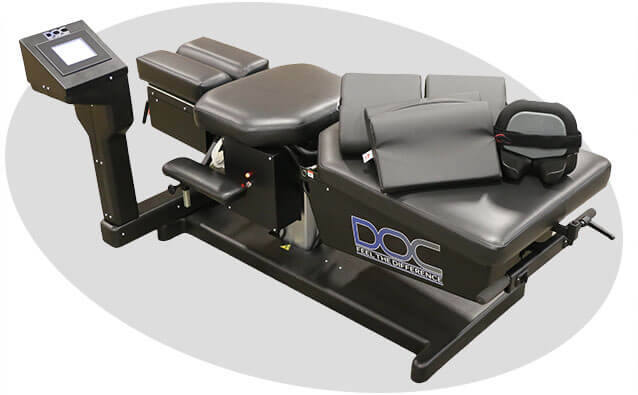
Spinal Decompression
Gentle, targeted traction that may reduce pressure on the pinched nerve root from a disc or narrowing.
How decompression works →Chiropractic Adjustments
Restores motion to the joints at and around the involved level, opening space for the nerve.
How adjustments help →Class IV Laser
Targets the inflammation around the irritated nerve, which is often what drives the burning and tingling.
How laser helps →EMS & rehab
Calms muscle guarding and rebuilds the support that keeps pressure off the nerve long-term.
How rehab helps →Quick answers.
How long does a pinched nerve take to heal?
Many pinched nerves ease within a few weeks once the pressure on the nerve is reduced, though numbness and weakness can take longer to recover than pain. Consistent conservative care, including decompression and adjustments, often supports that recovery. Cases that don't change in a couple of weeks should be evaluated.
Does spinal decompression help a pinched nerve?
Often, yes. When the nerve is pinched by a disc or by narrowing, decompression uses gentle, targeted traction that may reduce pressure on the nerve root and ease the radiating pain, numbness, or tingling. After an exam confirms the cause, it's one of the cornerstones of how we treat pinched nerves.
What does a pinched nerve feel like?
It usually causes symptoms that travel: sharp or burning pain, pins and needles, numbness, or weakness that radiates along the nerve, down a leg from the lower back, or into the shoulder and arm from the neck. The radiating pattern is what distinguishes it from a simple muscle ache.
Should I rest or move with a pinched nerve?
Gentle movement is usually better than strict bed rest. Light walking and frequent position changes keep the area mobile and nourished, while prolonged sitting or the positions that reproduce your symptoms are best limited. We give position-by-position guidance based on which nerve is involved.
Will a pinched nerve go away on its own?
Some do, especially mild ones, once the irritating activity stops. But because a pinched nerve usually has a structural cause, addressing that cause tends to produce faster, more complete, and more lasting relief, and lowers the odds it comes back.
Do I need an MRI?
Not always. Dr. Banman's exam, including the pattern of your symptoms and neurological testing, can usually identify which nerve is involved. We order imaging when it would change the plan, when red-flag symptoms are present, or when conservative care hasn't produced expected change.
Insurance?
Chiropractic adjustments may be covered. Spinal decompression is typically not covered by insurance. HSA/FSA accepted. Payment options →
When to come in sooner.
Most pinched nerves are urgent-but-not-emergency. A few symptoms mean same-day evaluation.
Loss of bowel or bladder control
A true emergency and a sign of cauda equina compression. Go to the emergency room first, then call us.
Progressive weakness
If the muscles a nerve controls are getting weaker over days, not stronger, that warrants quick evaluation to protect function.
Saddle numbness
Numbness in the area that would touch a bicycle seat is another cauda equina warning sign. Emergency department first.
Symptoms in both legs or both arms
Radiating symptoms on both sides at once should be evaluated promptly rather than waited out.
Fever or unexplained weight loss
Uncommon, but it changes the workup. We coordinate with your primary care if that picture is present.
History of cancer
New radiating pain in someone with a cancer history warrants imaging before a treatment plan. We don't skip that step.
Let's find out what's actually pressing on the nerve.
An honest exam, then a straight answer about whether we can help and what fits if we can. The quickest path is a phone call.