

Schools in Sarasota and Manatee counties open the first week of August. That means within the next two weeks, thousands of kids in Lakewood Ranch, Bradenton, and the surrounding communities will start loading backpacks onto spines that have not finished growing. Every September, the same thing happens in our office: a new wave of parents calling about a 10 or 11-year-old complaining of shoulder pain, mid-back aches, or neck stiffness that nobody can trace to anything specific. In most cases, the backpack is the most obvious place to start.
Dr. Michael Banman has been in practice in Lakewood Ranch for 23 years. Pediatric spine complaints spike every fall, a few weeks after school starts. This is what he covers with parents at those visits, condensed into one place you can use before the first day rather than after the first complaint.
If you have a child already showing signs of spinal curvature, early posture changes, or a history of back pain, a scoliosis evaluation or spine check before school starts is worth scheduling now, while appointment times are still available.
How Heavy Is Too Heavy? The Number Most Parents Don't Know
The threshold most pediatric spine researchers agree on is 10% of a child's body weight. A 70-pound third-grader should carry no more than 7 pounds. A 90-pound fifth-grader: 9 pounds. A 120-pound eighth-grader: 12 pounds.
Weigh your child's fully loaded backpack before school starts. Put everything in: books, binders, laptop or tablet, lunch box if it goes in there, water bottle, gym clothes. Most parents, when they do this for the first time, find a number between 15 and 25 pounds. That is not unusual in Florida middle schools. It is also not safe.
A 2018 study published in Applied Ergonomics followed more than 1,000 school-age children and found that 79% of them regularly exceeded the 10% threshold. In middle school groups, average pack weight was closer to 18-20% of body weight. That load, five days a week, 36 weeks a year, across the years when the spine is actively growing, is a real cumulative stress on structures that have not finished developing.
The American Chiropractic Association and the American Academy of Pediatrics have both published formal backpack safety guidelines. The research is consistent. The problem is that it almost never makes it from the journal to the parent.
What Actually Happens to a Growing Spine Under That Load
A child's spine is not simply a smaller version of an adult spine. The vertebral end plates (the growth zones at the top and bottom of each vertebra) remain soft and compressible well into the early teenage years. Repeated asymmetric or forward-flexed loading compresses those growth plates unevenly. Over years, this can contribute to the rounded upper back pattern that orthopedic researchers have associated with load during the growth years.
The mechanical chain works like this: the weight of a heavy backpack shifts behind the child's center of gravity. To stay upright, the child tips their upper body forward. That forward lean pushes the head in front of the shoulder line. The human head weighs roughly 10 to 12 pounds. For every inch it moves forward of the shoulders, the effective load on the cervical spine increases by approximately 10 pounds. A 12-year-old walking to class with a 20-pound backpack and their head three inches forward is stressing their neck with what functions like 40 or 50 additional pounds per step. That is the same mechanical process behind the tech-neck pattern we see in adults, and it starts years before the first smartphone.
Simultaneously, the lumbar spine (lower back) compensates for the weight behind it by flattening or flexing. Over time, this can contribute to anterior pelvic tilt and the forward-hip posture that becomes a chronic adult back-pain pattern.
Children's discs are resilient. The real risk is not a disc herniation from a backpack, but the postural habits that form during the growth years. The child who learns to carry load correctly, and to use their core for load transfer, builds a different spine than one who hunches through it for eight years.
The 5 Rules Dr. Banman Gives Every Parent Before School Starts
These are the guidelines we go through in our Lakewood Ranch office whenever a parent asks what to do:
1. Weigh the pack and work backward from 10%
The 10% limit is the starting point, not the ceiling. Aim under it. To get there:
- Audit the bag at the start of each week. Pull out anything that does not belong to an assignment due that day.
- If the school has a locker, use it. Many kids skip the locker because it costs time between classes. Build the habit before the school year starts so it feels automatic.
- Ask about digital versions. Most textbooks now have an app or online portal. If a teacher requires the physical book daily, ask whether the digital copy is accepted in class. A lot of teachers say yes when asked directly.
2. Both shoulder straps, every single time
One-shoulder carrying places the full load asymmetrically on one side of the spine and forces the torso to lean to compensate. The effect accumulates over a school year. We regularly see middle-schoolers whose carry-side shoulder sits measurably higher than the other, with the thoracic spine rotated toward the opposite side. If your child habitually one-shoulders their bag, that pattern is worth watching closely, and it is one of the reasons a baseline scoliosis screening before the school year is useful. A curve that develops gradually during a growth spurt is much easier to manage when it is caught early.
3. Tighten the straps so the bag rides close to the back
The most common backpack setup mistake is wearing the straps too loose. A bag that hangs low, bouncing against the lower back, has a longer lever arm and creates more compensatory lean than one that rides high against the mid-back. The bottom of the bag should sit no lower than about four inches below the natural waistline. Tighten both straps until the bag sits snug against the upper and mid-back. It should not swing independently when the child moves.
4. Use the waist belt for anything over 10 pounds
Many school backpacks include a waist belt and sternum strap that go unused because they look awkward. For any pack over the weight threshold, the waist belt is the single most effective load-distribution tool available. It shifts a significant portion of the weight from the shoulders and spine to the hips, which are anatomically built to carry it. Hiking packs are designed around this principle precisely because hikers learned decades ago that the spine is not the best structure for sustained load transfer. If the bag has a waist belt, get your child comfortable wearing it before the school year starts so it feels normal rather than embarrassing.
5. Pack the heaviest items closest to the back
Packing order matters. The heaviest items, typically textbooks and binders, should go in first against the back panel, as close to the spine as possible. Lighter items, snacks, chargers, and water bottles go in the outer pockets. This keeps the center of gravity as close to the body as the bag design allows and reduces the forward-pull effect that makes a heavy pack feel heavier than it is. A 15-pound bag packed correctly feels noticeably different from one packed carelessly.
Warning Signs the Backpack Is Already Causing Problems
Contact our office if your child shows any of these during the school year:
- Shoulder, neck, or mid-back pain that appears consistently after school but is not present on weekends or summer break. The temporal pattern is the signal. Random growing pains do not follow the school calendar.
- Visible shoulder asymmetry. Stand behind your child and look at their shoulders while they stand naturally relaxed. One shoulder sitting measurably higher than the other is one of the early signs we check in a scoliosis screening.
- Numbness or tingling in the hand or fingers after wearing the backpack. This can indicate brachial plexus compression from straps that are too tight on the wrong muscle groups, or from a pack that is too heavy for too long.
- Posture that has visibly changed since the school year started. Increased rounding in the upper back, a forward-head position, or a head tilt that was not there in August are all worth evaluating.
None of these is an emergency in isolation. But none is a normal part of growing up either. Many of these patterns, identified at the right age, respond well to targeted chiropractic care, corrective exercises, and straightforward adjustments to how the backpack is set up and loaded.
The Case for a Spine Check Before the First Bell
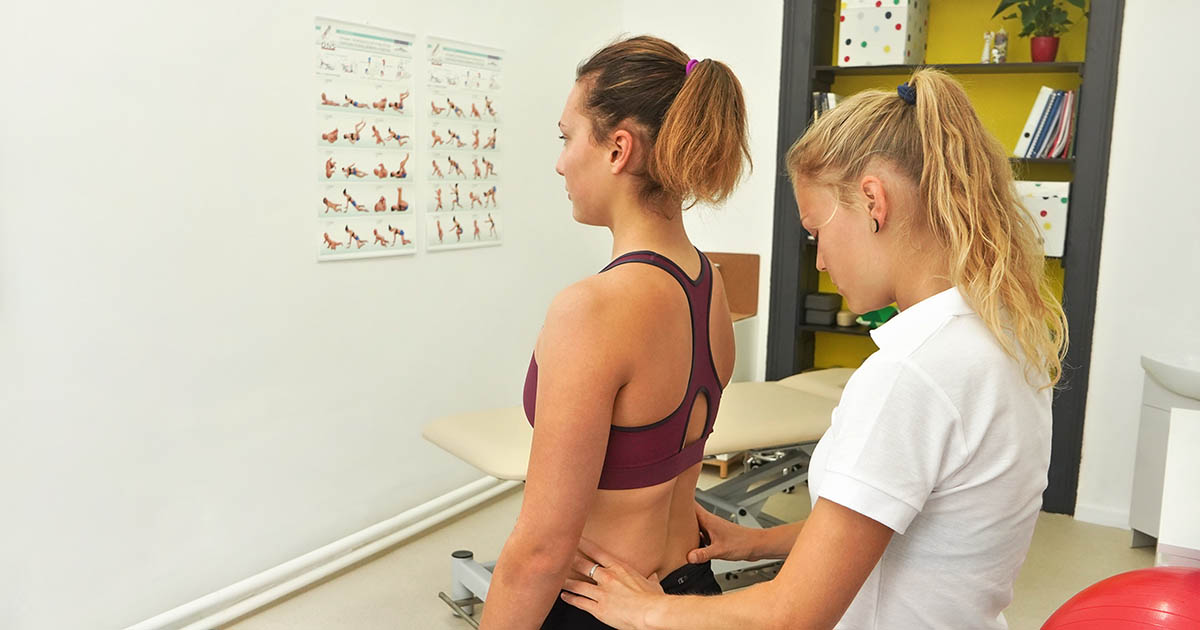
The most useful preventive step, beyond fixing the backpack, is a short baseline spine evaluation before the school year starts. In our office, a pediatric spine check covers:
- Shoulder symmetry and thoracic (mid-back) curvature
- Cervical (neck) range of motion and forward-head posture measurement
- Adam's forward bend test for scoliosis screening
- Any early signs of rotational asymmetry in the spine
The visit takes about 20 minutes for a child, involves no X-rays unless something specific requires one, and gives you a documented baseline. If something changes during the school year, comparing the current picture to the start-of-year baseline is far more informative than starting from zero in October when the complaint has already developed.
Scoliosis in particular progresses fastest during growth spurts. Girls typically experience their primary growth spurt between ages 10 and 12; boys between 12 and 14. If your child is in those age ranges, a back-to-school spine check is a straightforward thing to schedule regardless of whether they have any current complaints. The earlier a developing curve is identified, the more options exist to address it. Our guide to adolescent scoliosis covers what parents should know about the screening, what different curve measurements mean, and what non-surgical management looks like when a curve is caught at the right stage.
Dr. Michael Banman, DC, has more than 23 years as a chiropractor and speaks Spanish. For Spanish-speaking families, the evaluation is available in Spanish.
The Simple Thing to Do This Week
School starts fast in Florida. Getting the backpack sorted now, before the first day, takes 15 minutes and a kitchen scale. A spine evaluation takes about 20 minutes in our office. Neither requires a lot of time, and both prevent problems that are much easier to address before they develop into a complaint your child brings home in week three.
Load the pack tonight, put it on your bathroom scale, and divide by your child's weight. If that number is over 10%, you have your first action item. If it is also time for a baseline spine check, call us or book online. We are seeing patients through the summer and into the new school year.