

Cycling is one of the most popular forms of exercise in Lakewood Ranch and across the Gulf Coast, and for good reason: low joint impact, high cardiovascular return, and you can do it year-round in Florida. But there is a genuine mechanical conflict between what riding a bike does to your spine and what your lumbar discs need to stay healthy. Many of the patients we see with lower back pain in our Lakewood Ranch office are cyclists who pushed through discomfort until it became something harder to ignore.
The fix usually is not stopping cycling. It is understanding exactly what the position and vibration are doing to your spine, identifying which structure is actually irritated, and adjusting both your bike setup and your care. Here is the full picture.
What Cycling Does to Your Lumbar Spine
When you ride, your lumbar spine sits in sustained flexion. Whether you are on a road bike in an aggressive drop-bar position, a hybrid with a more upright posture, or a cruiser gliding down the Legacy Trail, your lower back is still forward-bent for the duration of the ride. That matters because the intervertebral disc behaves very differently under sustained flexion than it does under neutral load.
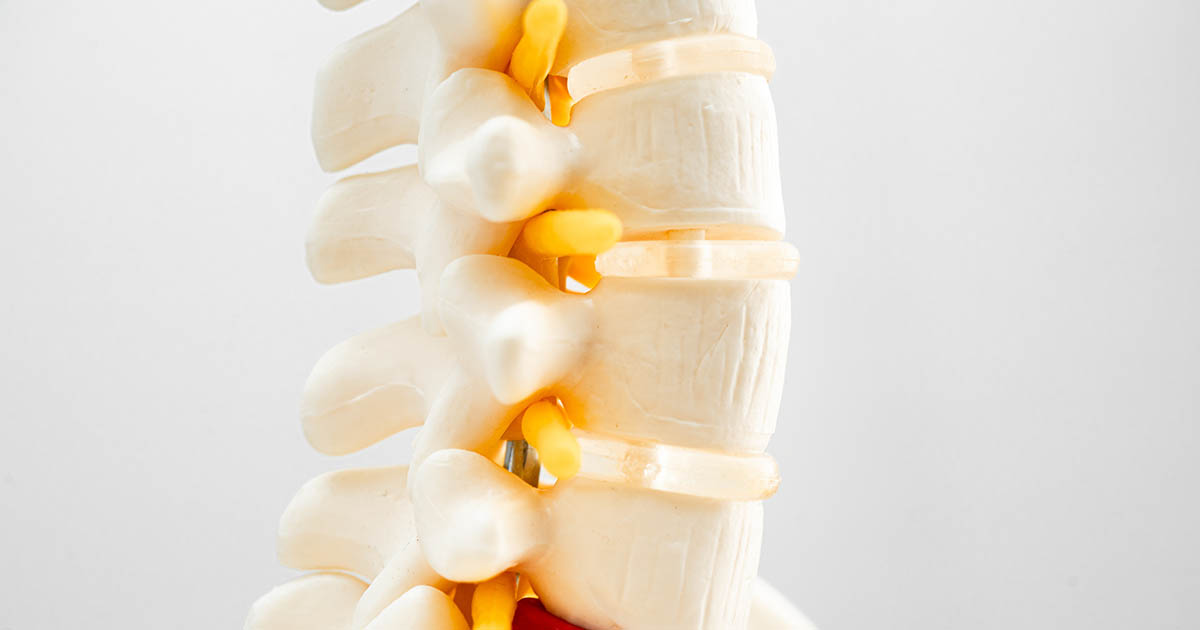
In neutral posture, disc pressure distributes across the entire end plate of the vertebra above and below. In sustained lumbar flexion, pressure shifts to the anterior disc and the posterior annular fibers take a stretch load. An hour into a ride, those posterior fibers have been under continuous tension. Add road vibration (especially on asphalt, gravel paths, or any cracked Florida sidewalk), and you are layering cyclic compressive forces on top of an already-stretched posterior wall. That is the mechanism behind disc-related back pain in cyclists: it is not a single traumatic event, it is accumulated load.
Your hip flexors also shorten during prolonged riding. When you dismount, shortened hip flexors pull the pelvis into anterior tilt, which increases lumbar lordosis abruptly after a prolonged kyphotic position. That transition is often when people feel the sharpest pain: not while riding, but in the 20 minutes after a long ride when they try to stand up straight.
Three Presentations We See in Cyclist Patients
Not all cycling back pain is the same. In 23 years of practice, the presentations that come through our Lakewood Ranch clinic generally fall into one of three categories, each with a different driver and a different care path.
1. Paraspinal muscle fatigue and spasm
The most common and most straightforward. The erector spinae and multifidus muscles that run alongside your spine have to work isometrically the entire ride to stabilize the lumbar spine in its flexed-forward position. On longer rides, they fatigue. Fatigued muscles spasm. The pain shows up as a diffuse ache across both sides of the lower back, usually during the ride rather than after, and resolves within 24 to 48 hours of rest.
This pattern usually responds to a combination of core strengthening (particularly the deep stabilizers like transverse abdominis), hip flexor lengthening off the bike, and a proper bike fit that reduces how far forward your torso has to lean.
2. Disc involvement
When the pain runs into the buttock or thigh, or worsens when you sit still after a ride but improves when you walk around, the disc is more likely involved. Disc herniation and disc bulge both produce posterior disc pressure that increases under sustained flexion. Cyclists with a pre-existing disc issue often notice that their first long ride of the season is their first serious back flare of the year.
Disc-driven cycling pain tends to be asymmetric (one side more than the other) and often has a pattern where bumpy roads or trail riding triggers it faster than smooth pavement. The vibration component is the key clue.
3. Sciatic nerve irritation
When the disc bulge is large enough, or when the piriformis muscle tightens from repetitive hip rotation on the pedals, the sciatic nerve can get caught in the middle. Patients describe a deep ache in the buttock that radiates down the back of the thigh, occasionally into the calf. It often gets worse in the hours after a long ride rather than during it. True sciatica needs to be distinguished from piriformis-related nerve entrapment, because the treatment approach differs.
The most useful diagnostic question: does the pain stay local to the lower back, or does it travel? Pain that travels below the knee during or after a ride is a sign that a nerve root or the sciatic nerve itself is involved. That warrants an evaluation, not just a recovery week.
The Bike Fit Factor
Bike fit is a legitimate clinical variable. A saddle too high forces excessive hip drop at the bottom of each pedal stroke, which rotates the pelvis and flexes the lumbar spine further. A saddle too far back increases anterior reach, which loads the thoracolumbar junction. Handlebars too low for someone with limited hip flexor mobility force the upper back to compensate by hunching, which changes the load distribution all the way down to L4-L5.
You do not have to go to a professional bike fitter for every adjustment. But if you are a regular cyclist with recurring back pain, two checks make a real difference:
- Saddle height: Seated on the bike with your heel on the pedal at the bottom of the stroke, your knee should be nearly straight (a slight bend). If your hips rock side to side at the bottom, the saddle is too high.
- Saddle tilt: Most recreational cyclists ride with a saddle that is slightly nose-down, which rotates the pelvis posteriorly and flattens lumbar lordosis. A level saddle or slightly nose-up (2 to 3 degrees) keeps the lumbar spine in a more neutral position.
- Reach: When your hands are on the hoods or the flat bar, your elbows should have a slight bend. Fully extended arms mean your upper body is overstretched, which loads the lower back to compensate.
These adjustments do not fix structural disc issues. But they reduce the mechanical load going into an already stressed lumbar segment. Combined with targeted care, they make a meaningful difference in how quickly someone recovers and whether the problem comes back.
Why Florida Cycling Creates a Specific Pattern
Two things about cycling in this part of Florida that matter clinically: the heat and the road surface.
Florida summer heat causes a significant drop in disc hydration over the course of a long ride. Intervertebral discs are about 80 percent water. When you are sweating heavily in July humidity and replacing fluid intake slowly, the disc loses hydration and its ability to absorb shock decreases. A ride that would have been manageable in April can produce a back flare in July on the same route, simply because the disc is less resilient under dehydration load.
Florida roads, bike paths, and sidewalks also tend to have specific vibration patterns: cracked asphalt, expansion joints every 20 feet, and trail surfaces that vary from packed shell to loose gravel. Each transition sends a vibration spike through the saddle and into the lumbar spine. If you have a disc that is already under sustained flexion load, those spikes are the factor that tips a manageable ride into a painful one.
The practical applications: hydrate aggressively before and during longer rides (not just water, but electrolytes), and consider a suspension seatpost if you ride primarily on rough surfaces. Suspension seatposts reduce vibration amplitude by 30 to 50 percent and are one of the single highest-return bike modifications for back pain cyclists.
What Conservative Care Actually Involves
The goal of an evaluation at our Lakewood Ranch office is to identify which structure is the primary driver. That changes the care plan significantly.
For muscle-dominant presentations, the focus is on manual therapy to release the spasm, strengthening exercises for the deep stabilizers, and a return-to-cycling plan with a specific recovery structure (shorter rides, higher cadence, lower gear resistance to reduce lumbar loading per pedal stroke).
For disc-involved presentations, spinal decompression is often the most direct intervention. Decompression uses computer-controlled traction to create negative intradiscal pressure, which reverses the compression that cycling accumulates over weeks and months. Many patients with cycling-related disc injuries find that a course of decompression allows them to return to riding at a higher level than pre-treatment because the disc has had a genuine opportunity to recover, not just a rest period where the pressure is still present.
For nerve-involved presentations, the decompression approach is similar but the care plan includes soft-tissue work on the piriformis and hip external rotators, Class IV laser to address the inflammatory component around the nerve, and specific off-bike exercises to restore hip rotation mobility without overloading the sciatic nerve.
When to Get Evaluated Instead of Riding Through It
There is a reasonable category of cycling back pain that responds to two or three rest days and comes back clean. But several patterns do not belong in that category:
- Pain that radiates into the leg or foot, especially below the knee
- Numbness or tingling in the saddle area, inner thigh, or genitals (this is a cauda equina warning sign; go to the ER, not a chiropractor)
- Back pain that wakes you from sleep after a ride
- Pain that gets worse over successive rides without a clear recovery between them
- A new pattern where even short, easy rides trigger significant discomfort that was not there a month ago
That last pattern is the one most cyclists dismiss. A gradual reduction in what you can tolerate on the bike is often a sign that cumulative disc load has crossed a threshold and the structure needs intervention, not more rest-and-repeat cycles.
The good news: disc-driven cycling back pain responds well to conservative care in the majority of cases we see. Most patients who come in with this pattern are back on the bike within 4 to 8 weeks, often with a better understanding of what to watch for and how to prevent it from compounding again.
Getting Started With an Evaluation
If you are a cyclist in the Lakewood Ranch, Bradenton, or Sarasota area dealing with recurring lower back pain, the first step is a proper examination. That means understanding the full picture: your bike setup, your ride history, your symptom pattern, and a physical assessment of what your spine and hips are actually doing. From there, we can tell you what is driving the pain and what a realistic recovery plan looks like.
Call our office at (727) 213-2982 or book a visit online. We work with cyclists specifically and understand that "stop riding" is not a satisfying answer when the bike is your stress relief, your social outlet, or your main form of exercise.