


Sit with us in the exam room for a moment. You have been putting off getting your back checked for months -- maybe longer. You finally get an MRI. The radiologist's report comes back with "degenerative disc disease" listed right there in the impression. You search those three words online. Thirty minutes later you are convinced your spine is collapsing and that you will be in surgery by 50.
That search was not helpful. Let us give you a more useful read. Dr. Banman has been evaluating spine patients for 23 years; in that time, he has seen more 30-somethings walk in with that same MRI report, that same look of dread, than he can count. And almost every time, the conversation that follows is the same: "This is real, and it does deserve attention -- but it is not what the words suggest."
If you are dealing with degenerative disc disease, here is the honest breakdown.
What a Disc Actually Is (and Why It Matters)
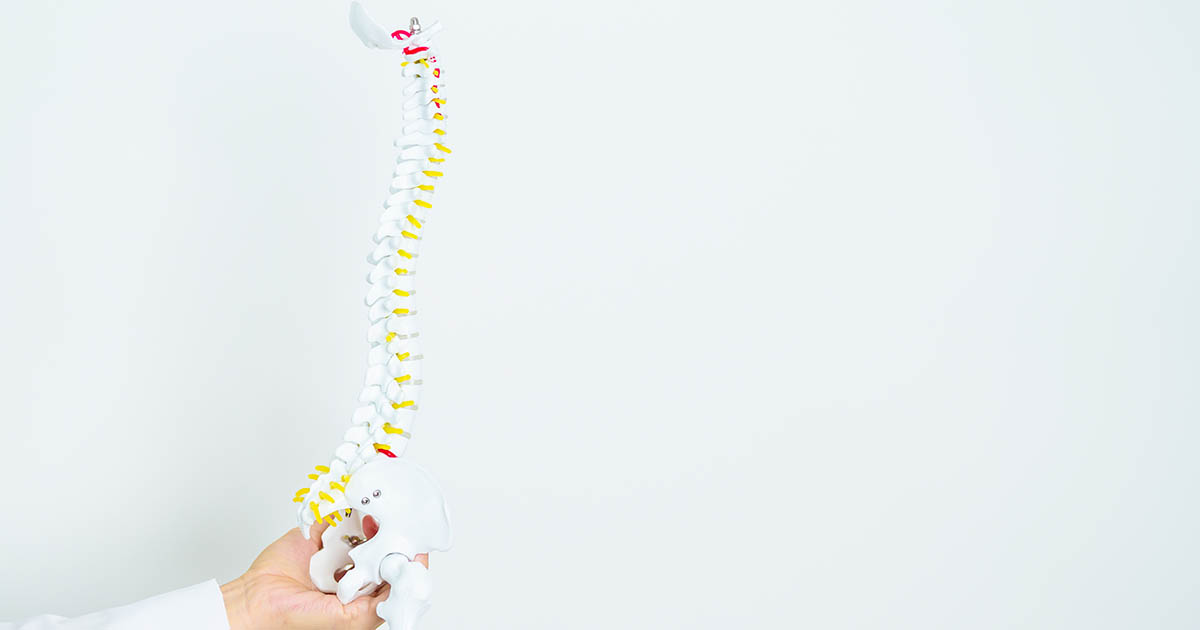
Your spinal discs are not bone. They are cartilage cushions that sit between each vertebra and do three things: absorb shock, allow movement in every direction, and keep the vertebrae from grinding against each other. Each disc has a tough outer ring called the annulus fibrosus and a gel-like center called the nucleus pulposus. The gel is mostly water when you are young. It is what gives your spine its spring.
Discs do not have their own blood supply after childhood. They get nutrients through movement -- compression and decompression during daily activity essentially pump fluid in and out of the tissue. That is why prolonged sitting is genuinely bad for discs: you are not moving, so the disc is not getting fed. Over time, without that fluid exchange, the disc starts to lose water content. It gets thinner. The annulus can develop small cracks. The space between vertebrae narrows on imaging. Radiologists call all of this "degeneration."
None of that is inherently a medical emergency. It is a description of tissue change.
Why Your 30s Is Not Actually That Surprising
Most people assume disc degeneration is a problem that starts in your 50s or 60s. The research says otherwise. Studies using MRI imaging on people with no back pain at all -- zero symptoms, perfectly functional -- found degenerative disc changes in roughly 37 percent of people in their 30s and about 52 percent of 40-year-olds. In your 50s that number climbs past 80 percent.
Read that again: more than one in three people in their 30s already show imaging evidence of disc degeneration, and the majority of them have no significant pain. The disc change shows up on the scan whether it is causing symptoms or not.
An MRI cannot tell your doctor whether your disc degeneration is the cause of your pain. It can only confirm that the degeneration is present. Connecting the finding to your specific symptoms is a clinical judgment -- one that requires a careful physical exam, not just a report.
The Gap Between "Finding" and "Cause"
This is the part that matters most and gets glossed over in most patient conversations. Radiologists report what they see. They are not diagnosing the cause of your pain -- they are describing tissue structure. A report that says "L4-L5 degenerative disc disease with mild foraminal narrowing" means the disc at that level shows wear and the openings where nerves exit the spine are slightly smaller than average. It does not automatically mean those nerves are being compressed. It does not mean the disc is the source of your pain.
Your lower back has a lot of structures that can hurt: facet joints, muscles, tendons, the sacroiliac joint, the disc itself, nerve roots. A good physical exam can distinguish between them in ways an MRI simply cannot. In our Lakewood Ranch office, the first visit involves a full movement assessment, orthopedic testing, and a neurological screen. We want to know where the pain actually comes from before we talk about treatment -- because the source changes everything about the approach.
What Actually Makes Disc Degeneration Painful (and What Does Not)
Disc degeneration becomes symptomatic when the structural changes start to affect surrounding tissue. That happens a few ways:
- Disc bulge or herniation: The outer wall weakens enough that the nucleus pushes outward. If it pushes toward a nerve root, you get the sharp, shooting pain most people associate with a herniated disc -- often radiating into the leg, which is what most people call sciatica.
- Loss of disc height: When the disc thins significantly, the vertebrae above and below move closer together. That can pinch the facet joints and reduce the space in the foramen where nerves pass.
- Instability: A disc that is losing its structural integrity allows more micro-motion at that spinal segment than normal. The muscles around it have to work harder to stabilize the area. That chronic overload is what many patients feel as a dull, persistent ache -- the kind that worsens after a day at a desk.
- Annular tears: Small cracks in the outer ring can be painful on their own, especially during flexion (bending forward). The annulus has nerve endings in its outer layers.
None of these scenarios is automatic. Two people can have identical MRI findings and one has significant pain while the other has none. The difference usually comes down to how the surrounding musculature is functioning, how mobile the adjacent segments are, and whether the structural change is actually touching a nerve.
Why Age 30 to 45 Is the Most Important Window
Here is something worth sitting with. Disc degeneration, once it starts, generally does not reverse. The disc does not re-hydrate. What you can control is whether the degeneration progresses rapidly or slowly -- and whether the changes stay asymptomatic or become a recurring problem.
The 30s and 40s are the window where the choices you make (posture habits, movement consistency, weight management, how you address early symptoms) have the most leverage. Patients who address disc-related back pain early -- before it produces radiculopathy or creates compensatory problems in adjacent segments -- tend to do better than those who wait until the pain is severe or the degeneration has spread to multiple levels.
That is not a scare tactic. It is the pattern Dr. Banman has seen consistently over 23 years of practice. The patients who come in at the first sign of a problem and commit to a plan generally maintain quality of life far better long-term than those who wait for the pain to become unavoidable.
What Conservative Care Actually Addresses
We are not going to tell you conservative care "cures" degenerative disc disease -- it does not reverse disc tissue changes. What it does is meaningful: it reduces mechanical load on the disc, restores mobility to restricted segments, strengthens the musculature that supports the spine, and when there is nerve involvement, can relieve the pressure causing the radicular pain.
At Spine and Wellness Center Lakewood Ranch, the tools we use most often for disc-related back pain include:
- Chiropractic adjustments: Restore proper motion to restricted segments above and below the affected level. When an adjacent level compensates for a stiff disc, it takes on excess load. Adjustments reduce that compensation pattern.
- Non-surgical spinal decompression: A motorized traction system that gently pulls the vertebrae apart, creating negative intradiscal pressure. The goal is to reduce the bulge, take pressure off any irritated nerve root, and allow fluid and nutrients to re-enter the disc. Many patients with L4-L5 or L5-S1 disc problems respond well to a structured decompression series.
- Class IV laser therapy: Accelerates cellular repair in the disc and surrounding soft tissue, reduces inflammation, and is particularly useful when there is an annular tear or significant nerve irritation.
- Targeted rehabilitation: Specific exercises designed to stabilize the lumbar spine without loading the disc in a way that aggravates it. This is different from generic "core strengthening" -- the exercise selection matters based on your specific findings.
For patients whose degeneration is more advanced and who have not responded adequately to conservative care alone, we also coordinate with our regenerative medicine partners in Colombia for options that go beyond what standard chiropractic and decompression can offer. That conversation is usually not the first step -- but it is good to know it exists.
Red Flags That Change the Conversation
Most disc-related back pain, including that tied to degenerative changes, is not an emergency. Some things are. Go to an emergency room or contact your physician immediately if you experience:
- Loss of bladder or bowel control (a potential sign of cauda equina syndrome, which is a surgical emergency)
- Progressive weakness in one or both legs -- not just pain, but the leg giving way or losing grip
- Saddle area numbness (inner thighs, groin, perineum)
- Fever combined with new back pain (can indicate infection)
- Back pain after a significant trauma (fall, collision)
These are not common presentations of degenerative disc disease, but they do occasionally occur with severe disc herniation or other spinal pathology. Dr. Banman will refer to a spine surgeon immediately if any of these flags appear. We do not manage those cases in our office -- and we will be direct with you if we think surgery is the appropriate next step rather than conservative care.
What the First Visit Looks Like
If you come in with an existing MRI, bring it (digital is fine -- DICOM files on a disc or a CD work). Dr. Banman will review it with you. He will also do his own clinical assessment to understand how those findings translate to your functional picture: where you actually hurt, what movements produce symptoms, whether any nerve signs are present.
From that, you get a clear explanation -- not jargon -- of what is going on and what a realistic plan looks like. "Realistic" means we do not promise outcomes we cannot guarantee, but we do tell you honestly what we expect based on what we see and 23 years of working with similar presentations. Most patients with L4-L5 or L5-S1 degeneration who do not yet have significant neurological signs have a good window for conservative care to make a real difference.
For more detail on what the condition involves and the full range of treatment approaches we use, visit our degenerative disc disease page. If you are also dealing with leg pain or sciatica-type symptoms, that page walks through the nerve root involvement that DDD can cause.
Keep reading


Get a clear answer on your MRI
Dr. Banman reviews imaging with every patient and explains exactly what the findings mean for your specific pain picture. Lakewood Ranch and surrounding areas. Call (727) 213-2982 or book online.
Book a visit