

Frozen shoulder is one of the most misunderstood conditions in the musculoskeletal world. Patients often describe it as shoulder pain that started for no apparent reason, gradually got worse, and then stopped getting better no matter what they tried. Some reach out when they can barely raise their arm to get dressed. Others have been living with severe stiffness for 12 to 18 months, having been told to wait it out.
The medical term is adhesive capsulitis. The "capsule" refers to the connective tissue sleeve that wraps around the ball-and-socket joint of the shoulder. When that capsule becomes inflamed, thickened, and scarred, it contracts inward, pulling the joint space tight and reducing range of motion in a predictable, progressive pattern. Understanding why it happens is the first step to actually doing something about it.
What frozen shoulder actually is (and what it is not)
Adhesive capsulitis is not a rotator cuff tear. It is not shoulder impingement. It is not bursitis. Those are all distinct structural problems that can produce similar-sounding symptoms, but the mechanism and the treatment are different.
What distinguishes frozen shoulder from the others is a specific finding on examination: limitation in both active and passive range of motion. Active range of motion is what you can do yourself. Passive range of motion is what the examiner can move the shoulder through with you completely relaxed. In a rotator cuff tear, passive range of motion is often near-normal because the joint itself is unaffected. In frozen shoulder, even passive movement is restricted because the capsule has physically contracted around the joint.
The most restricted motion is typically external rotation (rotating the arm outward) followed by abduction (raising the arm to the side) and finally internal rotation. This specific pattern, called the capsular pattern, is a hallmark of true adhesive capsulitis. When an examiner sees that pattern on exam, the diagnosis is highly likely even before imaging.
Frozen shoulder affects roughly 2 to 5 percent of the general population, with higher rates in adults between 40 and 60 years old. Women are affected more often than men. There is a well-documented association with diabetes (roughly 10 to 20 percent of diabetics develop it), hypothyroidism, and prolonged immobilization of the shoulder after injury or surgery. In many cases, however, no clear trigger is identified.
The three stages most patients do not know about
The reason frozen shoulder is so confusing is that it does not stay the same. It progresses through three stages, each with a different dominant symptom, and the treatment approach that helps in one stage can be counterproductive in another.
Stage 1: Freezing (the painful stage)
The freezing stage typically lasts 6 weeks to 9 months. Pain is the dominant symptom here. It can be severe, constant, and often worse at night (see our related post on shoulder pain that worsens at night for the broader picture of nocturnal shoulder symptoms). Range of motion loss is beginning but may not be the main complaint yet. Patients in this stage often assume the pain will resolve on its own, which is a reasonable assumption for most shoulder complaints. Frozen shoulder does not work that way.
What is happening inside: the synovial membrane lining the joint capsule becomes inflamed. The body responds to the inflammation by laying down fibrous tissue. The capsule starts to lose its normal elasticity. The joint space begins to shrink.
Stage 2: Frozen (the stiff stage)
The frozen stage typically lasts 4 to 6 months. Paradoxically, pain may lessen during this stage, which some patients misinterpret as improvement. Range of motion, however, is at its worst. Patients in this stage often cannot raise the arm above shoulder height, cannot reach behind the back, and cannot rotate the arm outward more than a few degrees. Getting dressed requires workarounds. Sleeping is difficult. Overhead tasks become impossible.
What is happening inside: the fibrous adhesions have matured and the capsule has contracted to near-maximum. The joint volume can decrease from a normal 20 to 30 milliliters to as little as 5 to 10 milliliters. The shoulder is mechanically stuck.
Stage 3: Thawing (the recovery stage)
The thawing stage can last from 6 months to 2 years. Range of motion gradually returns, often unevenly (external rotation tends to return last). Many patients do eventually recover most or all of their motion, but the timeline without active treatment is long, and residual stiffness is common.
The classic teaching is that frozen shoulder is "self-limiting" and resolves on its own in 1 to 3 years. That is technically true for many patients. But waiting 2 to 3 years to use your shoulder normally is not the only option, and for patients with diabetes or severe capsular involvement, spontaneous recovery is less reliable.
Why the shoulder capsule contracts in the first place
The short answer is that we do not fully understand what triggers the initial inflammation in most cases. Several mechanisms have been proposed:
- Autoimmune response: Some research suggests the capsule is attacked by the body's own immune system, similar to how autoimmune conditions affect other connective tissues. This may explain the association with thyroid disease and diabetes, both of which involve immune and metabolic dysregulation.
- Fibroblast overactivity: In adhesive capsulitis, fibroblasts (the cells that produce collagen) become hyperactive and deposit abnormal amounts of fibrous tissue in the capsule. The trigger for this overactivity is not clearly established.
- Cytokine cascade: Elevated levels of inflammatory cytokines (particularly TGF-beta and interleukins) have been found in the capsules of patients with frozen shoulder. These signaling proteins promote further fibrosis, creating a self-reinforcing cycle.
- Immobilization: After any shoulder injury, surgery, or even prolonged disuse (such as arm kept in a sling), the capsule can begin contracting. This is the most clearly mechanical version of the condition.
Understanding the mechanism matters because it guides treatment. If fibrosis is the dominant driver, treatments that disrupt or remodel fibrous tissue, such as shockwave therapy and Class IV laser, become relevant. If inflammation is primary, treatments that down-regulate the inflammatory cascade become the focus.
The most common reasons diagnosis and treatment are delayed
In our Lakewood Ranch practice, patients with frozen shoulder often arrive after having tried several things that did not work. The most common reasons recovery stalls:
Misidentified as a rotator cuff problem
Rotator cuff tears and frozen shoulder can both produce pain with arm elevation. The key difference is passive range of motion on exam. If a provider never checks passive range of motion (only asking you to move the arm yourself), the capsular restriction is easy to miss. Rotator cuff-focused protocols such as specific strengthening exercises can be painful and counterproductive in the freezing stage of adhesive capsulitis, when the capsule is acutely inflamed.
Rest alone
For most musculoskeletal conditions, relative rest helps during acute inflammation. With frozen shoulder, complete rest without any active mobilization tends to accelerate the fibrotic process. The capsule needs gentle, progressive movement to prevent adhesions from maturing. Rest without movement is essentially allowing the scar tissue to set.
Aggressive stretching in the wrong stage
In the thawing stage, progressive stretching is helpful. In the freezing stage, aggressive stretching into pain can drive more inflammation and paradoxically worsen the condition. Stage-appropriate care matters.
Cortisone injection without follow-up care
A corticosteroid injection can reduce the acute inflammatory pain of the freezing stage and buy a window of reduced pain in which to do mobilization work. Research shows it is most effective in the first 6 weeks of the condition. Without active mobilization in the window it creates, the benefit is temporary. Injection alone, without subsequent movement therapy, rarely changes the long-term outcome.
What treatment actually does at each stage
The goal of treatment in the freezing stage is to reduce the inflammatory drive while maintaining what range of motion still exists. In the frozen stage, the goal shifts to gradually remodeling the fibrotic capsule. In the thawing stage, the goal is to accelerate range-of-motion recovery and prevent compensatory patterns from setting in (frozen shoulder commonly drives biomechanical compensation in the neck and thoracic spine, which can then cause secondary symptoms of its own).
The tools we use, depending on stage:
- Chiropractic mobilization: Grade I and II joint mobilization techniques are well-tolerated in the freezing stage and can maintain joint mobility without provoking inflammation. Higher-grade mobilization is more appropriate in the frozen and thawing stages. The goal is not forceful manipulation but graduated, repetitive movement through the available range.
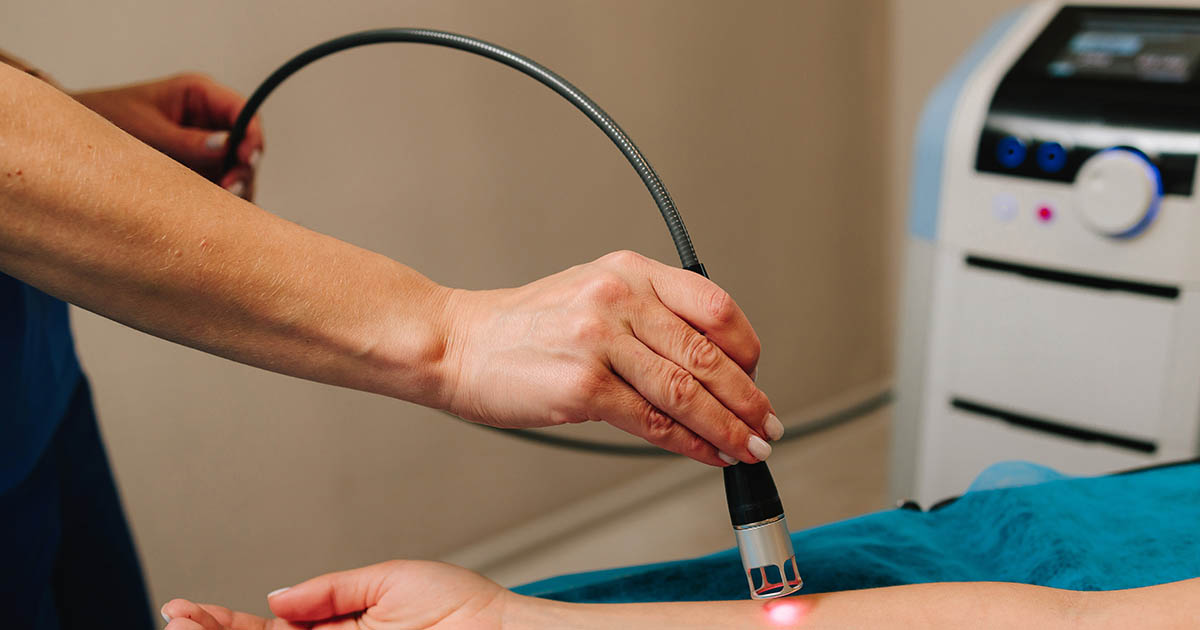
- Class IV laser therapy: Photobiomodulation at therapeutic wavelengths (810 to 980nm) has shown anti-inflammatory and tissue-remodeling effects in controlled studies. We use Class IV laser on the shoulder capsule to reduce the inflammatory cytokine load and support collagen remodeling. For more on how Class IV laser differs from cold laser and how it works, see our post on Class IV laser vs cold laser therapy.
- Shockwave therapy: Acoustic shockwave (both focused radial shockwave and Softwave) has shown effectiveness in adhesive capsulitis in multiple randomized trials. The proposed mechanism includes disruption of calcium deposits, stimulation of neovascularization, and promotion of extracellular matrix remodeling in the capsule. For a detailed comparison of shockwave modalities, see shockwave vs Softwave: what is the real difference.
- Active home exercises: Pendulum swings, cross-body stretches, and external rotation work are taught specifically based on the patient's current stage and pain tolerance. Exercises that were appropriate last month may not be appropriate today if the stage has shifted.
- Hydrodilatation and MUA (specialist referral): In cases that are not responding to conservative care, we coordinate referral to an orthopedic specialist for hydrodilatation (an injection that distends the joint capsule) or manipulation under anesthesia (MUA). These are more invasive options and carry their own risks, but they are worth considering when a patient has been in the frozen stage for 6 or more months without measurable progress.
What to expect from conservative care and realistic timelines
Many patients ask: how long will this take? The honest answer depends on how long the condition has been present, which stage it is in, and whether there are contributing factors like diabetes or a prior shoulder injury.
In the freezing stage, consistent care with laser and mobilization commonly helps pain and range-of-motion loss stabilize within 4 to 8 weeks. Moving a patient from the freezing into the thawing stage earlier than it would happen without intervention is a realistic goal.
In the frozen stage, the recovery arc is longer. Range-of-motion progress tends to be slow and nonlinear: patients often notice improvement in one plane before others return. External rotation is characteristically the last to recover. Many patients in the frozen stage who engage with consistent conservative care see meaningful functional improvement within 3 to 6 months of starting treatment.
The thawing stage often feels like two steps forward, one step back. Progress is real but not every week shows a gain. Patients who have reached near-full range of motion sometimes notice a plateau in the last 10 to 15 degrees of external rotation, which may persist for months. In most cases, this resolves over time with continued home exercise.
When to get evaluated and what we look for
If you have had shoulder pain and stiffness for more than 4 to 6 weeks, an evaluation makes sense. The earlier frozen shoulder is identified and managed, the more likely it is that the worst of the frozen stage can be shortened or avoided.
At our Lakewood Ranch clinic, a shoulder evaluation for suspected frozen shoulder includes:
- Full range-of-motion assessment in all planes (active and passive) with comparison to the unaffected side
- Capsular pattern testing to confirm the diagnosis
- Rotator cuff strength testing and provocation tests to rule out concurrent pathology (rotator cuff tears and frozen shoulder can coexist)
- Cervical and thoracic spine assessment, since the neck often compensates when shoulder motion is restricted
- Discussion of stage, contributing factors (diabetes, prior immobilization, thyroid status if not already evaluated), and what a realistic care plan looks like
Red flags that warrant immediate orthopedic or emergency evaluation rather than conservative care: severe trauma to the shoulder, sudden loss of all active and passive motion after a fall (possible fracture or dislocation), skin changes or constitutional symptoms suggesting infection, or a known history of shoulder cancer or bone metastasis. For those presentations, get to an emergency room or orthopedist first.
For the typical patient: pain and stiffness that have been building gradually over weeks or months without trauma, the picture is almost always amenable to conservative management. You do not have to wait 2 to 3 years for a shoulder that is currently frozen to unfreeze on its own. See our related post on shoulder pain that worsens at night for more on how nighttime shoulder symptoms fit into the broader picture.
If you are in Lakewood Ranch, Bradenton, or Sarasota, call us at (727) 213-2982. We have same-week availability for new shoulder evaluations. Dr. Banman will tell you which stage you are in and what a realistic care plan looks like from there. Learn more about care options at our services page.