
Walk into most chiropractic clinics or physical therapy offices today and you will see laser therapy on the menu. But "laser therapy" covers a wide range. Cold laser, LLLT, Class IV, high-power laser, photobiomodulation: all of these terms describe treatments that use light to reduce pain and inflammation, yet they are not interchangeable. The device type, power output, and tissue depth determine what a laser can actually do in a clinical setting.
This matters for patients because the distinction affects whether a laser is appropriate for a given condition. A cold laser applied to a deep disc injury is not the same clinical tool as a Class IV laser applied to the same target. This post explains the difference in plain language so you can ask better questions and make a more informed decision about your care.
How therapeutic laser works: the common ground
Both cold laser and Class IV laser operate through a process called photobiomodulation (PBM). The laser delivers light in the red to near-infrared spectrum, typically in the range of 600 to 1,000 nanometers in wavelength. When photons at these wavelengths reach biological tissue, they are absorbed by specific proteins inside cells, primarily a mitochondrial enzyme called cytochrome c oxidase.
That absorption triggers a cascade of intracellular events: increased production of ATP (the cell's energy currency), modulation of reactive oxygen species, changes in membrane potential, and downstream shifts in gene expression that influence inflammation and tissue repair. The practical result, when dosing is appropriate, is reduced local inflammation, accelerated tissue remodeling, and in some cases reduced nerve pain signaling.
Neither type uses ionizing radiation or UV light. Neither "burns" tissue at correct therapeutic doses. The mechanism is biochemical stimulation, not thermal destruction. The difference between the two types is entirely about power and penetration.
What "cold laser" actually means
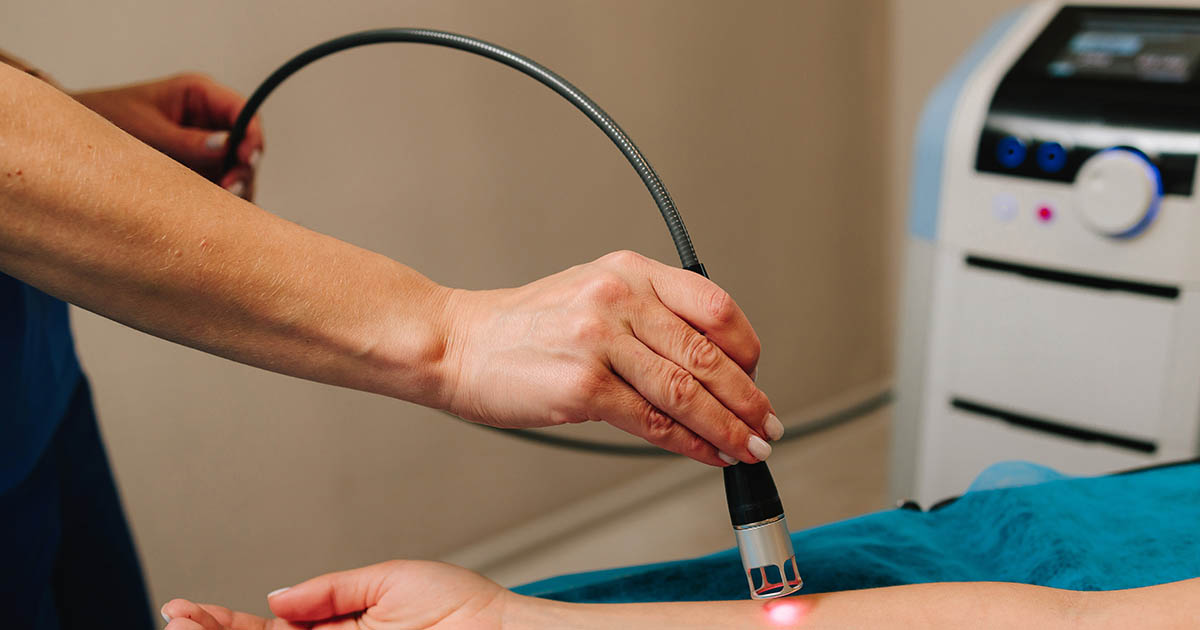
Cold laser goes by several names: Low Level Laser Therapy (LLLT), soft laser, or Class IIIB laser. The "cold" descriptor reflects its power range: typical devices output between 1 and 500 milliwatts. At these levels, the laser does not generate perceptible warmth in the tissue being treated, which is how the name originated.
Cold laser technology has a substantial research history spanning several decades. Multiple systematic reviews and meta-analyses have found statistically significant benefits for neck pain, lateral epicondylalgia (tennis elbow), and certain surface-level wound-healing applications. Cochrane reviews examining LLLT for musculoskeletal conditions generally support its use over sham treatment for appropriate indications.
The clinical ceiling for cold laser is tissue depth. At 1 to 500 milliwatts, meaningful photon density in human tissue drops off sharply after roughly 1 to 3 centimeters, depending on the wavelength, the water content of the tissue, and skin pigmentation (darker pigmentation absorbs more photons superficially). That is sufficient depth to reach superficial tendons, trigger points in thin muscles, small joint capsules near the surface, and skin wounds. It is not sufficient to reliably reach a lumbar disc, deep paraspinal musculature, or peripheral nerve tissue in the lower leg or foot.
What Class IV laser actually means
Class IV is an FDA classification for laser devices that output more than 500 milliwatts. Therapeutic Class IV units used in clinical settings typically range from 5 to 15 watts or higher, with both continuous-wave and pulsed-mode options depending on the clinical target. Some units used in chiropractic and sports medicine practices operate in the 10 to 15 watt range.
The higher power changes several things. First and most importantly, tissue penetration increases substantially. Research examining photon delivery at depth indicates that Class IV wavelengths can deliver meaningful energy to tissues 4 to 7 centimeters below the surface under appropriate conditions. That puts structures like the lumbar disc periphery, deep paraspinals, the rotator cuff beneath the deltoid muscle, and peripheral nerve tissue in the lower extremities within range. Cold laser at its upper end does not reach these depths reliably.
Second, higher power shortens treatment time. Because energy delivery (measured in joules) is power multiplied by time, a device operating at 10 watts can deliver the same energy dose in roughly 1/20th the time of a 500 mW device. Sessions that would run 25 to 30 minutes with cold laser can deliver equivalent dosing in 5 to 8 minutes with Class IV equipment.
Third, Class IV laser produces a warmth sensation in the treatment area. The probe is kept moving continuously to prevent localized tissue heating, but patients typically feel mild, comfortable warmth during treatment. That warmth is a sign that photons are being absorbed and converted to heat at rates perceptible by superficial nerve endings. It is not a burn risk when the operator follows protocol.
More power is not automatically better therapy. The goal is delivering the right energy dose to the right tissue depth. Class IV laser reaches structures that cold laser cannot, but that only matters when the condition you are treating involves those deep structures.
The clinical differences that actually matter
Here is a direct comparison across the dimensions that affect your care:
- Depth of penetration: Cold laser reaches 1 to 3 cm; Class IV reaches 4 to 7 cm or more depending on wavelength and tissue.
- Power output: Cold laser runs 1 to 500 mW; Class IV runs 500 mW to 15+ watts.
- Treatment time per area: Cold laser typically 10 to 30 minutes; Class IV typically 4 to 8 minutes for equivalent dosing.
- Patient sensation: Cold laser produces no perceptible warmth; Class IV produces mild to moderate warmth.
- Tissue targets: Cold laser suits surface tendons, trigger points, wounds, shallow joint structures; Class IV suits discs, deep muscles, peripheral nerves, rotator cuff, knee joint.
- Eye safety protocol: Both require wavelength-appropriate protective eyewear for patient and clinician; Class IV protocols are stricter due to higher power.
- Home device availability: Consumer and home-use laser devices are almost always cold laser (Class IIIB or weaker); Class IV devices require professional operation.
When cold laser still makes sense
Cold laser remains appropriate in several specific scenarios. Patients with hypersensitivity to warmth or who cannot tolerate the mild heat of Class IV treatment may do better with low-power protocols. Surface-level conditions, such as a fresh soft-tissue abrasion, a superficial surgical scar, or trigger points in a thin muscle like the upper trapezius near the surface, are well within cold laser's effective depth range.
Post-surgical applications near sensitive structures where the clinician needs precise, low-energy delivery also tend to favor cold laser. And for patients treating themselves at home with over-the-counter devices, those products are almost universally in the cold laser range, which is why their results are more limited and slower than clinical treatment.
The point is not that cold laser is ineffective. For surface-level conditions it is evidence-supported and clinically useful. The problem only arises when it is applied to conditions that require deeper tissue reach and the clinician or patient does not recognize the mismatch.
Conditions where Class IV is the primary choice at our clinic
At Spine and Wellness Center Lakewood Ranch, we use Class IV laser as part of structured care plans for several categories of conditions where tissue depth is the deciding factor:
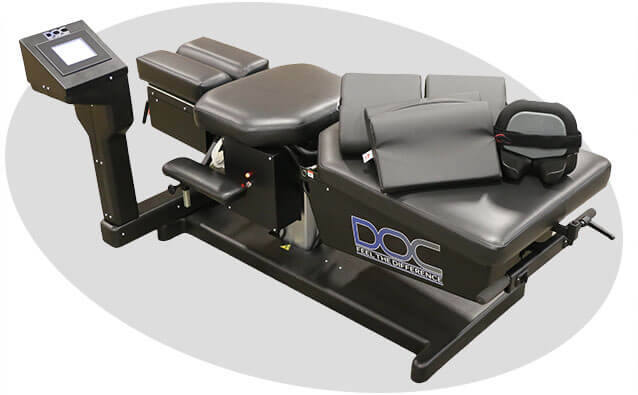
Disc-related low back and neck pain. The annulus fibrosus and surrounding periannular tissue sit several centimeters deep in the lumbar region. Cold laser does not consistently reach this depth. Class IV laser aimed at the appropriate spinal levels can contribute to reducing the periannular inflammatory environment that amplifies disc pain. We often combine this with spinal decompression therapy, which unloads disc pressure while the laser addresses the surrounding soft-tissue inflammation. The two approaches complement each other mechanically.
Peripheral neuropathy. Nerve tissue in the lower legs and feet sits under multiple layers of skin, subcutaneous fat, and fascia. For patients in our neuropathy program, Class IV laser is one of several tools targeting the peripheral nerve tissue at depth, alongside electrical stimulation and nutritional support. The goal is to reduce nerve inflammation and support whatever healing capacity the nerve retains.
Rotator cuff tendinopathy. The supraspinatus tendon in a typical adult sits beneath the deltoid muscle, placing it 3 to 4 centimeters below the skin surface. Class IV laser can reach that depth in most patients where cold laser falls short.
Chronic muscle spasm in deep paraspinals. The multifidus and erector spinae groups that stabilize the lumbar spine sit 3 to 5 centimeters below the skin in many patients. Persistent spasm in these muscles is a major driver of chronic low back pain, and laser at depth is one tool that can reduce the local inflammatory and ischemic component driving that spasm. Learn more about how these cases are evaluated on our back pain page.
What the research actually shows
The honest picture is that both types have supporting evidence, and neither is a reliable standalone treatment for structural pathology. LLLT (cold laser) has the larger body of literature simply because it has been in clinical use longer. For neck pain, lateral epicondylalgia, and certain wound-healing applications, the evidence quality is reasonable. For other conditions, results are mixed, partly because "cold laser" covers a huge range of devices, wavelengths, dosing protocols, and clinical populations.
Class IV laser has a smaller but growing body of clinical research. The biological mechanism is identical to LLLT, so the question is primarily about optimal dosing for different tissue depths, which is an area of active investigation. Some practitioners in the integrative medicine and sports medicine space have published positive outcome data for high-power laser in musculoskeletal conditions, but large-scale randomized controlled trials remain limited.
Neither type of laser resolves structural damage. A herniated disc does not rehydrate because of laser therapy. A peripheral nerve with severe axonal loss does not regenerate fully. What laser can do is reduce the inflammatory load around those structures, create conditions more favorable to the body's own repair processes, and in some patients reduce pain significantly as part of a broader care plan. That is a meaningful contribution, but it has to be framed correctly.
Red flags in how laser therapy is sometimes marketed
Laser therapy has attracted some overblown marketing claims. Here is how to recognize them. If a provider or advertisement says laser will "cure" your neuropathy, "fix" your disc herniation, or "eliminate" your chronic pain with certainty, that is not supported by the clinical evidence. If a clinic is billing entirely around laser with no evaluation, no diagnosis, and no broader care plan, that is a concern regardless of which type they use.
Legitimate laser therapy looks like this: a thorough intake exam identifies the specific structures involved, a diagnosis or working diagnosis is formed, and laser is incorporated as one component of a multi-modality plan with defined goals, a reasonable time horizon, and re-evaluation built in. Response varies between patients. Some see significant improvement in a few sessions. Others require more time. And in some cases, laser is not the most appropriate tool for the condition at hand. An honest provider will tell you all of this upfront.
How we approach it at Spine and Wellness Center
Our Class IV laser is one tool in a broader clinical toolkit. Dr. Banman (DC, 23+ years of practice) evaluates each patient to determine whether laser is appropriate, which tissue targets are relevant, and what protocol parameters make sense given the diagnosis. For patients with disc involvement, laser is often part of the same care block as spinal decompression. For neuropathy patients, it is part of a multi-modal program that includes electrical stimulation and lifestyle guidance. For acute soft-tissue injuries, it is sometimes used early in care to reduce initial inflammation and accelerate recovery.
We also explain to patients what laser will and will not do. If your case involves structural damage that laser cannot reverse, we say so. The goal is getting you functionally better, which sometimes means combining tools rather than relying on any single one. Our Class IV laser therapy page covers more detail on how we use it and who it is most likely to help.
If you are in the Lakewood Ranch, Bradenton, or Sarasota area and you have questions about whether laser therapy fits your situation, call us at (727) 213-2982 or book a consultation at celluron.janeapp.com. The first step is always a proper evaluation so the right tools go to the right problem.