

If you have been told your knee needs a cortisone shot, a scope, or a replacement, you may not have heard the full list of options. Knee decompression is a non-surgical, in-office therapy that mechanically unloads the joint using computer-controlled distraction force. It is one of the more underutilized tools in conservative knee care, and a meaningful number of patients who go through a full course avoid more invasive procedures altogether, at least for several years.
This post covers how it works, who tends to respond well, what it does not fix, and what evaluation and treatment look like at our Lakewood Ranch clinic.
What Is Knee Decompression?
Knee decompression is the application of gentle, controlled traction force to the knee joint. The goal is to create a brief period of negative pressure inside the joint space, which does several things at once: it reduces compressive load on cartilage, improves synovial fluid circulation, and creates a pumping effect that draws nutrients into tissue that has limited direct blood supply.
The same principle drives spinal decompression therapy, which has been used for disc-related back and neck pain for decades. The spine and the knee share a common mechanical problem: weight-bearing joints under chronic compression receive less fluid exchange, which slows cartilage repair and lets inflammatory byproducts accumulate. Distraction interrupts that cycle.
In practice, knee decompression uses a device that attaches just above and below the joint, applies a programmed traction force for a set duration (typically 8 to 15 minutes per session), then releases. The patient reclines comfortably. The device cycles through hold and release phases rather than maintaining constant pull, which is thought to produce the pumping effect more reliably than static traction alone.
The Mechanical Logic: Why Unloading the Joint Matters
Knee cartilage does not have its own blood supply. It receives nutrients through diffusion from synovial fluid, which bathes the joint surfaces. Normal motion and load cycling help drive that diffusion. The problem is that damaged or inflamed cartilage changes the mechanical environment of the joint: swelling increases intra-articular pressure, pain limits motion, and the altered mechanics concentrate load at specific contact zones that then wear faster.
Think of cartilage the way you would think of a dense sponge. When you compress a sponge and release it, fluid moves through it. Chronic compression without adequate release, which is what happens in a joint with limited range of motion, restricted gait, or persistent effusion, starves the cartilage of the fluid exchange it needs to maintain itself.
Decompression creates a temporary reduction in pressure that draws synovial fluid into the joint space, pulls the articular surfaces slightly apart, and gives the cartilage an opportunity to rehydrate and exchange waste products. Whether that translates to durable improvement depends heavily on how much structural change has already occurred and what else is being done alongside the decompression sessions.
Knee decompression is not a cure for severe osteoarthritis or structural joint damage. It is a tool for improving the mechanical and biochemical environment inside the joint so that other healing processes can do their job more effectively.
Who Tends to Respond Well
Knee decompression is not appropriate for every knee complaint. In our clinical experience, patients who tend to respond most favorably share several characteristics:
- Mild to moderate knee osteoarthritis (grades 1 to 3): Patients with early to moderate joint space narrowing often report meaningful reductions in daily pain and improved range of motion within 8 to 12 sessions. Grade 4 (bone-on-bone with deformity) cases tend to respond less predictably, though some still benefit from the combined therapies used alongside decompression.
- Post-surgical knee patients with persistent pain: Patients who have had a partial meniscectomy, ACL repair, or other knee procedure and continue experiencing pain and stiffness months after surgery sometimes respond well to decompression combined with laser therapy and progressive loading protocols.
- Knee pain that worsens with prolonged weight-bearing: If your knee feels progressively worse after standing for extended periods or at the end of the day, that pattern points to compressive load accumulation. Decompression addresses that mechanism directly.
- Patients who have not responded well to cortisone: Cortisone reduces inflammation temporarily but does nothing for the mechanical load distribution inside the joint. Patients who get 4 to 6 weeks of relief from an injection and then return to baseline pain are often good candidates for a mechanical approach.
- Patients trying to delay or avoid surgery: This is the most common reason patients come to us for knee decompression. Many are appropriate surgical candidates but want to explore conservative options first. For grades 1 to 3 osteoarthritis without significant structural instability, that is a reasonable clinical choice and one worth fully exploring.
What Knee Decompression Does Not Do
Honest patient education matters here because the internet is full of inflated claims about conservative therapies. Knee decompression does not regrow cartilage. It does not reverse bone-on-bone degeneration. It does not repair torn ligaments or menisci. It does not prevent future arthritis progression once the structural changes that drive that progression are already established.
It is a tool for managing the mechanical and biochemical environment of the joint, reducing symptom burden, and potentially slowing the rate at which things worsen. Many patients use it as part of a longer-term management plan rather than as a one-time fix. That framing matters: patients who expect a permanent cure from any conservative therapy tend to be disappointed; patients who expect meaningful, sustained symptom reduction and extended time before considering surgery tend to be satisfied.
Patients who are candidates for total knee replacement due to severe bone-on-bone arthritis with significant deformity should have that conversation with an orthopedic surgeon. We do not discourage surgical consultations. What we offer is an evidence-informed conservative option that some patients prefer to explore before committing to surgery, and a documented care course that gives the surgeon useful context about what conservative management has already been tried.
How Knee Decompression Compares to Cortisone Injections
Cortisone injections reduce synovial inflammation quickly. For patients in acute flares, they can be genuinely useful for lowering pain to a level where rehabilitation can begin. The limitation is duration: most patients get 4 to 8 weeks of relief before symptoms return, and each subsequent injection tends to provide a shorter window.
More importantly, repeated cortisone injections are associated with accelerated cartilage breakdown over time. Most orthopedic guidelines now recommend limiting knee cortisone to 3 to 4 injections per year, and many specialists recommend fewer.
Knee decompression carries no such tissue-damaging risk. The treatment does not involve needles, medications, or systemic effects. It can be performed as often as needed within a clinical program without the cartilage toxicity concern that limits cortisone use.
The tradeoff is onset speed. Cortisone works within days. Decompression effects tend to build over 2 to 4 weeks of consistent treatment. For patients in severe acute pain, the clinical sequence often makes sense: cortisone first to reduce pain to a workable level, then decompression-based therapy to address the underlying mechanical problem that the cortisone does not touch.
Combining Knee Decompression With Other Therapies
At our Lakewood Ranch clinic, knee decompression is rarely done in isolation. In most cases it is part of a multi-therapy plan that addresses the joint from several angles at once:
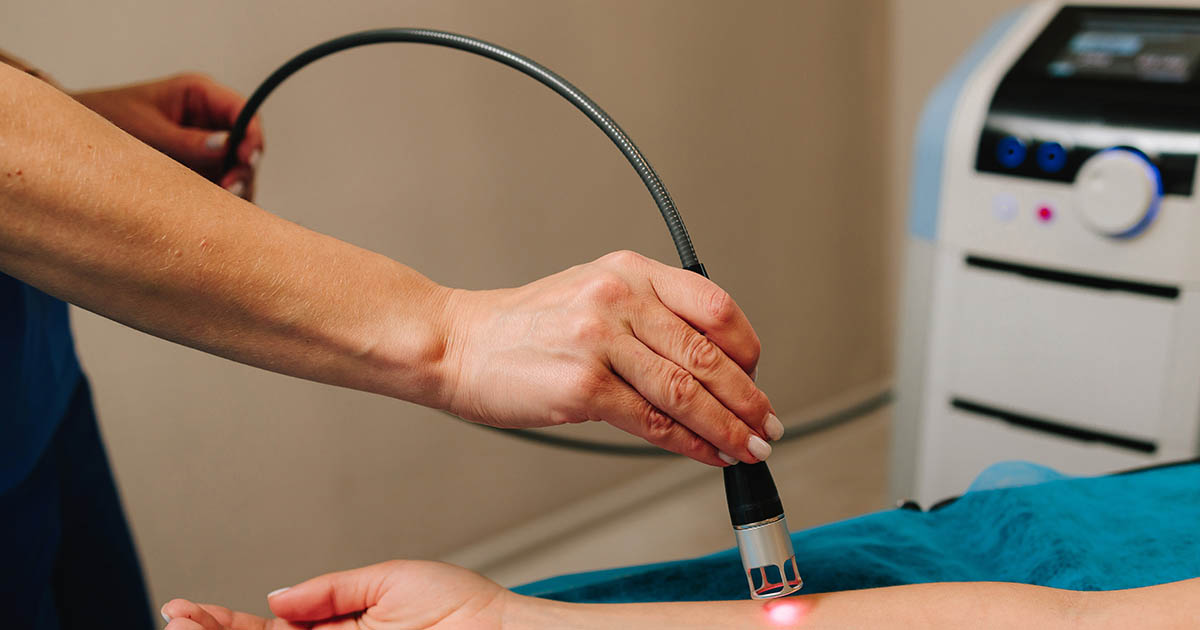
- Class IV laser therapy: Applied to the knee before or after decompression, Class IV laser reduces synovial inflammation and promotes tissue repair at the cellular level. The two work well together: decompression creates the fluid environment and the laser supports the repair processes running inside it.
- Shockwave or Softwave therapy: For knee tendinopathies (patellar tendinopathy, IT band syndrome, pes anserine bursitis) that accompany joint degeneration, acoustic wave therapy addresses the periarticular soft tissue while decompression addresses the joint space itself.
- EMS (electrical muscle stimulation): The quadriceps and vastus medialis are frequently inhibited in chronic knee pain patients. EMS re-recruits these muscles and improves dynamic joint stability, which makes decompression gains more durable over time.
- Chiropractic assessment of gait and hip mechanics: Knee loading is downstream of hip alignment and foot mechanics. Patients with chronic unilateral knee degeneration almost always have altered gait patterns that concentrate load on specific joint zones. Addressing those patterns is part of why isolated knee treatment often fails to hold.
For patients with more advanced degeneration, or pain that has failed all conservative approaches, our clinic also coordinates with the regenerative medicine program we offer through our Colombia partnership. That page covers what those protocols involve and who tends to benefit.
The Evaluation Process
Not every patient with knee pain is a candidate for decompression, and not every candidate gets the same program. The evaluation process matters.
At our clinic, a knee evaluation with Dr. Banman covers the following:
- Orthopedic testing: Assessment of ligament stability, meniscal integrity, patellar tracking, and range of motion to rule out conditions where decompression is contraindicated (active joint infection, recent fracture, severe instability requiring surgical stabilization).
- Imaging review: If you have recent X-rays or MRI, we review them together at the visit. If you do not have imaging and the clinical picture warrants it, we can facilitate a referral. Most grade 1 to 3 osteoarthritis cases do not require MRI before beginning a conservative program.
- Gait and biomechanical assessment: We examine how you load the knee through the gait cycle and during functional movements such as squatting and stair descent. This shapes the exercise and muscle activation component of the program and identifies any upstream contributors from the hip or foot.
- Goal alignment: The plan for a 45-year-old who wants to return to pickleball looks different from the plan for a 70-year-old whose goal is walking comfortably around the neighborhood. We build the program around realistic functional goals, not just pain scores.
See our conditions page for a broader overview of what we evaluate and treat, or review the spinal decompression page for a detailed mechanical breakdown of how distraction-based therapy works. The principles transfer directly to the knee.
What to Expect From a Course of Treatment
A typical initial course of knee decompression is 12 to 18 sessions over 4 to 6 weeks, combined with laser therapy and targeted exercise as appropriate. Most patients notice meaningful changes in the 8 to 12 session range. Some feel improvement in the first 3 to 4 sessions. A small percentage do not respond and are referred for orthopedic consultation.
After the initial course, many patients shift to a maintenance schedule (monthly or quarterly) that keeps the joint environment stable. Others manage with progressive exercise and lifestyle modifications and return only when symptoms flare.
Realistic expectations: the goal is reduced daily pain, improved functional range of motion, and extended time before more invasive intervention is needed. For many patients living with moderate knee osteoarthritis, those outcomes represent a meaningful quality-of-life gain even when they fall short of a complete resolution.
If you have been living with knee pain in the Lakewood Ranch, Bradenton, or Sarasota area and have not yet explored a conservative, mechanical approach, a comprehensive evaluation is the right first step. Call our office or book online below.