
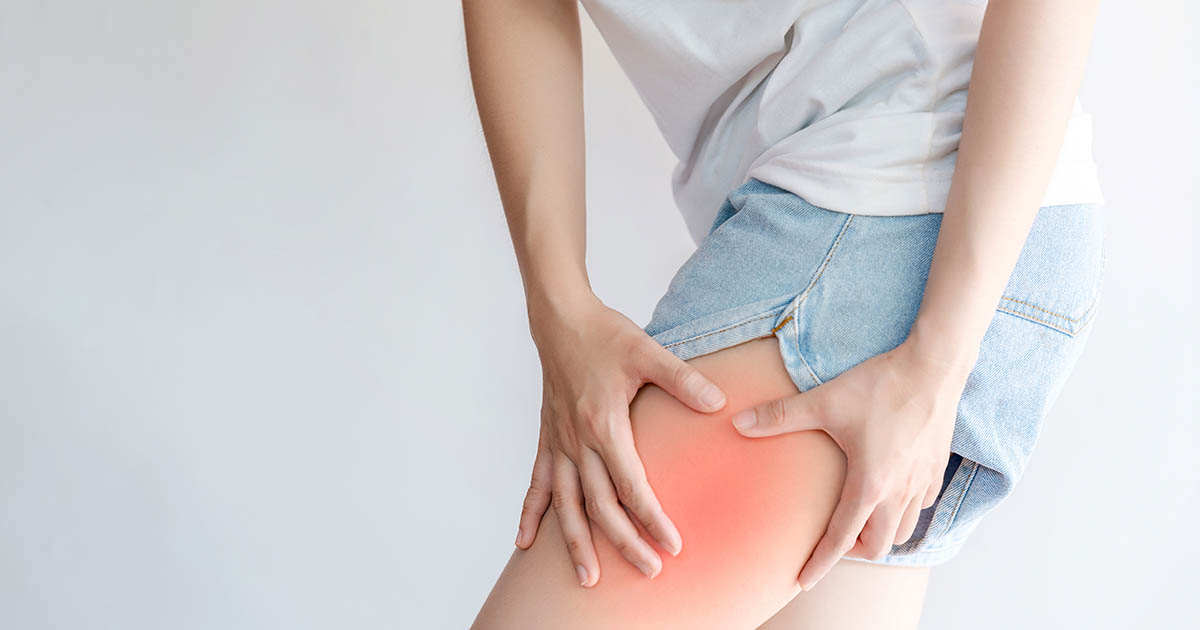
The sensation is hard to explain to someone who hasn't had it. A patch on the outer thigh, roughly the size of your palm, that burns when fabric touches it, goes numb when you stand for a few minutes, or tingles when you sit for too long. You assume it's a pulled muscle, or maybe a pinched nerve in your back. You stretch it, ice it, and wait. It does not go away.
If that description matches your experience, the likely explanation is a condition most people have never heard of: meralgia paresthetica. It is not a disc problem. It is not a hip muscle problem. It is a compression of one specific nerve, the lateral femoral cutaneous nerve (LFCN), that supplies sensation to the outer thigh. Understanding where that nerve runs and why it gets compressed tells you exactly what makes the symptoms appear, what makes them disappear, and what to do about them.
At our Lakewood Ranch clinic, we see meralgia paresthetica most often in the summer months, and this post explains why. We also see it in patients who were told it was sciatica, hip pain, or IT band syndrome, when the evaluation was never actually targeting this nerve. Correct identification changes the whole approach to care.
If you are dealing with outer thigh neuropathy symptoms, our neuropathy evaluation and treatment program at Spine and Wellness Center Lakewood Ranch is designed to identify the exact nerve involved and build a plan around it.
What meralgia paresthetica actually is
Meralgia paresthetica (meh-RAL-jee-ah par-es-THET-ih-kah) is a mononeuropathy: a condition affecting a single nerve. The nerve in question, the lateral femoral cutaneous nerve, is a pure sensory nerve. It carries no motor signals. That is a key clinical point. Meralgia paresthetica causes no muscle weakness, no reflex changes, and no power loss. It only affects sensation in a specific zone of the outer thigh.
That sensory zone typically runs from just below the hip on the outer thigh down to roughly mid-thigh level, stopping well before the knee. Patients describe the sensation as:
- Burning or heat on the outer thigh (especially with standing or walking)
- Numbness or a "dead" patch that you can still feel pressure through, but not light touch
- Tingling or a "pins and needles" feeling after sitting
- Hypersensitivity, where the sensation of clothing or a light touch is uncomfortable or painful
- Symptoms that are often worse at the end of the day and better first thing in the morning
The condition was first described in medical literature in the late 1800s. Despite a long track record, it is consistently underdiagnosed in primary care settings because the nerve is not routinely tested in a standard neurological exam and because the symptom location overlaps with hip pain, IT band syndrome, and even lumbar radiculopathy.
Where the lateral femoral cutaneous nerve runs (and where it gets stuck)
The LFCN originates from the lumbar plexus, branching off the L2 and L3 nerve roots. It travels across the iliacus muscle (the large hip flexor that connects your pelvis to your femur), then passes under or through the inguinal ligament at the front of the hip. From there it descends into the thigh, usually just inside the front hip bone (the anterior superior iliac spine, or ASIS).
That passage under the inguinal ligament is where the nerve is most vulnerable. The ligament is taut and inflexible. Anything that increases pressure on that ligament from above or compresses the surrounding tissue can trap the nerve and reduce its blood supply. Reduced blood supply to a nerve translates almost immediately into the sensory symptoms patients feel.
The LFCN is a pure sensory nerve with no motor function, which means meralgia paresthetica never causes muscle weakness. If your outer thigh symptoms come with leg weakness or a change in your knee reflex, the driver is more likely a lumbar disc or the femoral nerve itself, not the LFCN.
The nerve has significant anatomical variation from person to person. In some individuals it passes through a small notch in the ASIS. In others it travels deeper through muscle. This variability is part of why symptoms can vary in intensity and exact location between patients with the same underlying problem.
Why Florida summers make it worse
In 23 years of practice, the pattern is consistent: meralgia paresthetica complaints peak in late spring and summer in Lakewood Ranch. Several factors converge this time of year.
Tight waistbands on summer clothing
Swimsuit bottoms, board shorts with rigid waistbands, tight athletic shorts, and fitted summer pants all compress the inguinal ligament and the tissue around the LFCN. A waistband that sits slightly below the navel and is snug enough to leave a mark on your skin is compressing exactly the right territory to irritate this nerve. This is one of the most common triggers we see, and removing that compression often produces noticeable symptom reduction within days.
More time sitting in beach and pool chairs
Low beach chairs and reclined pool loungers flex the hip into a position that shortens the hip flexor muscles and increases tension on the inguinal ligament. Spend two hours in that position and the LFCN is under sustained pressure. Stand up, and the burning starts.
Weight fluctuation
Summer tends to bring changes in hydration, activity, and eating patterns. Even modest weight gain around the abdomen increases intra-abdominal pressure and the mechanical load on the inguinal ligament. Florida heat also causes fluid retention in some patients, which has the same effect.
Longer walks on uneven surfaces
Beach walking, hiking on trails, and walking on soft grass at outdoor events all alter gait mechanics in ways that increase torsional stress on the hip. Any position that repeatedly extends or externally rotates the hip while the inguinal ligament is under tension can compress the LFCN.
How to tell meralgia paresthetica apart from sciatica, hip pain, and IT band syndrome
This is where patients most often get stuck. The outer thigh is the overlap zone for several conditions, and the symptom descriptions are close enough that patients and providers frequently confuse them.
vs. Sciatica
Sciatica originates in the lumbar spine, usually from a disc compressing the L4, L5, or S1 nerve root. It typically travels down the posterior (back) of the thigh, through the calf, and into the foot. The outer thigh is not the primary territory of any of those nerve roots. If your symptoms are limited to the outer thigh with no calf, foot, or posterior leg involvement, you are probably not dealing with a disc-driven sciatic problem. For more on how nerve compression from the spine presents, see our sciatica page.
vs. Hip osteoarthritis
Hip OA produces pain in the groin, the front of the hip, and sometimes the lateral hip with weight-bearing. The pain is typically deep and achy, worsens with hip rotation (especially internal rotation), and is associated with a reduced range of hip motion. Meralgia paresthetica produces a superficial burning or numb sensation, does not reduce hip range of motion, and is not provoked by rotating the hip. X-ray of the hip joint in a patient with meralgia paresthetica is typically normal or age-appropriate, not showing the joint-space narrowing of arthritis.
vs. IT band syndrome
IT band syndrome causes lateral knee pain or outer thigh discomfort that appears during or immediately after running, cycling, or repeated knee flexion. The pain is typically below mid-thigh, concentrates at the lateral femoral condyle (just above the outer knee), and responds to foam rolling and activity modification. Meralgia paresthetica symptoms appear higher on the thigh, closer to the hip, and are triggered by standing or wearing tight clothing, not by knee mechanics.
vs. Greater trochanteric bursitis
Bursitis at the greater trochanter (the bony prominence on the outer hip) causes point tenderness directly on that prominence, aching with lying on the affected side, and pain with resisted hip abduction. Meralgia paresthetica is not tender at that specific point and does not worsen with hip abduction exercises.
The clinical test that most directly identifies LFCN involvement is the pelvic compression test: the examiner applies firm pressure to the iliac crest while the patient lies on their side. In meralgia paresthetica, this briefly decompresses the nerve tunnel and reduces symptoms temporarily. A positive response is highly specific for this diagnosis.
Who is most at risk
Meralgia paresthetica follows recognizable patterns. In our clinic, the presentations that come up most consistently include:
- Patients who gained weight around the abdomen (even 10 to 15 pounds can shift enough intra-abdominal pressure onto the inguinal ligament to compress the nerve)
- Pregnant patients (the growing uterus directly increases pressure on the pelvic ligaments; symptoms often resolve after delivery)
- Patients who stand at work for long shifts (nurses, teachers, retail workers)
- Construction and landscaping workers who repeatedly crouch or kneel with a tool belt around the hip
- Cyclists, especially road cyclists who spend hours in a hip-flexed position with tight cycling shorts compressing the hip crease
- Patients who recently had orthopedic or abdominal surgery, where retraction during the procedure or post-surgical swelling irritated the nerve
- Diabetic patients, where the nerve may be more susceptible to compression due to pre-existing peripheral nerve vulnerability
Patients with underlying peripheral neuropathy from diabetes, chemotherapy, or other causes deserve careful evaluation because they may have both conditions present at once, and treating the LFCN compression without also addressing the background neuropathy will produce incomplete results.
What evaluation and conservative care look like
A proper evaluation for suspected meralgia paresthetica includes:
- Detailed symptom mapping to confirm the outer thigh distribution
- Sensory testing (light touch, pinprick, temperature differentiation in the affected zone)
- Hip range of motion assessment to rule out hip joint pathology
- Pelvic compression test and ASIS palpation
- Assessment of waistband habits, work posture, and recent weight changes
- Lumbar screening to rule out L2 or L3 radiculopathy as a contributing or primary driver
In most cases, meralgia paresthetica responds well to conservative care. The approach depends on what is driving the compression, but commonly includes:
Mechanical decompression first
This means addressing whatever is externally compressing the nerve: switching to looser-waisted clothing, adjusting workstation height, modifying seated position, or temporarily reducing the activity pattern that provoked the flare. This step alone produces meaningful improvement in many patients within 2 to 4 weeks. It is not glamorous, but it works.
Soft tissue and nerve mobilization
The iliacus muscle and the psoas (together forming the iliopsoas) run directly adjacent to the LFCN pathway. When those muscles are chronically tight from prolonged sitting or hip-flexed postures, they contribute to the compression dynamic. Targeted soft tissue work addressing the iliopsoas and inguinal region reduces mechanical tension on the nerve tunnel. This is different from general hip flexor stretching and requires precision.
Addressing lumbar involvement
Because the LFCN branches from L2 and L3, lumbar function matters. If there is concurrent facet joint restriction at L2-L3 or early disc involvement at that level, it can sensitize the nerve and make LFCN compression more symptomatic than it would otherwise be. Chiropractic care addressing lumbar joint mobility at those segments reduces this upstream contribution to the problem.
Nerve support for stubborn cases
When symptoms have persisted for several months, the LFCN itself may have developed axonal irritability beyond simple mechanical compression. In these cases, neuromuscular electrical stimulation (EMS) and photobiomodulation (class IV laser) can calm the nerve and support recovery. These are tools we use in our neuropathy program for peripheral nerve conditions when conservative mechanical approaches alone are not enough.
When to seek care sooner rather than later
Meralgia paresthetica is rarely dangerous, but there are presentations that warrant faster evaluation. Seek care promptly if:
- Symptoms appeared suddenly after abdominal surgery, hip surgery, or a procedure involving the inguinal area
- The numb area is expanding beyond the typical outer thigh zone
- You have developed any leg weakness or changes in your walking pattern alongside the sensory symptoms (those are not features of meralgia paresthetica and suggest a different, more serious problem)
- Symptoms have been present for more than 8 weeks without any improvement
- You have diabetes and are noticing new peripheral symptoms in any extremity
For the majority of patients we evaluate, the history, the sensory exam, and the clinical provocation tests are sufficient to identify meralgia paresthetica and rule out the conditions it mimics. Electrodiagnostic testing (EMG/nerve conduction) can confirm the diagnosis but is usually reserved for cases where the clinical picture is ambiguous or when symptoms are not responding to initial care.
If the outer thigh symptoms have been bothering you for weeks and you are in the Lakewood Ranch, Bradenton, or Sarasota area, this is a straightforward condition to evaluate. Dr. Banman has 23 years of clinical experience with peripheral nerve presentations and will tell you clearly whether what you are dealing with is meralgia paresthetica, a lumbar nerve root problem, or something else. The exam is not long and the direction it gives you is specific. For a broader look at how we approach nerve pain, visit our neuropathy program page.