

The Lakewood Ranch and greater Sarasota-Bradenton area has one of the fastest-growing Spanish-speaking populations in Florida. And yet, when something goes wrong with your spine, your neck, or your nerves, navigating that care in a second language is genuinely hard. Not just inconvenient. Hard in a way that affects the quality of your diagnosis and the outcome of your treatment.
At Spine and Wellness Center Lakewood Ranch, Dr. Michael Banman speaks Spanish. Not conversational Spanish for pleasantries. Clinical Spanish: the kind you need to describe where the pain is, what it feels like, when it started, whether it radiates, whether it is worse in the morning or at night, and what you have already tried. That distinction matters more than most people realize, and this post explains why.
Why Language Matters More Than You Think in Spine Care
Spine and nerve conditions are inherently subjective. Pain is not something a provider can measure directly. What they can do is listen carefully to what you describe, map that description onto known patterns, and use it to guide the physical examination toward the most likely structures involved. That process depends almost entirely on precision in communication.
The problem with describing pain in a second language is that the vocabulary of pain is subtle. "Duele" and "arde" and "adormece" are not the same thing. Neither are "pressure" and "burning" and "numbness" in English. When a patient guesses at the English word closest to what they feel, the clinician sometimes follows the wrong diagnostic thread. A burning sensation in the leg from a compressed nerve root gets mapped to muscle soreness. Numbness in the fingers from a cervical disc issue gets attributed to circulation. Treatment starts in the wrong direction, and the patient wonders why they are not improving.
When a patient can say exactly what they feel in their own language, and the provider understands it precisely, the clinical picture becomes clearer in a single visit than it sometimes does after multiple appointments with an interpreter in the room.
This is not a hypothetical scenario. It is one of the most common patterns we see when new patients transfer care to our clinic. The history was there. The pain description was there. It just did not survive the translation intact.
What Dr. Banman's Spanish Fluency Actually Means at This Clinic
There is a difference between a clinic that offers a phone interpreter service and one where the treating physician conducts the entire appointment in Spanish. The difference is clinically significant.
Phone interpreters in medical settings are often general-language interpreters with limited exposure to anatomy, orthopedic terminology, or the specific vocabulary of chiropractic and spine care. They translate words, not concepts. "Decompression" becomes "descompresion" without any explanation of what the procedure actually involves. "Disc herniation" gets rendered literally rather than described in terms a patient can act on.
When Dr. Banman conducts an appointment in Spanish, the intake form goes over in Spanish, the health history is taken in Spanish, the orthopedic and neurological tests are explained in Spanish as they are being done, and the findings are discussed directly between physician and patient. There is no intermediary, no delay, no lost nuance. You can ask questions in Spanish and get answers in Spanish. You can push back, ask for clarification, or say "that is not quite what I meant" and be understood immediately.
Dr. Banman has been in practice for more than 23 years. He works with a Colombia-based regenerative medicine program for patients whose conditions may benefit from that level of care. For Spanish-speaking patients, his fluency in the language is one less barrier between where they are and the care they need.
To learn more about his background and training, see the Meet Dr. Banman page.
What to Expect at Your First Appointment
If you have never been to a chiropractic clinic before, or if your previous experiences were not well explained, here is a realistic picture of what a first visit at Spine and Wellness Center Lakewood Ranch looks like.
The appointment takes about 45 minutes. It is not a rushed intake. The goal is to understand what is actually happening in your spine and nervous system well enough to recommend a plan that makes sense for your specific situation, not a generic program sold to every new patient who walks in.
- Health history review: Dr. Banman will ask about the current complaint, how long it has been present, what makes it better or worse, what you have already tried, and whether there are other relevant health factors. This portion of the visit is conducted in the language that is most comfortable for you.
- Orthopedic and neurological tests: Standardized physical tests that help identify which structure is involved. These might include range-of-motion assessment, specific tension tests for the sciatic nerve or brachial plexus, and reflex or sensation checks to map any neurological involvement.
- Review of any existing imaging: If you have prior X-rays or MRI images, bring them. Dr. Banman will review them with you and explain what they show, in plain language, in Spanish if that is what you prefer.
- Clear findings and a transparent plan: At the end of the evaluation, you will know what Dr. Banman found, what he thinks is driving the problem, and what he recommends. There is no pressure to commit to a long-term package on the same day.
For a full overview of what to bring and what to expect as a first-time patient, the new patient page covers the practical details.
Common Spine and Nerve Conditions We Evaluate in Spanish
Spanish-speaking patients come to our clinic with the same range of conditions as any other patient population. The most common presentations we see are:
- Lower back pain and disc problems: Often described as a deep ache that is worse in the morning, when sitting for long periods, or after bending. Disc-related pain tends to be aggravated by prolonged postures and relieved temporarily by movement. Many patients in this category are candidates for spinal decompression therapy, which gently unloads the disc and allows it to rehydrate and heal.
- Sciatica: Pain, numbness, or a burning or electric sensation that runs from the lower back or buttock into one leg, sometimes all the way to the foot. This is usually nerve compression at the level of the lumbar spine, and the disc is often involved. The treatment plan depends on how much nerve involvement there is and how long it has been present.
- Neck pain and headaches: Cervical spine problems frequently produce headaches that start at the base of the skull, not behind the eyes. They can also cause referred pain into the shoulder blade, the arm, or the fingers. Whiplash from auto accidents is a particularly common driver of this pattern.
- Numbness and tingling in the arms or legs: Often a nerve compression sign. The location and pattern of the numbness helps identify where the compression is occurring: disc, joint, or peripheral nerve.
- Scoliosis: For patients who already have a diagnosis, or whose children have been told they have a curve that needs monitoring, Dr. Banman can evaluate the curve in Spanish. Management in adults is different from management in growing spines, and the conversation about realistic goals is one that benefits from being held in a language the patient fully understands.
Auto Accidents: Navigating Florida PIP in Spanish
One area where language barriers cause particularly costly misunderstandings is auto injury care. Florida's Personal Injury Protection (PIP) law gives every insured driver up to $10,000 in medical coverage after a car accident, regardless of fault. But patients who do not fully understand the rules often lose access to that coverage before they even use it.
The most critical rule is the 14-day window. Florida law requires that you receive your initial medical evaluation within 14 days of the accident. Missing that window eliminates your PIP coverage entirely. Many Spanish-speaking patients we see either did not know the clock was running or were not clearly told what "14 days" meant in terms of what they needed to do.
At our clinic, Dr. Banman can walk you through the PIP process in Spanish: what the coverage includes, what documentation is required, how we handle billing, and how we coordinate with your attorney if you have one. The details are in our full guide to Florida PIP after a car accident.
For auto injury cases specifically, we have 24-hour response. The 14-day clock does not wait for a convenient appointment slot, and neither should your care.
Our Services: Explained Simply, In the Language You Prefer
One thing that discourages Spanish-speaking patients from pursuing care at multi-modality clinics is that the treatment options sound complicated or unfamiliar. When those options are explained only in English, the confusion can make a patient decline care that would genuinely help them.
Here is a plain-language summary of the main services we offer at our Lakewood Ranch clinic, all of which can be explained in detail in Spanish during your visit:
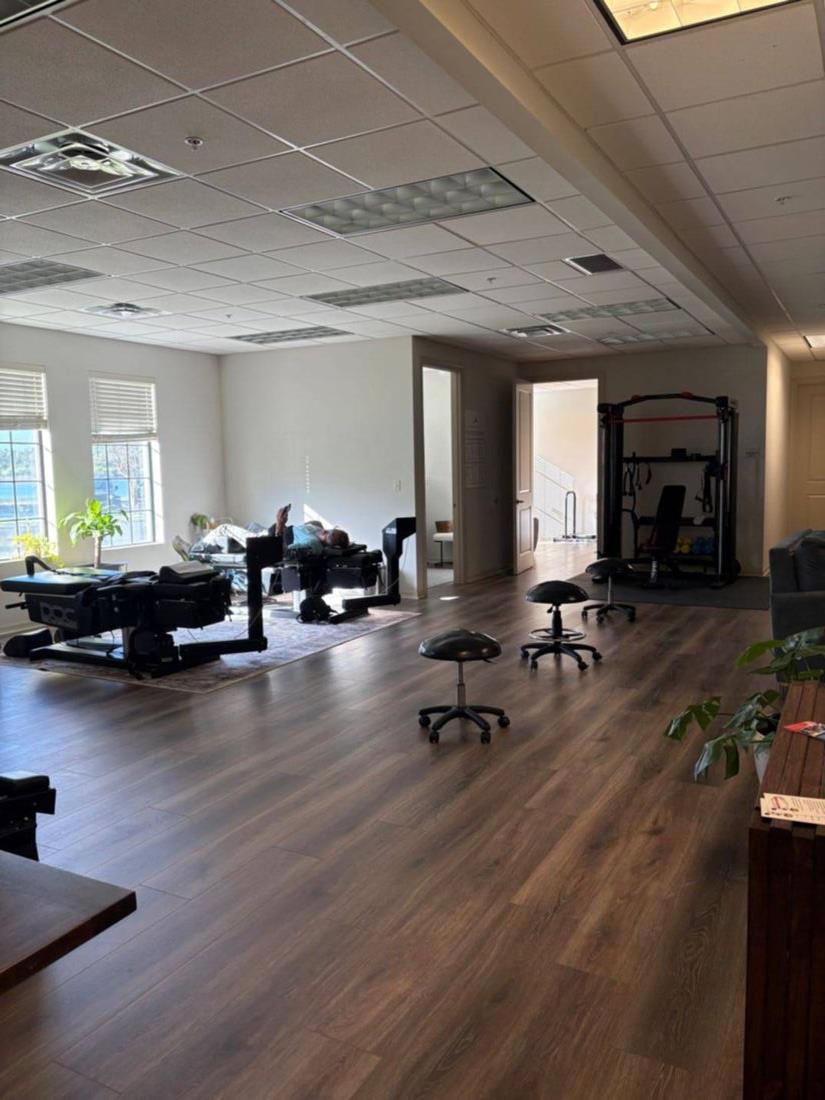
- Spinal decompression: A computer-controlled table that gently pulls on the spine to reduce pressure inside a compressed disc. The goal is to draw the disc material back toward its center and allow the disc to rehydrate. Most sessions take 15 to 20 minutes and are not painful.
- Class IV laser therapy: A medical-grade laser that delivers energy into injured tissue to reduce inflammation and support cellular repair. Used frequently for soft-tissue injuries, nerve pain, and conditions that involve chronic inflammation.
- Shockwave therapy: A device that sends pressure waves into dense scar tissue or chronic musculoskeletal problems. Often effective for conditions that have not responded to other conservative care.
- Hyperbaric oxygen therapy (HBOT): A pressurized oxygen chamber that delivers high concentrations of oxygen to the bloodstream, supporting recovery in nerve and tissue injuries.
- Regenerative medicine via Colombia: For patients with advanced degeneration or conditions that have exhausted conventional options, Dr. Banman offers consultations about regenerative medicine, in Spanish if you prefer. These procedures are not performed at our Lakewood Ranch office.
- Chiropractic adjustments: Targeted spinal manipulation to restore joint mechanics, reduce nerve irritation, and address the structural component of pain. Applied selectively based on the findings of your examination, not routinely to every patient regardless of presentation.
Scheduling from Lakewood Ranch, Bradenton, or Sarasota
Our clinic is located in Lakewood Ranch and serves patients throughout the Sarasota and Manatee County area. Whether you are a long-time resident of the Lakewood Ranch community or you are driving in from Bradenton, Sarasota, Venice, or anywhere in between, a first appointment involves no commitment beyond showing up.
You can book online at any hour, or call us during business hours to speak with our team. If you would prefer to confirm in advance that Spanish is available for your appointment, mention it when you call. It is always available; there is no need to schedule a special session or request an interpreter in advance.
For auto injury cases, call directly. We prioritize 24-hour response on new accident cases because the 14-day PIP window does not allow for the usual scheduling timeline.
If you are still working through what may be causing your pain and want to understand your options before committing to an appointment, the Meet Dr. Banman page provides more background on his training, certifications, and clinical philosophy.