

Every week we see patients who come in three, four, or five days after a car accident and say the same thing: "I felt completely fine right after. No pain at all. I thought I was lucky." Then the second and third days arrived, and suddenly they can barely turn their head to check a blind spot.
This pattern is so common that it has a clinical name: delayed-onset whiplash syndrome. The delay is not imagined. It is not weakness. It is the predictable result of several overlapping biological processes that each unfold on their own timeline after the initial injury. Understanding the timeline helps explain why your symptoms are real, why they showed up when they did, and why getting evaluated early, even before pain peaks, is the right decision.
You Felt Fine at the Scene. That Is Actually Normal.
The immediate aftermath of a collision is physiologically unusual. Your body just experienced a sudden mechanical force and interpreted it as a threat. The sympathetic nervous system responded within seconds: adrenaline and noradrenaline flooded the bloodstream, cortisol followed close behind, and your pain threshold rose sharply.
This is not a placebo effect. These hormones genuinely suppress pain signaling at the spinal cord level through a mechanism called stress-induced analgesia. It evolved to help injured animals (and humans) escape danger rather than stop and assess injuries mid-threat. The mechanism works very well in the short term.
What stress-induced analgesia does not do is prevent tissue injury. The force of the collision still moved your cervical spine through a rapid, uncontrolled arc. Ligaments still got stretched or partially torn. Disc tissue still absorbed an asymmetric load. Muscles still got pulled past their normal range. The injury happened regardless of whether you felt it in the moment.
Feeling fine at the accident scene does not rule out a real injury. It rules out the immediate pain response. Those are different things, and confusing them is how patients end up in pain a week later with no medical record and no PIP coverage.
The Inflammatory Cascade Peaks at 24 to 72 Hours
After a mechanical injury, the body launches an inflammatory response with a predictable timeline. The first few hours involve vasodilation and increased vascular permeability at the injury site. Inflammatory mediators (prostaglandins, bradykinin, histamine, cytokines) begin accumulating in the affected tissues almost immediately after injury.
By hour 24, that accumulation has grown enough to produce noticeable swelling and to begin sensitizing local nerve endings. By hours 48 to 72, in most uncomplicated soft-tissue injuries, inflammatory mediator concentrations reach their peak. This is typically when pain is at its worst and when stiffness and restricted range of motion become most apparent.
This is why your neck felt slightly stiff on day two but was in full spasm by day three. The injury was the same injury. The inflammation just took time to build.
Cervical soft-tissue injuries often have a longer peak window than, for example, an ankle sprain, because the tissue density, nerve supply density, and postural load of the cervical spine are all higher. Some patients with significant disc or ligament involvement do not hit their symptom peak until five to seven days post-injury.
Muscle Guarding: The Delayed Spasm Pattern
A second mechanism driving delayed symptoms is muscle guarding. After joint or disc injury, the surrounding musculature reflexively tightens to protect the injured area. This is a useful short-term response: it limits motion and prevents further damage.
The problem is that protective spasm itself generates significant pain and restricted range of motion, and it does not develop instantly. It takes 24 to 48 hours for the muscle-guarding response to fully engage as the nervous system processes the injury and recalibrates what it considers safe movement.
The trapezius, levator scapulae, sternocleidomastoid, and suboccipital muscles (all the structures that hold and move the neck) are involved in cervical whiplash guarding. When they go into sustained spasm simultaneously, patients typically develop:
- Severe restriction turning the head left or right
- A radiating ache into the shoulder blades and upper back
- Headaches starting at the base of the skull (the suboccipital contribution)
- Difficulty looking up or tilting the head
- Generalized fatigue and sleep disruption from sustained muscle tension
Patients often describe this as "waking up a different person": they went to sleep mildly sore on day two and woke on day three unable to lift their head from the pillow without using both hands to support the neck.
Disc Involvement That Does Not Announce Itself Immediately
Soft-tissue and muscle injuries explain delayed soreness. Disc involvement explains a more serious pattern that can take even longer to emerge.
The intervertebral discs of the cervical spine are load-bearing shock absorbers between each vertebra. A rapid flexion-extension force (the physics of most rear-end collisions) loads those discs unevenly and quickly. The outer ring of the disc, the annulus fibrosus, can develop micro-tears or small fissures from this loading event.
Initially, those micro-tears may not produce significant pain. The outer third of the annulus does have pain-sensing nerve fibers, but the pressure gradient inside the disc at rest may not be enough to register. Over the days following the injury, two things change:
- Inflammation in the adjacent tissue sensitizes local nerve endings, lowering the threshold for pain perception throughout the affected segment.
- Normal daily loading (sitting at a desk, sleeping on an unsupported pillow, driving to work) repeatedly stresses the now-compromised disc tissue at exactly the levels that were injured.
By day three to seven, some patients begin experiencing pain that radiates into the arm, tingling or numbness in the fingers, or sharp electric sensations with certain movements. These are signals of nerve root involvement: disc material beginning to encroach on a nerve root exiting the cervical spine. This is no longer a pure muscle strain and requires a different evaluation and care protocol.
For more on how cervical disc injuries present and are evaluated after a collision, see our auto and whiplash care page.
Why "I Felt Fine" Can Be the Most Expensive Thing You Say
Florida's Personal Injury Protection statute gives you 14 days from the date of the accident to initiate medical care. Miss that window and your PIP coverage drops to zero (not reduced, zero) regardless of how genuine your injuries are.
Here is the scenario that plays out more often than it should: you feel fine at the scene. You decide to wait and see. By day four, pain arrives. By day seven, it is severe. But you have been managing it at home because it seems like it might just be muscle soreness. Day 14 passes without a medical visit. You finally go to a clinic on day 16 and learn that your $10,000 in PIP coverage is gone.
This is not a technicality that lawyers can work around after the fact. It is the statute, and insurers use it without hesitation.
The medically rational decision after any collision significant enough to cause property damage, deploy an airbag, or produce even mild symptoms is to get evaluated within the first 48 hours. An evaluation that finds nothing serious is still covered by your PIP benefits. Missing the evaluation window costs you coverage you already paid for in your premiums.
For a complete breakdown of Florida PIP rules, the 14-day clock, and the emergency medical condition requirement, see our post on Florida PIP after a car accident.
Red Flags That Mean More Than Delayed Muscle Soreness
Most delayed-onset whiplash responds well to appropriate conservative care. But certain patterns indicate more serious injury and require urgent evaluation rather than watchful waiting:
- Radiating arm pain (especially below the elbow) that appeared 2 to 5 days after the collision: possible cervical disc herniation with nerve root compression. Does not resolve on its own without addressing the disc.
- Weakness in the hand or fingers: nerve root compromise. Imaging is needed before care begins.
- Severe headache that progressively worsens over 24 to 48 hours: can signal concussion or intracranial involvement. Refer to the ER if this is the pattern.
- Difficulty swallowing, hoarseness, or throat tightness after a frontal or rear collision: possible anterior cervical soft-tissue injury. Evaluate urgently.
- Numbness or tingling in the face, tongue, or both arms simultaneously: possible central nervous system involvement. ER referral indicated.
- Any loss of bowel or bladder control: spinal cord involvement. Call 911.
These presentations are less common than straightforward whiplash, but they occur. Knowing which cluster your symptoms belong to determines whether a chiropractic-based recovery program is the right path, or whether imaging referral or an ER visit needs to come first.
What a Proper Post-Collision Cervical Evaluation Looks Like
A thorough evaluation for post-accident cervical injury is not a quick urgent-care check. It involves a structured sequence:
- Range-of-motion testing documented in degrees (serves as a baseline for tracking progress and for the PIP claim record)
- Orthopedic stress tests for cervical ligament integrity (Spurling's test, upper limb tension tests, anterior shear testing)
- Neurological screen covering dermatomal sensation, deep tendon reflexes, and grip strength
- Postural analysis and spinal palpation to identify restricted or hypermobile segments
- Mechanism-of-injury documentation and functional limitation inventory (both required for complete PIP claim support)
If neurological signs are present, imaging referral (typically cervical X-ray first, then MRI for soft-tissue detail) is the appropriate next step. Most straightforward whiplash cases without neurological involvement do not require imaging unless symptoms progress or fail to respond to initial conservative care.
Access to the full $10,000 PIP benefit, rather than the $2,500 limit, depends on an "emergency medical condition" determination by a qualifying provider such as a medical doctor, osteopathic physician, dentist, physician assistant, or advanced practice registered nurse. A chiropractor cannot make that determination. Getting evaluated early matters.
How Delayed-Onset Whiplash Is Treated at Our Clinic
At our Lakewood Ranch office, whiplash cases are evaluated by Dr. Banman directly. Care protocols for delayed-onset presentations are staged to match the tissue's state at each phase:
Acute phase (days 2 to 14): The priority is reducing active inflammation and restoring baseline mobility without aggravating sensitive tissue. Class IV laser therapy (photobiomodulation) is particularly effective here: it reduces inflammatory mediator activity directly within the tissue at the cellular level, often producing measurable range-of-motion improvement within the first two or three sessions. Gentle manual therapy begins restoring cervical mobility. Learn more about our Class IV laser therapy.
Middle phase (weeks 2 to 6): Cervical spinal manipulation where appropriate, electrical muscle stimulation to address the established muscle-guarding pattern, and progressive active range-of-motion work. Soft-tissue release for the suboccipitals and upper trapezius reduces the headache component significantly in most patients.
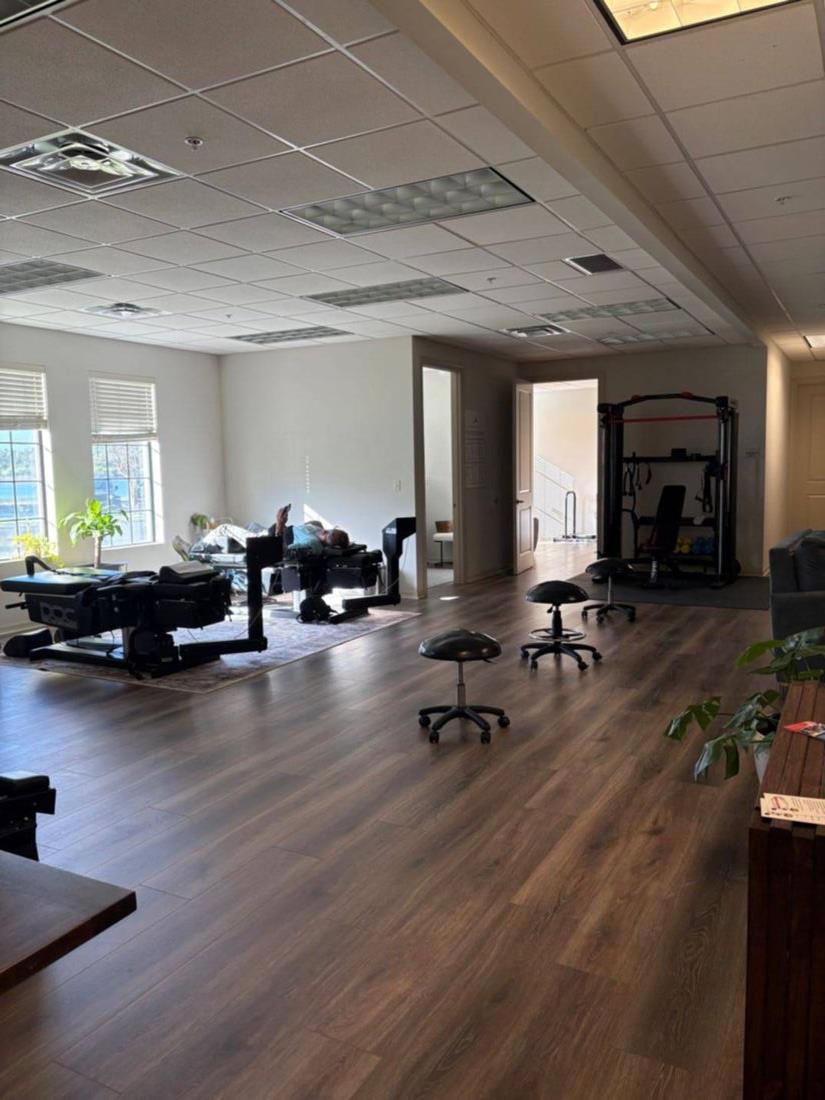
If disc involvement is confirmed or suspected: Cervical spinal decompression under computer-monitored distraction targeting the specific levels involved. This reduces intradiscal pressure and the nerve root encroachment driving radiating arm symptoms, without surgery. For more detail, see our neck pain and headaches page.
Patients who begin care within the first week after a collision typically achieve significant functional recovery over 6 to 10 weeks. In our experience, patients who wait until 4 to 6 weeks post-injury to begin care tend to have longer recovery timelines and more established guarding patterns that require more intensive intervention to address.
Our clinic accepts PIP assignment, meaning we bill your PIP carrier directly. PIP pays 80 percent of reasonable medical expenses, and any remaining balance depends on your policy. We also coordinate with attorneys handling personal injury claims when the collision involved significant property damage or third-party liability situations. If you want to see how the whole process fits together, from the first call through documentation and treatment, start with our auto accident injury guide.
For a full overview of what our auto-injury program includes, see our auto injury care page.