
Patients come in asking about EMS for all kinds of reasons. Some read about it online after a disc injury. Some heard it from a trainer at the gym. Some had a friend who swore by it for back pain. A handful tried it at a big-box physical therapy chain, felt very little, and assumed it was useless.
The reality is more nuanced than any of those sources suggest. Electrical muscle stimulation is a real clinical tool with well-defined mechanisms. It works remarkably well for specific problems. It does almost nothing for others. The difference usually comes down to whether the provider understood what they were treating before they attached the electrodes.
What EMS Is (and What It Is Not)
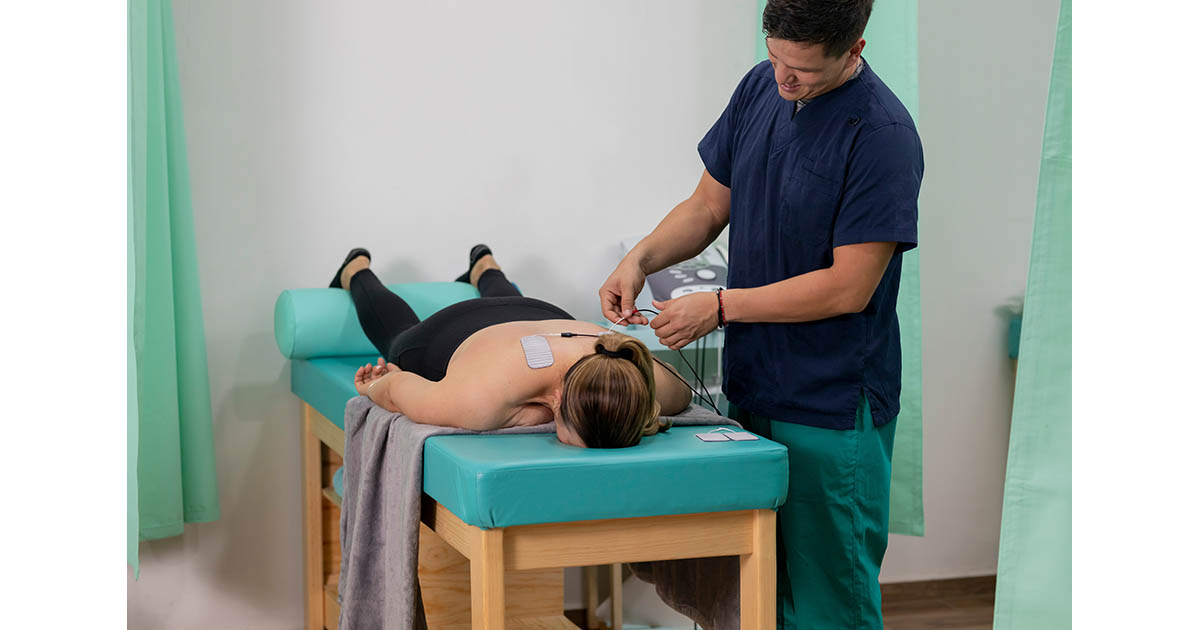
EMS stands for electrical muscle stimulation. It delivers low-level electrical current through electrode pads placed on the skin surface. That current passes through tissue and reaches underlying muscle fibers and nerve pathways, causing them to contract or modulate their signaling depending on the frequency and waveform used.
The most common source of confusion is the difference between EMS and TENS. They look identical from the outside: both use electrode pads, both connect to a small device, both send current into tissue. But they are designed to do different things.
- TENS (Transcutaneous Electrical Nerve Stimulation) targets sensory nerve fibers. Its primary goal is pain modulation: high-frequency TENS activates inhibitory gate-control pathways that reduce pain signal transmission; low-frequency TENS stimulates endorphin release. TENS does not directly contract muscles.
- EMS (Electrical Muscle Stimulation) targets motor nerve fibers at the frequencies needed to trigger muscle contraction. The goal is to recruit muscle tissue, either to re-educate a weakened muscle, reduce atrophy, or drive blood and metabolic activity into an area that has become chronically guarded and underused.
Many devices used in clinical settings can deliver both waveforms. The label on the machine matters less than the settings the provider programs. When someone tells you EMS did nothing for them, the first question worth asking is whether the device was actually running an EMS protocol or a TENS protocol called by a different name.
How EMS Works at the Tissue Level
When an EMS unit sends current through electrode pads, the current follows the path of least resistance through tissue. Skin has high resistance; muscle and nerve tissue have much lower resistance. That is why the current can reach the structures underneath without causing surface damage at clinical intensity levels.
At the motor nerve, a sufficient current triggers an action potential. That action potential travels to the muscle fibers served by that nerve branch and causes a contraction. The contraction is involuntary: the muscle contracts whether the patient is actively trying to contract it or not. That is precisely the point.
When a muscle has been inhibited by pain, guarding, or disuse, the brain's voluntary pathways to that muscle become downregulated. Patients describe it as "not knowing how to fire" a specific muscle. This is common after lumbar disc injuries (where the multifidus and deep stabilizers shut down), after shoulder injuries (where the rotator cuff inhibits), and in chronic neuropathy cases (where motor nerve conduction is degraded).
EMS bypasses the voluntary pathway. It fires the muscle regardless. Done consistently over a course of treatment, this process can restore the motor recruitment patterns the brain has suppressed. It is less about "strengthening" in the traditional sense and more about re-establishing the neuromuscular connection that guarding and pain have interrupted.
EMS does not replace the muscle activation you lost. It reintroduces it in a controlled environment so your nervous system can begin re-learning the pattern it stopped using.
When EMS Actually Moves the Needle
In our experience, EMS tends to produce meaningful results in four distinct clinical scenarios. These are not the only applications, but they represent the clearest signal-to-noise cases we see in a chiropractic setting.
Post-injury muscle inhibition
After a disc herniation, lumbar strain, or any painful spine episode, the paraspinal muscles closest to the injury site undergo reflex inhibition. The body is trying to protect the area. The problem is that this protective guarding often persists long after the acute injury phase has passed. The muscles stay offline. Without the deep stabilizers actively supporting the spine, the disc and facet joints absorb more load than they should. Pain perpetuates itself.
EMS applied to the paraspinal muscles at therapeutic intensity can begin reinstating the motor recruitment that guarding suppressed. In our clinic, we typically use EMS as part of a disc recovery protocol alongside spinal decompression, not as a standalone modality. Decompression unloads the disc; EMS reactivates the stabilizers. One prepares the structural environment; the other rebuilds the muscular support.
Peripheral neuropathy and motor nerve re-education
In peripheral neuropathy, the motor and sensory nerves serving the extremities are damaged or dysfunctional. Patients experience weakness, numbness, tingling, and burning alongside the obvious sensory symptoms. The motor weakness often progresses unnoticed because patients compensate with other muscle groups.
EMS at specific frequencies can stimulate the remaining motor nerve fibers, maintain muscle bulk in the affected areas, and in some cases improve nerve conduction velocity over a course of treatment. This is a complement to, not a substitute for, a structured neuropathy program. For patients in our neuropathy program, EMS is one layer of a multi-modal protocol that also includes Class IV laser, ReBuilder therapy, and nutritional support.
Chronic guarding and poor muscle activation patterns
Some patients come to us not after an acute injury but after years of chronic pain. Their muscles have adapted to a guarded posture for so long that the normal recruitment sequence has been reorganized. They use superficial muscles (erector spinae, trapezius) to do the work deep stabilizers (multifidus, transverse abdominis, rotator cuff internal rotators) should be doing. This produces a pattern of chronic fatigue, tightness, and vulnerability to re-injury.
EMS targeted at the inhibited deep stabilizers can help re-establish their participation in movement. The key is accurate electrode placement. Targeting the wrong layer produces contraction of the wrong muscle and reinforces the compensatory pattern rather than correcting it.
Post-surgical or post-immobilization atrophy
After surgery, a limb has been immobilized, or a patient has been on strict rest, muscle atrophy begins within the first 72 hours. EMS is one of the few interventions that can stimulate a muscle without asking the patient to actively load it. For patients who cannot yet perform active exercise, EMS can slow atrophy and maintain circulation to the recovering tissue. For post-surgical cases, this is always coordinated with the surgical team's protocol.
Conditions That Respond Well to EMS
Based on what we see in clinical practice, these conditions tend to respond well when EMS is applied correctly as part of a structured plan:
- Lumbar disc injury with paraspinal inhibition
- Chronic lower back pain with documented deep stabilizer weakness
- Sciatica with associated motor weakness in the leg (see our sciatica care page)
- Peripheral neuropathy with motor involvement
- Rotator cuff injuries with subscapularis or teres minor inhibition
- Frozen shoulder in the early rehabilitation phase
- Cervical strain with deep flexor inhibition (a common finding in whiplash)
- Post-surgical atrophy (coordinated with the operating provider)
These are not universal guarantees. Every patient presents differently. But these are the categories where we consistently see EMS pull its weight in a comprehensive care plan.
When EMS Is Only Part of the Answer
EMS does not address structural disc pathology. It cannot reduce a herniated disc. It cannot decompress a stenotic spinal canal. It cannot correct a scoliotic curve. Applying EMS to a patient whose primary driver is a disc bulge pressing on a nerve root will produce temporary comfort in some cases, but it does not change the structural situation.
This is the scenario that creates the "EMS did nothing for me" experience. If the real driver is disc compression and the treatment is EMS, the underlying problem is still there. The pain modulation effect from TENS-style current may mask it for a session or two. But the root cause has not been addressed.
For disc-driven problems, the priority is usually spinal decompression to unload the disc and create the conditions for healing. EMS becomes part of the picture after the structural decompression work has begun, to restore the muscle function that was disrupted by the injury and the disuse that followed it.
Similarly, EMS on its own is not a neuropathy program. For patients with advanced peripheral neuropathy, it is at most one part of a broader plan, and results vary. The electrical muscle stimulation component of our EMS care page describes the specific parameters we use.
What a Real EMS Session Looks Like at Our Clinic
The first step is always assessment, not treatment. Before placing a single electrode, Dr. Banman identifies which muscles are inhibited, which are overactivated in compensation, and what is driving the pattern. This means manual muscle testing, movement assessment, and often a review of imaging if disc pathology is suspected.
Electrode placement is specific to the findings, not generic. We are not applying a standard "back pain protocol" that places pads on the lower back of every patient regardless of what the assessment found. We are targeting the specific muscles that showed inhibition on exam.
The session itself typically runs 15 to 20 minutes. The current intensity is titrated to the point where visible muscle contraction is occurring without discomfort. The sensation is often described as "a tapping or squeezing" sensation under the pads. It should not be painful. If it is, the intensity or pad placement needs adjustment.
After the active EMS phase, the clinician may follow with manual work, heat, or another modality depending on the session plan. EMS is rarely the only thing happening in a visit; it is positioned within a sequence designed to produce a cumulative effect across the full course of care.
Realistic Expectations: Timeline and Frequency
Patients sometimes expect to feel dramatically different after the first EMS session. Some do. Most do not, and that is normal. EMS works through neuroplastic adaptation: the nervous system needs repeated stimulation to consolidate a new motor recruitment pattern. One session establishes a signal. A course of sessions reinforces it.
For post-injury muscle inhibition, many patients begin to notice improved stability and reduced guarding somewhere between sessions 4 and 8. For neuropathy cases, the timeline is longer; meaningful improvement often becomes apparent over several weeks of consistent treatment, not days.
How EMS is sequenced within the overall care plan also matters. In our experience, patients who receive EMS after spinal decompression in the same visit tend to retain the decompression benefit more durably than those who do decompression alone. The muscle reactivation after the unloading procedure gives the spine something to hold onto between sessions.
The question is not whether EMS works. It is whether EMS is the right intervention for the right problem at the right time, at the right settings, and whether the rest of the care plan supports what it is trying to accomplish.
Should You Ask About EMS at Your Next Visit?
If you have chronic back pain with a history of disc injury and you notice your core "not engaging" the way it used to, EMS is worth a conversation. If you have peripheral neuropathy with motor weakness in your feet or hands, same. If you have cervical strain that keeps coming back and you have never had deep cervical flexor activation assessed, that too is worth evaluating.
What we would caution against is treating EMS as a self-service solution based on consumer devices. The over-the-counter TENS and EMS units sold online are designed for pain relief and are not delivering the clinical waveforms, intensity levels, or electrode placements used in a supervised setting. They are not dangerous, but they are also not the same thing as therapeutic EMS. Using one at home and concluding that EMS does not work is not a valid test.
The same applies to one-size-fits-all protocols at clinics where EMS is applied to every new patient with "back pain" before anyone has identified which muscles are actually inhibited. That kind of protocol produces inconsistent results, and the inconsistency gets attributed to EMS when the real issue is that the treatment was never targeted at the actual problem.
If you are curious whether EMS has a role in your specific situation, the starting point is an honest assessment of what is driving your pain. From there, the role of EMS, if any, becomes clearer.