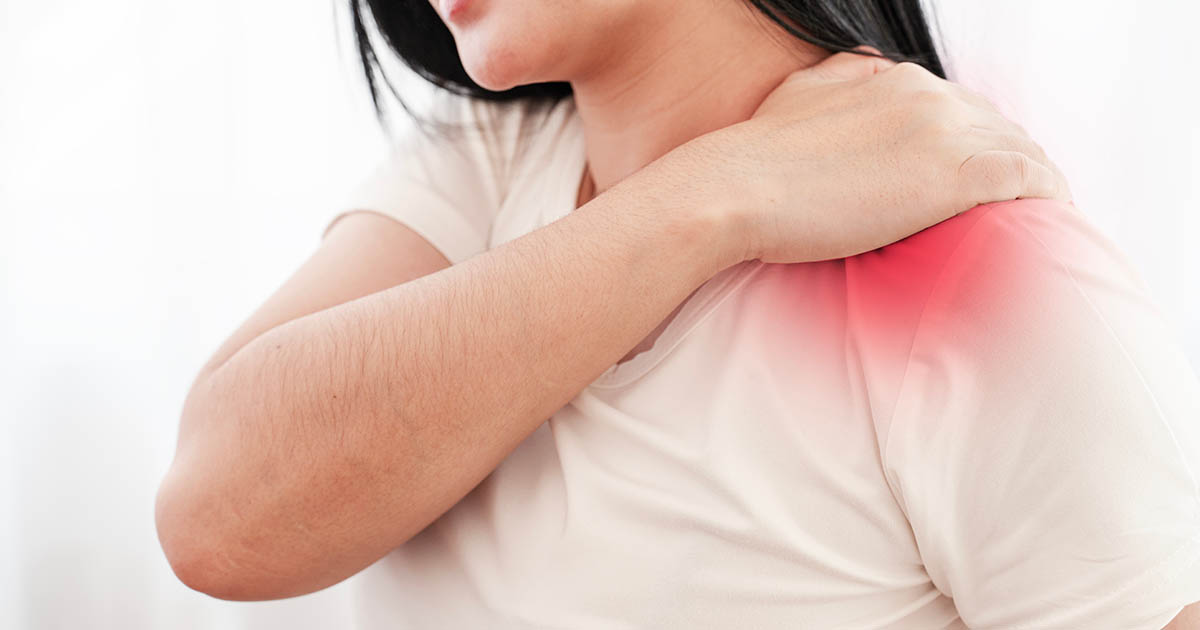


Last spring a patient came in after eight weeks of massage for what her previous provider had labeled "muscle tension" at the base of her skull. The massage helped for a day or two, then the pain came back just as strong. When we evaluated her, the real driver was a C4-C5 disc putting pressure on a cervical nerve root. Her neck muscles were tight because of the nerve irritation, not the other way around. She had been treating a symptom, not a source.
That scenario plays out in our Lakewood Ranch office more often than most people expect. Nerve pain and muscle pain overlap in location, they both hurt, and they often travel together. But they are mechanically different problems, and the treatment for one does not fix the other. Sorting them out early is one of the most useful things an evaluation can do. If you are dealing with pain that hasn't responded to what you've tried, understanding the difference is a good place to start.
For a deeper look at the nerve-pain side specifically, see our peripheral neuropathy care page, which covers how nerve-driven pain is evaluated and managed at our clinic.
What muscle pain actually feels like
Muscle pain has a recognizable quality: deep, aching, or sore. It tends to stay in one area rather than traveling. Press directly on the painful muscle and it hurts more. The muscle may feel tight or knotted on palpation. If you use it hard, the pain increases; if you rest it for a few days, it often improves on its own.
Classic muscle pain scenarios:
- Post-workout soreness that peaks 24-48 hours after exercise and fades by day 4-5
- Muscle strain from a sudden movement, lift, or awkward twist
- Chronic guarding around a joint that's been overloaded repeatedly
- Tension from sustained postures (shoulders raised during desk work, jaw clenching at night)
One key marker: muscle pain generally does not produce numbness, tingling, burning, or that "electric" sensation. If those qualities appear, something other than the muscle itself is likely involved.
What nerve pain actually feels like
Nerve pain has a different vocabulary. Patients describe it as burning, shooting, stabbing, or electric. Sometimes it feels like a current running down a limb. Sometimes it is more of a constant burn with no relief, even at rest. Sometimes it comes and goes in sharp jolts.
The other telling feature is that nerve pain travels. It follows a route, because nerves do. Sciatic nerve compression at the L4-L5 or L5-S1 level produces pain that runs from the low back through the buttock, down the back of the thigh, and sometimes into the calf or foot. Cervical nerve root compression at C6 produces pain from the neck through the shoulder and into the thumb and index finger. That path is predictable because the nerve is physically in those locations.
The burning in your calf, the tingling in your fingers, the numbness on the outer thigh: those are not muscular symptoms. They are nerve signals firing where they shouldn't be, because something is pressing on the wire.
Nerve pain frequently comes with accompanying symptoms that muscle soreness does not:
- Numbness or reduced sensation in a specific region of skin
- Tingling or pins-and-needles that may come and go
- Weakness in a specific muscle group (grip failing, foot drop, difficulty pushing up on the toes)
- Night symptoms that wake you from sleep, which is unusual for pure muscle pain
- Hypersensitivity, where light touch or a breeze over the area feels disproportionately intense
Where the confusion comes from
The reason nerve and muscle pain get mixed up so often is that they coexist. Nerve compression almost always causes secondary muscle guarding. The body is protective: when a nerve root is irritated, the surrounding musculature braces to stabilize the area and limit movement that would make the compression worse.
So you get tight neck muscles AND a compressed nerve. You get a spasming piriformis AND sciatic irritation underneath it. You get stiff paraspinals AND a bulging disc they're protecting. When a practitioner finds the tight muscle and treats it, they're not wrong that something is there. But if that's the only target, relief is temporary, because the nerve pressure that triggered the guarding is still present.
This is the most common reason massage, stretching, and heat fail to produce lasting relief: the patient is working on the secondary problem while the primary one (the nerve) remains unaddressed.
For disc-driven nerve pain specifically, our page on sciatica and nerve root compression covers what's actually happening at the structural level.
Common scenarios where nerve pain is mistaken for muscle pain
Tight hamstrings from a lumbar disc: Disc herniation at L4-L5 or L5-S1 irritates the nerve roots that feed the hamstrings. The hamstrings feel chronically tight and don't respond to stretching, because they're not actually short. They're under neural tension from below. Aggressive hamstring stretching can actually worsen the disc irritation by loading the nerve root further.
Neck and shoulder "muscle tension" from cervical radiculopathy: Compression at C5-C6 or C6-C7 produces pain in the neck, upper trapezius, and shoulder blade that patients often describe as tension. They get massage; the muscles relax temporarily; the pain returns. The actual source is a cervical disc or bone spur narrowing the foramen where the nerve exits. See our page on neck pain and cervicogenic headaches for how the cervical spine drives these patterns.
Foot soreness from peripheral neuropathy: Many patients dismiss early neuropathy as tired feet or overuse soreness. The burning that builds through the day and spikes at night is nerve-driven, not muscular. Resting doesn't fix it the way muscle fatigue resolves overnight. This pattern, especially in patients with diabetes, alcohol history, or chemotherapy exposure, points toward peripheral nerve damage rather than soft tissue wear.
Wrist fatigue from carpal tunnel: The aching in the forearm and the hand tiredness can feel muscular. But if it comes with thumb-side hand numbness, nighttime tingling that wakes you up, or weakness in grip or pinch, the median nerve at the wrist is the driver, not overused forearm flexors.
How a clinical evaluation separates them
The evaluation tools for nerve pain are different from those for muscle pain, and that's by design.
For nerve pain, Dr. Banman uses:
- Dermatomal mapping: Checking for areas of reduced or altered sensation that correspond to specific nerve root distributions
- Deep tendon reflexes: Depressed or absent reflexes at the knee or Achilles suggest nerve root involvement at specific levels
- Orthopedic provocation tests: Spurling's test loads the cervical foramen (positive means pain radiates into the arm); straight leg raise (SLR) tensions the sciatic nerve (pain below the knee at low angles suggests lumbar disc involvement); Phalen's and Tinel's for median nerve compression at the wrist
- Strength testing: Specific muscle groups are innervated by specific nerve root levels. Weakness in a predictable pattern (difficulty resisting ankle dorsiflexion, for example) confirms a suspected level
For muscle pain, the primary tool is palpation: identifying the specific muscle, assessing tightness and tenderness, and checking whether joint mobility restrictions are loading the muscle inappropriately.
Often both are present, and the evaluation establishes which is primary and which is secondary. Treating the nerve compression resolves both the nerve pain and, in many cases, the muscle guarding that followed.
When nerve symptoms need immediate attention
Most nerve pain develops gradually and benefits from conservative care, including spinal care for back-driven nerve symptoms or a structured neuropathy recovery program for peripheral cases. But certain presentations require same-day evaluation or emergency care:
- Cauda equina syndrome warning signs: bladder or bowel dysfunction (incontinence or retention) combined with low back pain and leg symptoms is a spinal emergency. Go to the ER.
- Rapidly progressive weakness: If you woke up and your foot is dragging, or your grip has significantly failed in hours, that is not something to wait on.
- Bilateral leg symptoms following trauma: Symptoms on both sides after a fall or impact suggest a central compression that needs imaging immediately.
- Saddle anesthesia: Numbness in the inner thighs, perineum, or genitalia is a red flag for cauda equina involvement.
For everything else, the distinction between nerve and muscle guides a care plan that actually addresses the right structure. In 23+ years of practice, the most consistent pattern we see is patients who have been managing symptoms without ever getting a clear answer on the source. The evaluation changes that.
The takeaway on nerve pain vs. muscle pain
Deep ache, local soreness, responds to touch and rest: muscle. Burning, shooting, electric, travels a path, comes with numbness or tingling: nerve. Secondary muscle guarding always follows nerve irritation, which is why treating the muscle alone produces temporary relief at best.
The practical implication: if the same pain keeps coming back after massage, stretching, or heat, something upstream from the muscle is likely involved. An evaluation that maps the dermatomal distribution, tests reflexes, and uses orthopedic provocation testing gives you a real answer in one visit instead of another six weeks of guessing.