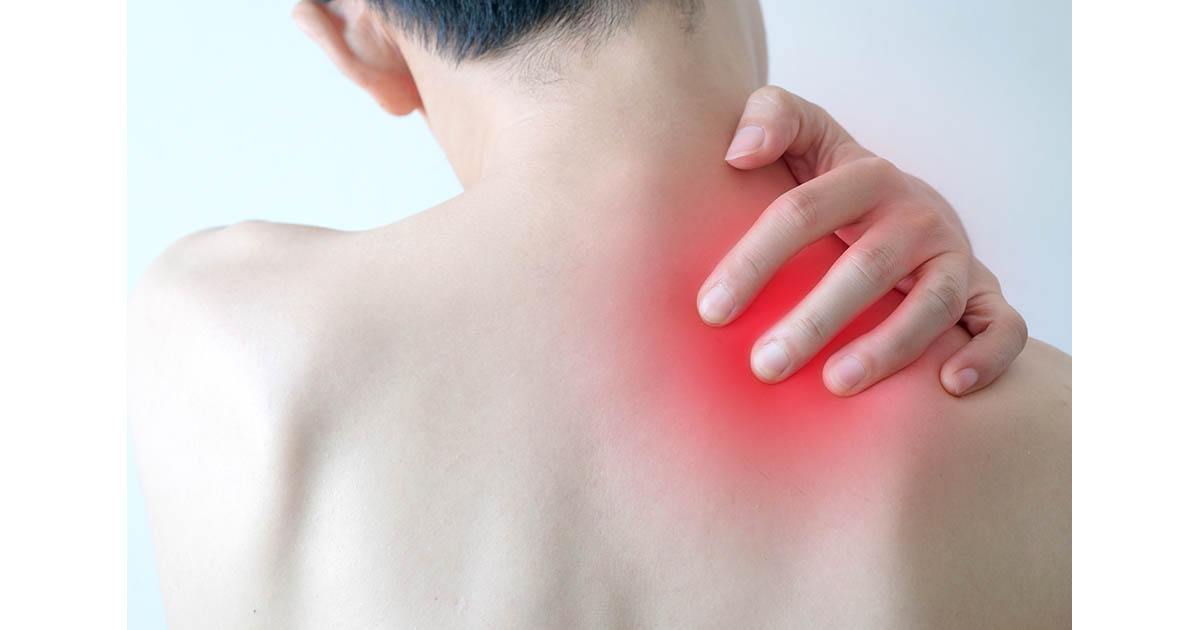


That burning pressure between the shoulder blades is one of the more common complaints we hear at our Lakewood Ranch office, especially from people who work at a desk, drive long distances, or spend hours looking at a screen. It typically arrives as a dull ache by mid-afternoon, sharpens into something that feels almost like a bruise after a long day, and rarely clears up fully with heat, ibuprofen, or a few days of rest. When people do try massage, it helps for a day or two. Then the tension rebuilds to the same intensity within a week.
That cycle is usually the first signal that something structural is involved, not just tired muscle.
Pain in the interscapular region, the area between and around the inner edges of the shoulder blades, has at least four distinct structural sources. Which one is responsible changes what works and what does not. Stretching a rhomboid that is being overpulled by a forward-head posture pattern will not produce lasting change until the posture driver is corrected. A thoracic facet joint that is not moving correctly will not respond to massage because massage does not restore joint motion. A cervical disc that is referring pain into the mid-back will not respond to mid-back treatment at all until the cervical component is identified and addressed.
This post covers the four most common drivers of interscapular pain, how we distinguish them clinically, and what actually produces lasting change in patients we see in Lakewood Ranch and the surrounding Sarasota-Bradenton area.
The Four Most Common Structural Sources
For most people with pain between the shoulder blades, the cause is one of these four. Occasionally more than one is present at the same time, which is part of why this area can be frustrating to self-treat.
Rhomboid strain and middle trapezius trigger points
The rhomboids are the pair of diamond-shaped muscles that run from the thoracic spine to the inner border of each shoulder blade. Their job is to pull the shoulder blades back toward the spine. In people whose shoulders are rolled forward, which is the default posture for most desk workers and heavy phone users, the rhomboids are chronically stretched under low-grade load. A muscle held in sustained stretch for hours at a time develops trigger points: small bands of contracted muscle tissue that refer pain in predictable patterns.
Rhomboid trigger points typically produce a dull aching quality right along the inner edge of the shoulder blade. Middle trapezius trigger points, which frequently accompany rhomboid involvement, add a broader burning quality across the upper mid-back. The distinguishing feature: this pain reproduces when you add more stretch (rolling the shoulder further forward, crossing the arms in front of the body) and partially eases when you deliberately pull the shoulder blade back. The muscle is not injured in the typical sense. It is overloaded in an abnormal position.
Thoracic facet joint irritation
Each pair of vertebrae in the thoracic spine is connected by two small joints at the back: the facet joints. These joints guide rotation and take compressive load. When a facet joint is restricted, inflamed, or moving poorly, it produces a deep and sometimes sharp pain that is usually within an inch or two of the spine. It worsens with rotation or extension of the upper back. Patients often describe it as a catch, something that feels like it needs to pop but will not. That sensation is almost always a restricted thoracic facet.
Facet-driven pain is more localized than rhomboid or disc-referred pain and is specifically reproduced by pressing directly on the affected segment and by rotating the upper body toward the painful side. It may also worsen with deep breathing, because the thoracic facets share attachments with the rib heads.
Referred pain from a cervical disc
The lower cervical spine, specifically levels C4 through C7, has referral patterns that extend downward into the upper back and around the shoulder blade. When a disc at one of those levels is herniated or significantly degenerative, the nerve root, or the disc itself, can generate pain that travels to the mid-back rather than, or in addition to, the arm or neck. Patients often focus on the shoulder blade pain and do not connect it to neck stiffness or a prior neck issue that has since quieted down.
Referred pain from a cervical source is frequently described as a deep, poorly localized ache rather than a sharp or burning quality. It does not change much with thoracic movements. What does reproduce it is passive neck rotation or extension toward the affected side, or sustained looking-down posture that loads the lower cervical discs. The neck itself may or may not be overtly painful when the patient presents. Our neck pain program addresses the cervical drivers that contribute to this referral pattern.
Referred pain from a thoracic disc
Thoracic disc herniations are far less common than cervical or lumbar disc herniations, but they do occur. The mid-back is exactly where they cause symptoms. A thoracic disc referral pattern is often described as a band of pressure or burning that wraps from the back around the side of the chest wall, following the path of the intercostal nerve. Unlike rhomboid or facet pain, it tends to be more diffuse and may be accompanied by unusual skin sensitivity over the affected area. Thoracic nerve root involvement warrants specific imaging to rule out cord-related pathology and should not be managed with trial-and-error care alone.
Why Desk Work and Posture Are Almost Always Involved
Even when the primary structural driver is a facet joint or a cervical disc, posture is almost always a contributing factor. The mechanics are straightforward. The natural cervical and thoracic curve distributes load vertically through the spine. When the head shifts forward, which is what happens when someone looks at a screen positioned at chest height without deliberate ergonomic setup, the effective load on the lower cervical and upper thoracic spine increases significantly with every inch of forward translation.
The muscles between the shoulder blades are then asked to work harder to hold the weight of the arms and shoulder girdle against gravity, while also being overstretched by the forward-rolled shoulder position. The result: structures that are already mechanically compromised get stressed with every hour at the desk.
- A minor thoracic facet restriction that might have been a non-issue with normal posture becomes chronically irritated under sustained flexion load
- Rhomboid trigger points that might have resolved with a day's rest instead build for weeks because the driving position never changes
- A lower cervical disc that has some degenerative wear gets loaded in a compromised forward-head position for six to eight hours a day
- The shoulder internal rotation of desk posture pulls the scapula away from the spine, keeping the rhomboids on constant stretch
This is why interscapular pain in desk workers tends to be progressive and resists home care. The structural source continues to be loaded in the same abnormal way every workday.
When Shoulder Blade Pain Is Not Musculoskeletal: Red Flags
Most pain between the shoulder blades is mechanical and responds to conservative care. A small percentage is referred from visceral sources, and those require a different evaluation pathway entirely.
Symptoms that warrant prompt medical evaluation rather than chiropractic care as a first step:
- Pain that is not affected at all by movement, position, or activity (purely constant, positionally independent)
- Sudden severe pain between the shoulder blades, particularly with a tearing quality or accompanied by chest discomfort
- Associated shortness of breath, sweating, or jaw pain in combination with mid-back pain
- Pain substantially worse at night that does not change at all with movement or position
- Known history of cancer with new, unexplained interscapular pain
- Fever, unintentional weight loss, or persistent fatigue alongside new mid-back pain
Aortic dissection, pulmonary embolism, and cardiac events can all refer to the interscapular region. These presentations are uncommon, and the quality is distinctly different from the mechanical aches most patients describe. If there is any real question, an emergency evaluation is the correct first step. If the pain worsens with prolonged sitting, changes with thoracic movement, and reproduces predictably with shoulder or cervical positioning, the mechanical source is overwhelmingly more likely.
The ache between the shoulder blades that worsens as the workday goes on and improves after movement is almost always structural. The one that does not change no matter what you do is the one to have evaluated medically first.
The Evaluation: What We Look for Before Treating
The clinical evaluation is what separates the four sources from each other. We cannot treat them with the same approach and expect consistent outcomes. At Spine and Wellness Center Lakewood Ranch, the evaluation includes:
Motion testing of the thoracic and cervical spine. Which movements reproduce the pain and which do not narrows the likely source. Thoracic rotation and extension implicate the thoracic facets or discs. Cervical extension and rotation toward a side implicates the cervical foraminal space and the lower cervical discs.
Segmental palpation. Pressing directly on each thoracic vertebral level identifies the specific restricted or inflamed segment. A facet joint that has lost its normal end-feel and reproduces the patient's familiar pain under pressure is meaningful diagnostic data that changes the care plan immediately.
Cervical orthopedic tests. Spurling's test, the shoulder depression test, and cervical distraction help identify whether the cervical spine is generating referred pain into the interscapular region. A positive Spurling's at C6 in a patient who reports shoulder blade pain tells us the cervical disc is part of the picture.
Postural and scapular assessment. We look at scapular resting position, shoulder internal rotation, and forward head distance to understand the load environment the structures are working under. If the rhomboids are being held in sustained stretch for eight hours a day, treating the rhomboids in isolation without addressing the postural driver produces only temporary change.
Imaging context. If the history suggests disc involvement, or if conservative care has not produced the expected response in a reasonable timeframe, cervical or thoracic MRI provides the structural picture. We review imaging reports and explain what a finding means for your care plan.
What Actually Helps and Why Each Tool Does a Different Job
Each structural source has a specific therapeutic target. Part of why interscapular pain gets managed poorly in the primary-care setting is that generic muscle relaxants and anti-inflammatories address symptoms without addressing the mechanism. Patients take two weeks of medication, feel somewhat better, and then the pain returns to baseline as soon as the medication stops because the structural driver was never changed.
Chiropractic adjustment of the thoracic and cervical spine. The most direct intervention for thoracic facet restriction is a specific adjustment to the restricted segment. Restoring normal joint motion changes the mechanical load on the facet, reduces the inflammatory response in the joint capsule, and often produces immediate reduction in the catch sensation patients describe. For cervical disc involvement, cervical adjustments targeted at the appropriate level reduce the compressive load on the affected disc and associated nerve root. The adjustment does not need to be forceful. In many patients with thoracic facet irritation, a gentle segmental mobilization achieves the same mechanical goal. What matters is that the correct segment is identified and moved through its restricted range, which is a structural intervention massage cannot replicate.
Class IV laser therapy. Laser at therapeutic wavelengths penetrates soft tissue and drives cellular energy production in the treated area. For interscapular pain this produces two distinct effects: faster resolution of the inflammatory response in the facet capsule or disc, and accelerated repair of the trigger-point tissue in the rhomboid and middle trapezius. Our Class IV laser is frequently combined with adjustment because the two mechanisms work together: adjustment restores joint mechanics, and laser supports tissue-level healing at the cellular level. Patients with significant trigger-point involvement typically notice a reduction in the knot-like density of the tissue within three to five treatment sessions.
Electrical muscle stimulation (EMS). For the mid-back specifically, EMS serves two purposes depending on the phase of care. In the acute phase, it reduces the intensity of the pain signal by saturating the affected nerve pathways, which is why it often provides a window of relief that makes adjustment more comfortable. In the rehabilitation phase, EMS activates the rhomboids and lower trapezius directly, helping to re-establish the correct firing pattern in muscles that have been inhibited by prolonged overstretching.
Postural rehabilitation. This is the component of care that determines whether the improvement holds. Without addressing the postural drivers, the structural sources are re-aggravated in the same sitting pattern each workweek. Postural rehabilitation in our office means specific exercises to restore mid-scapular strength and endurance, correct forward head carriage, and open the anterior shoulder and chest wall, combined with practical ergonomic guidance on screen height and monitor distance.
For cases where cervical disc involvement is significant, non-surgical spinal decompression may be incorporated into the care plan to address the disc component directly. The back pain program at our Lakewood Ranch clinic provides the broader structural framework when multiple spinal regions are involved.
Why It Keeps Coming Back Without Structural Care
The cycle most patients describe before coming to see us, a few days of relief after massage or stretching, followed by the tension rebuilding to its prior intensity within a week, makes complete sense once you understand the mechanical picture.
The massage relaxed the muscle temporarily. The thoracic facet restriction that was causing the muscle to guard is still there. The forward head carriage that is loading the lower cervical disc is unchanged. The rhomboids are still being held in sustained stretch for eight hours every workday. Nothing structural was modified, so the same structures get reloaded in the same way and produce the same response on the same schedule.
The outcome Dr. Banman's patients report is not that the pain never returns. It is that the intensity decreases over a course of care, the frequency of flares drops, and the recovery time when something does tighten shortens. A patient who needed two weeks of daily discomfort to recover from a flare now reports the same tightness resolves in two days with targeted care. That change in recovery trajectory is the marker of structural improvement, not just symptomatic management.
If shoulder blade pain has been cycling for more than a few weeks, or if massage and stretching have repeatedly failed to hold, the structural driver has not been identified. The team at Spine and Wellness Center Lakewood Ranch evaluates and treats the cervical and thoracic sources covered in this post. Call (727) 213-2982 or book online for an initial evaluation.