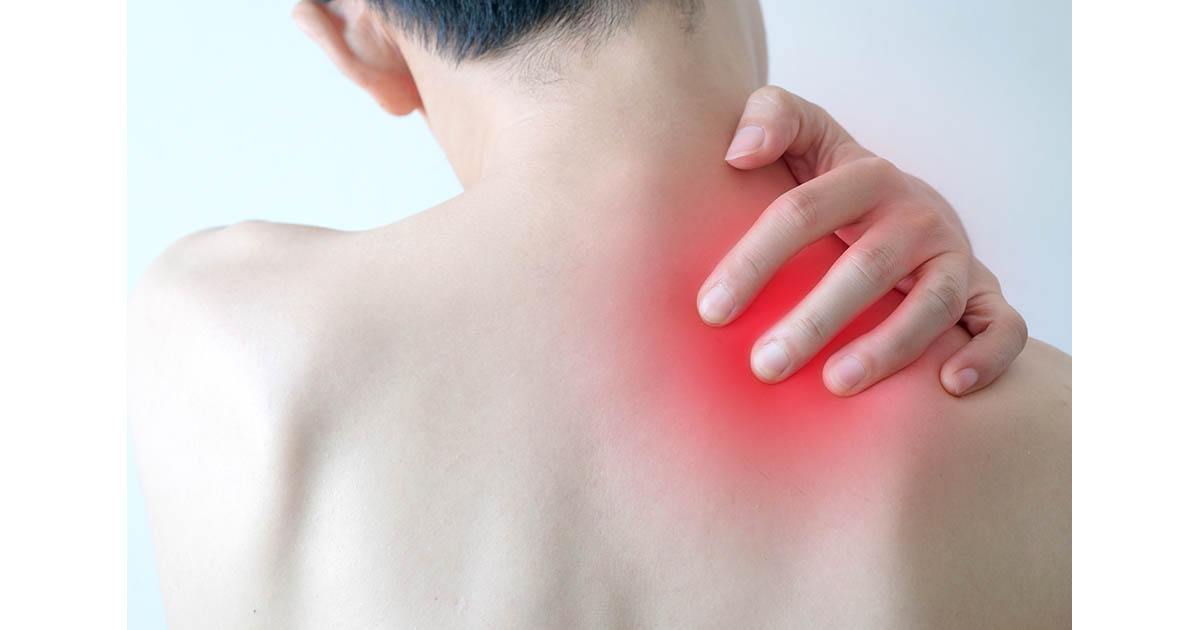


You get a massage on Tuesday. By Friday the knots are back. You stretch every morning. By noon, the tension across your shoulders has returned. The neck pain you thought was from sleeping wrong has been there, off and on, for two years.
This pattern has a name: upper cross syndrome (UCS). It is not a disease or diagnosis in the traditional sense. It is a predictable postural and muscle imbalance pattern that chiropractor Vladimir Janda identified and documented decades ago. The reason it matters is that understanding it changes what you do about it. Chasing the symptoms (the tight traps, the stiff neck) without addressing the underlying imbalance is why the pain keeps coming back.
What Upper Cross Syndrome Actually Is
The name comes from the X-shaped pattern of muscle dysfunction that develops over time. Picture a cross drawn from shoulder to shoulder and from the back of your head to your sternum. Along that cross, you will find two distinct groups of muscles behaving badly in opposite ways.
Tight and overactive: upper trapezius (the muscles that shrug your shoulders), levator scapulae (the muscle running from your shoulder blade to your cervical spine), pectoralis major and minor (your chest muscles), and the suboccipital muscles (the small muscles at the base of your skull).
Weak and underactive: deep cervical flexors (the muscles at the front of your neck that hold your head level), lower trapezius (the stabilizers that keep your shoulder blades down and back), serratus anterior (the muscles that anchor your shoulder blades to your ribcage), and the rhomboids (the muscles between your shoulder blades).
That imbalance, tight front and upper muscles pulling against weak lower and front-of-neck muscles, shifts your posture in a very specific direction: head forward, upper back rounded, shoulders elevated and internally rotated. One inch of forward head posture adds roughly 10 pounds of effective load to your cervical spine. Most people with established upper cross syndrome carry their head two to three inches forward, which means 20 to 30 additional pounds of compressive force on the discs and joints of the neck.
Upper cross syndrome is not a muscle problem that causes a posture problem. It is a posture problem that creates a muscle problem, which makes the posture worse, which worsens the muscle imbalance. That cycle is what makes it self-perpetuating.
How Upper Cross Syndrome Develops
This pattern does not happen overnight. It accumulates over months and years of sustained postures that your body eventually treats as the default. The most common drivers:
- Desk work: Eight hours a day with your head slightly forward of your shoulders, eyes at or below screen level, arms reaching toward a keyboard.
- Phone use: Looking down at a screen pulls your head forward and rounds your upper back. Forty-five degrees of neck flexion creates roughly 49 pounds of force on your cervical discs. Most people do this for two to four hours daily.
- Driving: The standard driving position (arms forward, back reclined, head slightly forward) loads the exact muscles that become overactive in UCS.
- Sleeping on your stomach: Forces your neck into rotation for hours, repeatedly shortening the suboccipital muscles on one side.
- Uneven chest and back training: Gym programs that emphasize chest pressing over rowing and pulling consistently overdevelop the pecs relative to the rhomboids and lower traps.
Symptoms: What Upper Cross Syndrome Feels Like
The symptom picture is recognizable once you know what to look for. Patients almost never walk in saying "I have upper cross syndrome." They come in with one or more of these complaints:
Chronic neck stiffness and pain that is worse in the morning or after sitting for a while, and that eases temporarily with movement before returning. The pain typically runs from the base of the skull down into the neck and upper trapezius. Many patients describe it as a constant background tension that occasionally spikes into something sharper.
Headaches that start at the base of the skull. The suboccipital muscles and the upper cervical joints are the most common anatomical source of cervicogenic headaches, the type that originates from the cervical spine rather than the brain. Tight suboccipitals compress the greater occipital nerve and the C2 nerve root, producing a headache that typically runs from the back of the head forward toward the eyes or temples. See our article on why headaches start at the base of the skull for a deeper look at this pattern.
Upper trapezius and levator scapulae trigger points. The "knots" in the upper shoulders that massage therapists keep finding. These are not primarily muscle problems. They are the result of those muscles working overtime because the deeper stabilizers are not doing their share. Release the trigger point without changing the underlying imbalance and the knot is back in a week.
Rounded shoulders and protracted shoulder blades. The pectorals pull the shoulders forward and internally rotate the arms. If you stand in front of a mirror and your palms face your thighs or behind you (rather than facing your body), you have some degree of shoulder internal rotation driven by tight pecs.
Shoulder impingement symptoms. The forward and elevated shoulder position reduces the subacromial space, the gap between your rotator cuff tendons and the acromion. Pain with reaching overhead, reaching behind your back, or certain arm positions is a common downstream consequence of UCS-driven shoulder mechanics.
Jaw tension and TMJ symptoms. The forward head posture pulls the mandible back relative to the skull. This alters the bite relationship and loads the temporomandibular joint. Many patients with UCS have jaw clicking, clenching, or aching that has never been properly connected to their neck posture.
Why Massage and Stretching Alone Do Not Fix It
Massage and stretching address the overactive, tight side of the equation (upper traps, pecs, suboccipitals). That temporary relief is real. Those muscles genuinely are shortened and loaded, and releasing them reduces the symptom burden for a few days. But without also addressing the weak side (deep cervical flexors, lower traps, serratus anterior, rhomboids), the imbalance reasserts itself. The tight muscles tighten back up because the weak muscles still cannot hold the posture up.
This is the most common reason people cycle through massage for years without the pattern resolving. They are treating half the problem.
The other thing massage and stretching cannot address is what the sustained forward posture has done to the cervical joints themselves. When the head stays forward for long periods, the posterior joints (facet joints) of the upper cervical spine become compressed and restricted. The ligaments at the front of the cervical spine become adaptively shortened. Disc pressure in the lower cervical spine increases. None of that changes with a massage or a chest stretch.
What Changes the Pattern
Genuinely resolving upper cross syndrome requires working on all three components: the joints, the tight muscles, and the weak muscles. In our Lakewood Ranch clinic, a typical approach includes:
Cervical Spine Mobilization and Adjustment
The restricted segments in the upper and mid cervical spine need to move again before the muscles attached to them can function correctly. Chiropractic adjustments restore joint mobility, reduce the protective guarding patterns that keep the surrounding muscles in spasm, and normalize the movement pattern. This is the piece that stretching cannot replicate, because stretching acts on muscles, not joint mechanics. For patients with established upper cervical restriction, this is usually the highest-leverage intervention.
Soft Tissue Work on the Tight Side
This includes the pectoralis minor (often chronically shortened and rarely addressed), the levator scapulae, the upper trapezius, and the suboccipital group. We use targeted soft tissue release rather than general massage, focused on the muscles that are actually driving the imbalance rather than the ones that hurt the most (which are often a consequence, not the source).
Therapeutic Exercise for the Weak Side
Deep cervical flexor activation (chin tucks done precisely, not just as a stretch), scapular retraction and depression exercises, serratus anterior loading, and rowing-pattern movements that engage the lower traps and rhomboids. These need to be loaded progressively, not just performed as light mobility work, because the goal is to rebuild the endurance capacity that allows the muscles to hold your head up without fatiguing across a workday.
Ergonomic and Habit Modification
Screen height (monitor top should be at or above eye level), lumbar support in the chair, phone positioning, driving seat adjustment, and sleep position all need to change or the postural stimulus that created the problem keeps running in the background. Changes at the workstation can cut the daily exposure to the provocative posture by several hours.
How Long Does It Take?
That depends on how long the pattern has been established. Patients who have had UCS symptoms for less than a year typically respond in six to ten weeks of consistent care. Longer-standing cases may take longer to see durable changes, particularly in the postural adaptation component, but the symptom burden usually starts dropping meaningfully within the first few visits. The goal is not just to feel better temporarily. The goal is to restore enough cervical joint mobility and muscular balance that the pattern does not immediately reassert itself when care ends.
One useful benchmark: when a patient can maintain a neutral head position for a full workday without neck fatigue or tension returning, the muscular side has made meaningful progress. That is different from the position feeling forced and uncomfortable, which is what it feels like in the early stages of retraining.
Related Conditions That Often Coexist With UCS
Upper cross syndrome rarely exists in isolation. Conditions that commonly show up alongside it in our Lakewood Ranch patients:
- Cervicogenic headaches driven by C1-C3 joint dysfunction and suboccipital tension
- Shoulder impingement from the reduced subacromial space created by the forward-rounded shoulder posture
- Cervical disc herniation at C5-C6 or C6-C7, which are the levels that bear the most load in forward head posture
- TMJ dysfunction from the altered jaw mechanics described earlier
- Thoracic outlet syndrome, where the nerves and vessels passing between the collar bone and first rib are compressed by the elevated, rounded shoulder position
If you have more than one of these going on simultaneously, that is actually a useful diagnostic signal pointing toward UCS as the underlying organizer, not just several unrelated problems happening to occur together.
Our approach to neck pain and cervicogenic headaches addresses both the cervical spine and the surrounding muscle balance. For patients with shoulder symptoms that do not respond to isolated shoulder treatment, evaluating for UCS often clarifies why.
When to Get Evaluated
See a provider if any of the following are true:
- Neck or shoulder pain that has been present for more than four to six weeks without improving
- Headaches that consistently start at the back of your head or base of your skull
- Pain, tingling, or numbness that runs from your neck into your arm or hand (this can indicate disc involvement, not just UCS, and needs proper evaluation)
- A noticeable difference in shoulder height or rotation between sides
- Symptoms that return within a week after massage or manual therapy, despite consistency
The pain, numbness, and tingling scenario deserves emphasis. Upper cross syndrome in isolation does not produce arm symptoms. When those are present, it means the cervical discs or nerve roots are also involved, and the evaluation needs to be more comprehensive than a postural assessment alone. See our post on pinched nerve in the neck vs the shoulder for more on how to distinguish these patterns.
For patients in Lakewood Ranch, Bradenton, or Sarasota who are dealing with chronic neck and shoulder pain that keeps returning: the pattern is identifiable, the mechanisms are well understood, and the interventions exist. The piece that is usually missing is addressing all three components at once rather than just the part that hurts the most.
Call us at (727) 213-2982 or book at celluron.janeapp.com. We offer same-week appointments for new patients and same-day evaluation for patients in acute pain.