

A lot of headache sufferers spend years chasing the same round of treatments: ibuprofen, darkness, ice packs, occasionally a neurologist who rules out the serious stuff and sends them home with a migraine diagnosis that doesn't quite fit. The headaches keep coming. The prescriptions help sometimes. Nothing makes them stop.
For a meaningful subset of these patients, the problem isn't inside the head at all. The cervical spine, specifically the upper three vertebrae and the muscles attached to them, generates pain that travels forward into the head and mimics everything from a tension headache to a migraine with aura. The clinical term is cervicogenic headache, and in our experience at Spine and Wellness Center Lakewood Ranch, it's among the most underdiagnosed patterns we evaluate.
This article explains what cervicogenic headaches are, how to recognize them, why they develop, and what actually changes the pattern.
What Is a Cervicogenic Headache?
Cervicogenic simply means "originating from the cervical spine." The upper cervical vertebrae (C1, C2, and C3) share nerve pathways with the trigeminal nerve, which carries sensation from the face, scalp, and forehead. When the upper cervical structures become irritated, those signals get interpreted by the brain as head pain, even though the source is in the neck.
This shared pathway is called the trigeminocervical nucleus. It's not a theory; it's a well-characterized anatomical structure that explains why neck problems produce forward-radiating headache pain. The nucleus processes both incoming trigeminal signals (from the face) and upper cervical signals (from the neck) in the same region of the brainstem. When neck structures are irritated enough, the convergence causes referred pain that travels across the scalp, behind the eye, and into the forehead.
Cervicogenic headaches typically have several distinguishing features:
- Pain begins or is clearly worsened by neck movement or sustained neck positions
- The headache is one-sided and tends to stay on the same side
- There is usually neck stiffness accompanying the headache, either before or during the episode
- The pain starts at the back of the head (suboccipital region) and radiates forward
- Pressure applied to the upper cervical area reproduces or worsens the head pain
Cervicogenic headaches are not a diagnosis of exclusion. They have a specific origin, a specific referral pattern, and specific physical exam findings. Many patients carry a migraine label for years before anyone examines their cervical spine.
How to Tell If Your Headache Is Coming from Your Neck
Distinguishing cervicogenic headaches from migraines and tension headaches matters because the treatments are completely different. Here are the patterns that point most strongly toward a cervical origin.
1. The headache changes with neck position
If turning your head, looking up, or sitting in a particular position consistently triggers or worsens a headache, that is a strong signal that the cervical spine is involved. True migraines are not position-dependent in this way. A person with a migraine who keeps their head still while changing neck posture should not see the headache respond. A cervicogenic headache often does.
2. It starts at the base of your skull
The suboccipital region is where the skull meets the cervical spine. The muscles here, the rectus capitis posterior major and minor, the obliquus capitis superior and inferior, and the semispinalis capitis, attach directly to the cervical vertebrae. When these muscles are in sustained spasm or when the underlying vertebral joints are restricted or irritated, the referred pain pattern travels forward.
If you can reliably identify a starting point at the back of your head, particularly just below the skull on one side, before the pain moves forward, you are describing a pattern that deserves cervical evaluation.
3. It follows prolonged desk work, driving, or phone use
Forward head posture, which most people adopt without noticing during desk work and phone use, shifts the load on the cervical spine dramatically. For every inch the head moves forward of neutral, the effective weight on the cervical vertebrae increases by roughly 10 pounds. At the two-to-three-inch forward head posture typical of someone hunching over a laptop, the cervical spine is managing something closer to 42 to 60 pounds of effective load rather than the 12 pounds the head actually weighs.
That sustained mechanical overload compresses the upper cervical joints, tightens the suboccipital muscles, and eventually produces referred headache pain. If your headaches show up predictably after long work sessions or long drives but not on days when you are more physically active, that pattern is pointing at posture-driven cervical load.
4. The headache stays on one side
True migraines can be bilateral or can switch sides between episodes. Cervicogenic headaches are strongly unilateral and tend to stay on the same side, the side where the cervical irritation is greatest. If you have had years of headaches that are always on the right, always starting at the right base of skull, and always traveling to the right eye or temple, that consistency is a meaningful clinical clue.
5. Your neck was injured at some point
Prior whiplash, a fall, or any event that generated rapid cervical loading can cause joint damage, disc degeneration, or scar tissue in the upper cervical region that persists for years. Many patients with chronic cervicogenic headaches have a history of a car accident or sports injury that seemed to resolve at the time but laid the groundwork for later cervical dysfunction. The headache pattern may not fully emerge until years after the original event.
What Drives Cervicogenic Headaches: The Structures Involved
Understanding which structures are usually involved helps clarify why the pattern is so consistent across patients.
Upper cervical facet joints (C1-C2 and C2-C3)
The facet joints connect adjacent vertebrae and guide movement. The C1-C2 and C2-C3 joints are particularly prone to generating referred headache pain when they become restricted, inflamed, or degenerative. The C2-C3 facet joint is one of the most commonly implicated structures in cervicogenic headache and is directly accessible to manual therapy when the examination confirms it is the primary driver.
Suboccipital muscles
These four small muscles at the base of the skull control fine head movement and are heavily loaded by sustained forward head posture. They are also unique in containing an unusually high density of muscle spindles, which are sensory receptors that feed directly into the brainstem. Chronic spasm in these muscles generates persistent afferent signals into the trigeminocervical nucleus, which can sustain or amplify headache patterns even when the joint component is treated.
Cervical discs (C2-C3 and C3-C4)
Disc degeneration or herniation at C2-C3 or C3-C4 can compress the nerve roots that contribute to headache referral patterns. This is less common than joint-driven cervicogenic headache but should be evaluated in patients who have significant neck pain accompanying the headaches, particularly with any neurological symptoms such as tingling or weakness in the arms. For disc-driven cervical pain patterns, our neck pain and headaches page covers what evaluation looks like at our clinic.
Greater occipital nerve
The greater occipital nerve emerges from the C2 nerve root and travels across the back of the scalp. When the surrounding muscles are tight or the C1-C2 joint is restricted, this nerve can become entrapped, producing a sharp, burning, or electrical pain that runs up the back of the head. Many patients with occipital neuralgia (a related but distinct condition) have an underlying cervical driver that has not been addressed.
What Imaging Shows (and What It Misses)
Cervical X-rays or MRI can identify disc degeneration, joint arthritis, and structural changes, but normal imaging does not rule out cervicogenic headaches. The facet joints, muscle spasm patterns, and soft-tissue restrictions that drive most cervicogenic presentations are not reliably captured on standard imaging. A patient can have a completely normal cervical MRI and still have clinically significant upper cervical joint restriction that produces daily headaches.
The most reliable way to confirm a cervical contribution is through a thorough physical examination: range of motion testing, joint palpation, muscle assessment, and cervical provocation testing. If pressure applied to specific cervical segments reproduces the patient's familiar headache pain, that is clinically significant regardless of what imaging shows.
This is why evaluation matters more than imaging reports for this particular diagnosis. It also means you should be cautious about accepting "your MRI is normal" as the end of the investigation if your headache pattern has the features described above.
What Actually Changes the Pattern
Once a cervical contribution is confirmed through examination, the treatment options are specific to the structures involved.
Cervical chiropractic adjustments
Manual adjustments to the upper cervical joints, particularly C1-C2 and C2-C3, directly address joint restriction that is driving the headache referral pattern. The goal is to restore normal segmental motion and reduce the mechanical irritation of the nerve tissue in that region. In our experience, many patients notice a meaningful reduction in headache frequency within the first several weeks of consistent cervical care. Our chiropractic adjustments page covers the specifics of what the evaluation and adjustment process involves at our clinic.
Soft-tissue work and suboccipital release
Addressing the suboccipital muscles directly is often necessary alongside joint work. Trigger points in these muscles refer pain into the back of the head and behind the eyes in patterns that are almost identical to the cervicogenic headache pattern. Manual release of these trigger points, combined with stretching and postural retraining, removes a persistent source of afferent overload to the trigeminocervical nucleus.
Class IV laser therapy
For cases where soft-tissue inflammation around the upper cervical joints or suboccipital muscles is a significant driver, Class IV laser therapy can reduce inflammation and accelerate tissue recovery in ways that allow manual work to hold longer. We use Class IV laser as part of cervicogenic headache protocols when examination findings suggest active soft-tissue irritation. More detail on how it works is on our Class IV laser page.
Cervical spinal decompression
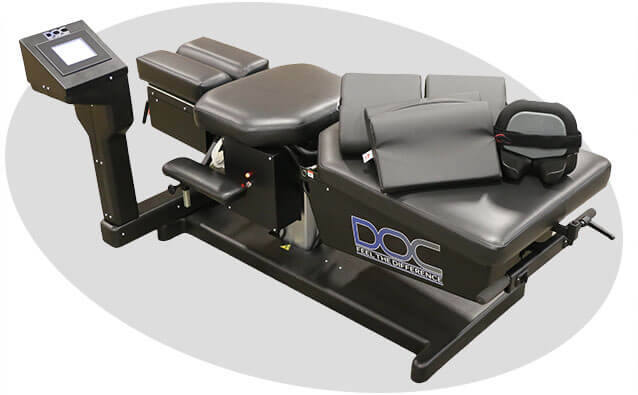
For patients where imaging or examination confirms a disc component at C2-C3 or C3-C4, cervical spinal decompression can reduce disc pressure on the adjacent nerve roots and reduce the central driver of the headache pattern. This is more specific to patients with both neck pain and headaches where radicular features (arm symptoms) are present. Our spinal decompression page covers who is and isn't a candidate for this approach.
Postural correction
For patients whose primary driver is forward head posture from sustained desk or screen work, postural retraining is a necessary part of any treatment program. Adjusting ergonomic setup, learning neutral cervical positioning, and building the deep cervical flexor strength to maintain it takes weeks of consistent work but reduces the mechanical load that was producing the joint irritation in the first place. Without this component, treatment of the joint and muscle findings tends to provide temporary relief rather than durable improvement.
Red Flags That Need Immediate Evaluation
Not every headache is a musculoskeletal problem. The following patterns warrant urgent medical evaluation, not chiropractic evaluation first:
- Sudden, severe headache unlike any you have had before (sometimes described as "thunderclap")
- Headache with fever, stiff neck, and light sensitivity together (possible meningitis)
- Headache following a head injury with confusion, vomiting, or loss of consciousness
- Headache with new neurological symptoms: vision changes, weakness, speech difficulty, facial drooping
- Headache that is rapidly worsening over days
- New headache in someone over 50 who has not had headaches previously
If any of these apply, go to an emergency room or call 911. These patterns can indicate stroke, aneurysm, meningitis, or other conditions that need immediate imaging and treatment that is outside the scope of musculoskeletal care.
The Pattern Most Patients Describe
In our Lakewood Ranch clinic, the typical cervicogenic headache patient has a story that goes something like this. They have had headaches for years, usually more on one side, usually starting at the back of the head and traveling forward by mid-morning. They have tried various medications with partial and inconsistent results. They often have a desk job or drive long distances regularly. Some have a history of a whiplash injury that seemed to resolve. Nobody has ever done a thorough physical examination of their cervical spine specifically in the context of the headaches.
When we examine them, the findings are usually consistent: restricted motion at C1-C2 or C2-C3, significant suboccipital muscle tension on the affected side, and reproduction of their familiar headache pain with palpation of the upper cervical joints. The examination makes sense of years of symptoms in a single visit.
That doesn't mean every case resolves quickly. Some patients have had cervical dysfunction for long enough that the sensitization process in the trigeminocervical nucleus has become a contributor in its own right and requires time and consistent treatment to calm down. But the trajectory is different from the cycle of medication management that wasn't addressing the structural cause.
Is This Worth Getting Evaluated?
If your headaches consistently start at the back of your head, worsen with neck movement or sustained postures, stay on one side, and haven't fully responded to medication-only management, a thorough cervical evaluation is a reasonable next step. The evaluation itself is low-risk, and the findings will either confirm a cervical contribution or help narrow toward a different explanation.
What most cervicogenic headache patients tell us is that they wish someone had looked at their neck years earlier. The pattern was there all along.