

In 23 years of practice in Lakewood Ranch and the broader Sarasota area, this story comes in regularly: a patient was deadlifting, squatting, or doing Romanian deadlifts and felt a sudden catch or deep pull in the lower back. Maybe they kept training for a few more days. Then the pain spread into the glute or down the leg. Now they are worried they can never lift again.
Sometimes that fear is well-founded. Often it is not. The outcome depends on what kind of tissue is injured, how far the damage has progressed, and whether the person has a clear picture of what to do while it heals. That clarity starts with a proper exam. Our page on herniated disc treatment in Lakewood Ranch gives a broader overview of what non-surgical disc care typically looks like, and why the evaluation itself matters before any modification plan is built.
That said, there is quite a bit you can understand right now that will help you make smarter decisions in the next few weeks.
What actually happens to a disc when you lift heavy
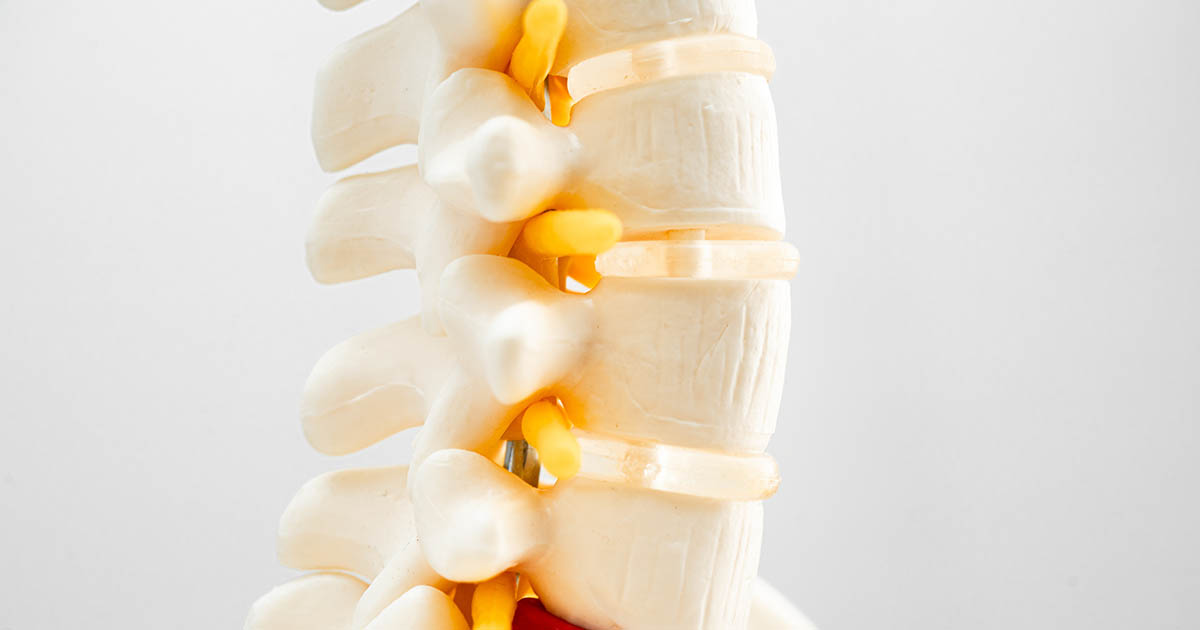
The lumbar discs (especially L4-L5 and L5-S1) sit between the vertebrae and act as shock absorbers. Each disc has a tough outer ring called the annulus fibrosus and a gel-like center called the nucleus pulposus. Under compressive load (a squat, a deadlift, a loaded row), the disc distributes force outward. That is normal and healthy when the disc is intact and the spine is in a reasonable position.
The problem starts when compressive load combines with a compromised position or repeated micro-trauma: the outer rings begin to crack, and the nucleus starts migrating outward. A bulging disc means the nucleus is pressing the outer ring outward but has not broken through. A herniated disc means part of the nucleus has pushed through the annulus. Both can press on nerve roots, which is why lower back disc injuries so often produce pain or numbness in the leg.
The nerve roots that exit the lumbar spine merge into the sciatic nerve, which is why a disc problem at L4-L5 or L5-S1 typically shows up as what most people call sciatica. Understanding which disc level is involved, and how badly, is the foundation for any sensible modification plan. A mild annular bulge with no nerve compression can often be trained around fairly aggressively. A herniation with active nerve impingement usually requires a decompression phase before axial loading goes back on the program.
Which lifts put the most stress on lumbar discs
Not all gym movements create equal disc loading. The following consistently show up in patients who come in after a lifting injury:
- Conventional deadlifts and Romanian deadlifts (high compressive load combined with hip hinge; injury risk rises sharply when spinal position breaks down under fatigue)
- Barbell back squats (significant axial load, especially when limited thoracic extension forces the lumbar segments to carry more of the movement)
- Good mornings and Jefferson curls (direct hinge or flexion load on the posterior chain with little room for error)
- Heavy bent-over barbell rows (repetitive loading to the lumbar spine in a compromised forward-flexed position)
- Box jumps and high-impact landings (compressive spike on landing, particularly problematic for existing disc pathology)
These movements are not permanently off the table. They are the first to modify when a disc is irritated and the last to return to after recovery, which is a meaningfully different framing.
What most patients can still train during recovery
Patients are frequently surprised at how much training is still possible while managing an active disc issue. The goal is to preserve as much stimulus as possible while removing the specific loading patterns that continue to aggravate the disc.
- Upper body pushing and pulling (bench press, overhead press, lat pulldowns, cable rows) with a supported or neutral lumbar spine
- Machine-based lower body work (leg press, leg extension, leg curl) where the lumbar spine carries no direct axial load
- Single-leg work with an upright torso (split squats, step-ups) when tolerated without sciatica provocation
- Core stability in a neutral spine position (dead bugs, bird dogs, pallof press) rather than crunch-based flexion work
- Stationary cycling for cardiovascular maintenance in most disc presentations
The most common mistake we see is trying to push through disc pain by just lowering the weight on the same movements. Disc injuries do not reliably respond to reduced load alone. They respond to a reduced loading pattern while the disc is given a chance to stabilize. A fully recovered disc that returns to deadlifting at 80% is safer than a disc that never healed properly and is training at 60%.
What makes lifting-related disc injuries different from desk-job disc injuries
Lifters and sedentary patients often show similar findings on imaging but present very differently in the exam room. The gym patient typically has significantly more paraspinal muscle mass, which provides genuine stability during the healing process. That is a real advantage.
The disadvantage is that many people who train seriously have developed a high pain tolerance and are skilled at overriding warning signals. They push through the early stages of disc involvement far longer than they should, which is frequently why they show up with more advanced pathology than their age and fitness level would predict. The injury that could have been a 4-week setback becomes a 4-month one.
There is also a movement-pattern dimension specific to lifting. Someone whose daily life does not involve deadlifts can reduce disc loading almost completely by changing a few habits. A lifter who wants to return to competitive-level training has to actively re-groove the patterns that contributed to the injury. That process benefits from professional guidance. For a deeper look at the non-surgical options available for disc pathology, see our spinal decompression page and the general back pain care overview.
How spinal decompression fits into a lifting recovery program
Non-surgical spinal decompression is a traction-based treatment that gently unloads the disc and creates a negative-pressure environment that can draw herniated material back toward center. It is not a replacement for movement rehabilitation, but it is useful during the phase when the disc is actively inflamed and compressive loading needs to be kept low.
In our Lakewood Ranch office, decompression is typically part of a broader protocol that also includes soft-tissue work, Class IV laser therapy to reduce disc-level inflammation, and progressive neuromuscular re-education as symptoms settle. The combination tends to move faster than passive rest alone, because it is actively addressing the disc environment rather than just waiting for symptoms to calm.
Lifters who do best in this phase are the ones who can accept a short period (often 4 to 6 weeks) of decompression-focused care without continuing the movements that load the disc axially. That is not always easy for someone who has built a training identity around heavy compound lifts. But the payoff is clear in our experience: patients who work through a proper recovery protocol return to meaningful training far more often, and without the ongoing fear of re-injury that plagues those who never addressed the underlying disc involvement. There is also useful context on the difference between a bulge and a full herniation on our disc herniation vs. bulge breakdown, which helps make sense of what your imaging is actually showing.
Red flags that mean stop training and get evaluated immediately
Most gym-related back pain is not an emergency. But certain presentations need same-day evaluation at an urgent care or ER, not a chiropractic office:
- Loss of bladder or bowel control following a lifting injury
- Saddle anesthesia (numbness in the groin, inner thighs, or perianal area)
- Rapidly progressing leg weakness (not just pain, but genuine inability to bear weight)
- Bilateral leg symptoms that appear suddenly after a unilateral injury
These findings can indicate cauda equina syndrome or severe central disc herniation, both of which are genuine surgical emergencies. They are uncommon in lifting contexts, but possible with acute compressive injuries. Short of those red flags, most lifting-related disc presentations fall into the "get evaluated in the next few days" category. Pain that is bad but stable, new sciatica following a training session, and back tightness that has not resolved in 5 to 7 days all warrant a clinical exam to identify what is happening and build a structured plan. Our overview of why back pain is so often disc-related covers the underlying patterns that explain why this is more common than most patients expect.
Returning to full training after treatment: a realistic timeline
Return to training after a disc injury is a graded progression. The patients who re-injure themselves most often are the ones who interpret "feeling better" as "healed" and jump straight back to their previous working weights. Disc tissue heals more slowly than muscle, and the absence of pain is not the same thing as structural recovery.
A general progression (always individualized based on the actual clinical findings):
- Symptom resolution and baseline spine stability work with no axial loading
- Introduction of machine-based lower body training with careful symptom monitoring
- Goblet squats and light Romanian deadlifts with trained attention to spinal position
- Progressive loading of hip hinge and squat patterns over 6 to 10 weeks
- Return to conventional compound lifts at reduced working weight, building gradually over the following 8 to 12 weeks
Most patients who work through this process systematically return to meaningful training, often at or close to their previous level. The timeline varies based on disc involvement severity, tissue health, and consistency in the rehab phase. What is almost always within our control is the quality of the process itself, which is what makes the difference between a one-time setback and a recurring injury pattern.
If you are in the Lakewood Ranch, Bradenton, or Sarasota area and are dealing with back pain that started in the gym, call us at (727) 213-2982. We will tell you exactly what is going on and what it means for your training.