

You are sitting at your desk or on a long drive, and at some point one of your legs starts to go numb. Maybe it tingles. Maybe it feels heavy, or a little electric. You stand up and it takes a minute to come back. You have felt it before. You are probably wondering whether it matters.
In our Lakewood Ranch office, leg numbness while sitting is one of the most common symptoms people describe during an initial evaluation. It is also one of the most under-investigated, because patients often chalk it up to "just how I sit." Sometimes that is exactly right. Other times it is the first signal from a compressed nerve that is not going to improve on its own.
The key question is not whether it happens, but how it happens: how quickly it starts, how long it takes to resolve, whether it travels, whether it is in one leg or both, and whether you have any pain or weakness attached to it. Those details matter a lot for distinguishing a positional nuisance from something that needs real attention. If your leg numbness is persistent, one-sided, or accompanied by pain, it is worth understanding your sciatica and nerve compression options in Lakewood Ranch before the pattern becomes harder to reverse.
Two very different reasons a leg goes numb
Before anything else, a distinction: leg numbness while sitting has two basic mechanisms, and they behave differently.
Vascular compression is when you cut off blood supply to the leg by sitting on the back of the thigh (the femoral artery and vein run close to the surface there). This is the "foot fell asleep" experience most people know: it starts within 5 to 15 minutes of sitting in one position, affects the entire lower leg or foot, and clears within 30 to 60 seconds of standing and moving. No pain, no burning, no shooting sensation. It fixes itself the moment you change position. If this describes your experience exactly, it is almost certainly benign and mechanical.
Nerve compression is different in character. It often starts faster, with tingling or a burning quality, may travel along a specific path down the leg (rather than being diffuse), tends to linger longer after you stand, and frequently comes with other symptoms: a dull ache in the lower back or glute, weakness when you try to raise your toes, or an electric shooting sensation when you shift position. This is the pattern worth paying attention to.
The most common nerve cause: lumbar disc pressure and sciatica
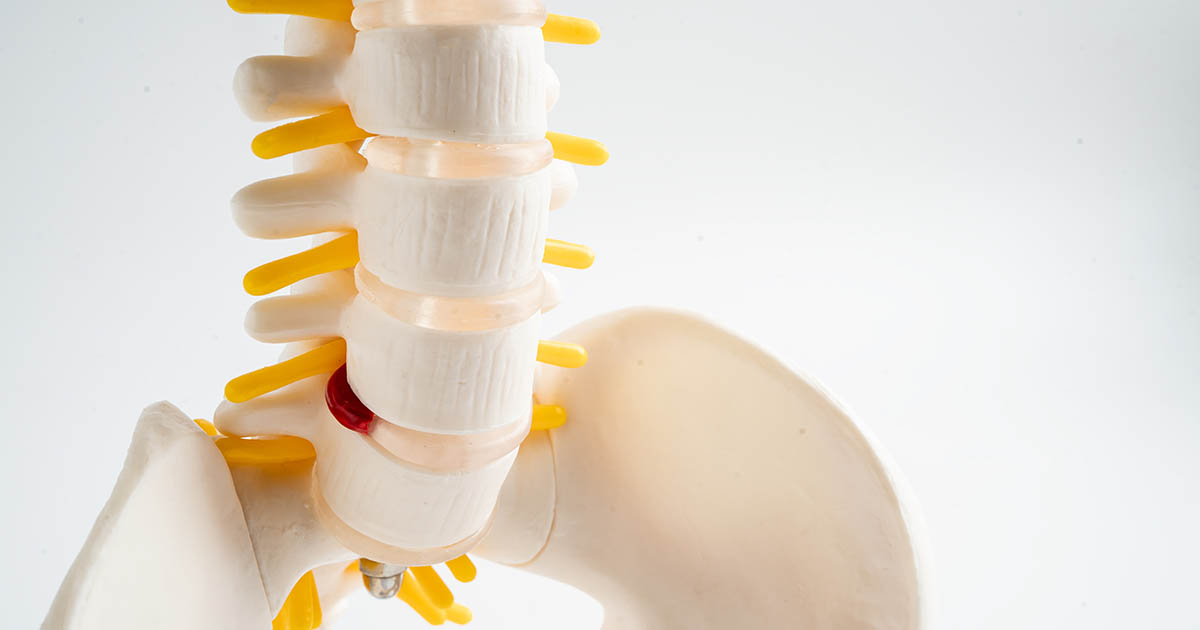
Sitting increases pressure inside the lumbar discs by roughly 40 percent compared to standing. That number is not an abstraction. If you already have a disc that is slightly bulging or herniated at L4-L5 or L5-S1 (the two lowest segments, where the weight of the whole upper body concentrates), that increased pressure pushes the disc material further against the nerve root every time you sit down for any length of time.
The sciatic nerve is the largest nerve in the body: it exits the lumbar spine through multiple roots and runs down through the glute, behind the knee, and into the calf and foot. When a disc presses against one of its roots, the signal the nerve sends downstream is experienced as tingling, numbness, burning, or a combination along the path it supplies. The right side of L5 sends sensation into the top of the foot and big toe. S1 serves the outer foot and heel. So the location of your numbness can actually point directly to which spinal level is involved.
If your leg numbness while sitting is accompanied by any pain in the lower back or glute that preceded the leg symptoms, or if you notice it only in one leg, a lumbar disc issue is the most likely culprit. Our post on the 5 signs your sciatica is disc-driven breaks down the specific patterns that separate disc compression from other causes.
Piriformis syndrome: when the hip muscle is the culprit
The piriformis is a small muscle deep in the glute that connects the sacrum to the top of the femur. In roughly 15 percent of the population, part or all of the sciatic nerve passes through the piriformis rather than below it. Even in people where the nerve runs below it, a tight or inflamed piriformis can compress the sciatic nerve as it exits the pelvis.
This matters for sitting specifically because the piriformis is under stretch and in direct contact with the sciatic nerve when you are in a hip-flexed, internally rotated position. The classic desk-worker or driver posture fits exactly. Many patients with piriformis syndrome describe numbness or tingling that starts in the glute and travels to the back of the thigh, often within 10 to 15 minutes of sitting. They also often have a sore, tender spot deep in one glute that reproduces the leg symptoms when pressed.
Piriformis compression is not a disc problem, and it responds to completely different treatment. Spinal manipulation, targeted soft-tissue work to the piriformis, and a specific set of hip stretches almost always move the needle where decompression alone would not. Our full breakdown of this pattern is in the post on piriformis syndrome and sciatic nerve compression.
Spinal stenosis: why sitting can help or hurt
Spinal stenosis is a narrowing of the spinal canal or the foraminal openings where nerve roots exit. In the lumbar spine, stenosis classically causes neurogenic claudication: leg pain, heaviness, and numbness with standing and walking that is relieved by sitting or leaning forward. Patients describe needing to lean on a shopping cart to walk through a grocery store, then feeling fine once they sit in the car.
But lumbar spinal stenosis can also cause symptoms when sitting in certain positions, particularly when the spine is loaded in extension (leaning back). And cervical stenosis (narrowing in the neck) can produce leg symptoms that seem completely disconnected from the neck, because the spinal cord runs through the cervical canal and compression there can affect signals to the lower extremities.
If your leg numbness when sitting is bilateral (both legs), if you are over 55, or if you have noticed increasing weakness in the legs over time, stenosis needs to be on the evaluation list. This is also a scenario where imaging is usually indicated before a treatment plan is finalized.
What your numbness pattern reveals
The distribution of numbness is one of the most useful diagnostic clues available without imaging. A clinician trained in neurological examination uses dermatome mapping to identify which nerve roots, if any, are involved:
- Outer calf and top of foot: L5 nerve root. Often from a disc at L4-L5.
- Heel and outer foot: S1 nerve root. Often from a disc at L5-S1.
- Inner thigh: Femoral nerve (L2-L4). Can indicate an upper lumbar disc issue or meralgia paresthetica.
- Entire lower leg, stocking distribution: Less likely a single nerve root; suggests peripheral neuropathy, vascular issue, or central stenosis.
- Both legs, saddle area: Potential cauda equina involvement (rare, but a red flag requiring urgent evaluation).
The pattern matters enormously for treatment. Numbness from an L5 root compression responds differently than numbness from piriformis syndrome or peripheral neuropathy, even if the two feel identical to the patient. Getting the correct source right is what determines whether treatment works.
Red flags that move the timeline
Most leg numbness while sitting is not an emergency. But a few presentations require faster action than a routine appointment allows:
- Loss of bladder or bowel control combined with leg numbness: This combination (cauda equina syndrome) is a surgical emergency. Go to the emergency room, not our office.
- Progressive leg weakness over days or weeks: Foot drop, an inability to raise the toes, or legs that feel unreliable when walking are signs of accelerating nerve injury.
- Bilateral leg numbness with any saddle anesthesia: Numbness in the perineum, inner thighs, or genitals alongside bilateral leg symptoms is another cauda equina warning sign.
- Recent significant trauma or fall: If numbness started after a fall, accident, or impact, imaging is warranted before any manual treatment.
For most people with recurring leg numbness while sitting, the window for conservative care is open and the prognosis is good with early evaluation. What closes that window is waiting months while compression continues and the nerve develops chronic irritation that is harder to reverse.
How we evaluate leg numbness at Spine and Wellness Center Lakewood Ranch
Dr. Banman's initial evaluation for leg numbness includes both orthopedic and neurological testing. The straight leg raise (SLR) test reproduces sciatic pain and helps identify disc involvement. Dermatomal sensation testing maps the exact areas of reduced or altered sensation against known nerve root patterns. Reflex testing at the knee and ankle identifies signs of active nerve root compression. Range of motion and end-feel assessment tells us whether the lumbar spine is restricted and in what direction.
In 23-plus years of practice, the most common finding is a combination pattern: some degree of disc involvement at L4-L5 or L5-S1 combined with secondary piriformis tightness that developed as a protective response. Treating only the disc (or only the piriformis) produces partial results. Addressing both together in a coordinated plan is what produces lasting improvement for most patients.
When the clinical picture is unclear, when stenosis is suspected, or when conservative care has not moved the needle after a reasonable trial, we refer for imaging and coordinate with appropriate specialists. Not every case resolves without imaging. The goal is to avoid unnecessary imaging for the large majority of cases that respond to conservative care, while not delaying imaging for the cases that genuinely need it.
For patients with persistent or complex nerve symptoms, our neuropathy recovery program in Lakewood Ranch integrates multiple modalities, including Class IV laser therapy, to support nerve health alongside structural correction. For disc-driven sciatica specifically, non-surgical spinal decompression is one of the most effective tools we have for reducing disc pressure on the nerve root.
What you can do before your appointment
A few things are useful to track before your first visit, because they help narrow the evaluation considerably:
- Which leg is affected (right, left, or both)?
- Where exactly does the numbness go: thigh, knee, calf, foot, toes?
- How long before it starts after sitting? (5 minutes vs 45 minutes is very different.)
- How long does it take to fully resolve after you stand?
- Any associated lower back or glute ache?
- Does changing sitting position help or change the pattern?
- Any history of disc injury, prior imaging, or prior episodes of sciatica?
These details take 2 minutes to note and cut evaluation time significantly. Bring them.