

Whole body vibration (WBV) has been part of chiropractic and rehabilitation practice for about two decades, but it still generates more marketing noise than clinical clarity. You will find websites claiming WBV can do everything from reversing bone loss to resolving chronic back pain in a few sessions. You will also find skeptics who dismiss it entirely as an expensive novelty.
The real picture is more specific and more useful than either of those positions. WBV produces measurable results for a defined set of conditions, particularly those involving post-injury muscle inhibition, bone density loss, and certain balance and neuropathy presentations. For other conditions, it adds little beyond a mild warm-up effect. Knowing which category you fall into determines whether WBV belongs in your care plan or not.
What whole body vibration actually does in the body
The oscillating platform creates rapid, rhythmic force changes through the lower limbs at frequencies typically ranging from 20 to 50 Hz (vibration cycles per second). At each oscillation, the joint position shifts slightly. Muscle spindles (stretch receptors embedded in muscle tissue) detect those micro-changes and fire reflex contractions through the spinal cord. This is called the tonic vibration reflex.
The tonic vibration reflex fires faster than voluntary effort and reaches deep stabilizing muscles that most patients cannot consciously activate effectively, particularly after injury. The multifidus (the deep spinal stabilizer at each vertebral level), the transversus abdominis, and the soleus are especially responsive. They activate before the brain sends a voluntary signal.
Simultaneously, the oscillation generates mechanical micro-loading forces through the skeleton. At frequencies between 25 and 40 Hz, those micro-load cycles signal osteoblasts (bone-building cells) to increase mineral deposition. This is the basis for the strongest body of clinical evidence supporting WBV: bone density improvement in patients with osteoporosis or osteopenia.
Two distinct physiological effects, then: neuromuscular (reflex muscle activation) and osteogenic (bone-loading signal). The clinical applications follow directly from which of these two effects a given patient needs.
The conditions where WBV adds measurable clinical value
The evidence base for WBV is uneven across conditions. The following categories have the most consistent support in the clinical literature and in our experience at Spine and Wellness Center Lakewood Ranch:
Bone density loss (osteoporosis and osteopenia)
This is the best-supported application of WBV. Multiple randomized controlled trials have shown modest but reproducible increases in lumbar spine and femoral neck bone density with consistent WBV training over 6 to 12 months. The effect size is meaningful for patients who cannot tolerate high-impact exercise or resistance training due to pain or mobility limits. WBV delivers bone-loading signals without requiring them to bear heavy external loads.
Post-injury muscle inhibition
After a disc herniation, a facet injury, or any significant joint trauma, the surrounding paraspinal muscles are neurologically inhibited by the spinal cord as part of a protective reflex. This inhibition is not the same as weakness from disuse. It is an active, spinal cord-level response that does not reverse automatically when the pain resolves.
The multifidus, in particular, often remains inhibited at the injured level long after the acute phase. Patients who return to full activity with an inhibited multifidus re-injure at the same level at disproportionately high rates. WBV bypasses the inhibitory circuit by triggering contraction through the tonic vibration reflex rather than through voluntary effort. In our experience, this is the most clinically compelling application of WBV for spine patients.
Scoliosis stabilization
In patients with scoliosis, the deep stabilizing muscles along the concave side of the curve are often tonically underactive due to abnormal sensory input from the deformed spinal segments. Voluntary exercises can partially address this, but patients frequently cannot recruit those muscles effectively through normal effort alone. WBV provides a non-volitional stimulus that activates the deep stabilizers regardless of the patient's ability to consciously engage them. For more on how we manage adult scoliosis, see our scoliosis bracing page.
Peripheral neuropathy and balance impairment
Peripheral neuropathy impairs proprioception (joint position sense) and sensory feedback from the feet and lower legs. The resulting balance deficit is one of the leading contributors to fall risk in older adults. WBV provides a high-frequency sensory input stimulus that can partially compensate for the reduced afferent signal from damaged peripheral nerves. In patients with neuropathy affecting balance, WBV is typically paired with balance training protocols rather than used in isolation. See our neuropathy program page for how this fits into a full neuropathy care plan.
Fall prevention in older adults
Separate from neuropathy, the balance improvement literature for WBV in elderly populations is relatively robust. Studies consistently show measurable gains in static and dynamic balance after 8 to 12 weeks of WBV training. For patients whose primary concern is fall risk rather than pain, this is a meaningful application with a favorable safety profile.
The tonic vibration reflex reaches deep stabilizers before the brain sends a voluntary command. For patients whose injury has shut those stabilizers off, that reflex pathway is often the only way back in.
Muscle inhibition after injury: the detailed mechanism
Because muscle inhibition is the most common reason we add WBV to a spine patient's care plan, it is worth understanding the mechanism in more detail.
When a disc herniates or a facet joint is injured, pain signals reach the dorsal horn of the spinal cord. The spinal cord responds by reducing motor output to the muscles near the injured segment, particularly the multifidus. This is protective in the short term: reducing muscle tension around an acutely injured area limits further damage. But the inhibition persists through mechanisms that are not fully understood, even after the acute inflammation has resolved.
The practical consequence is that a patient can complete a full course of pain treatment, feel substantially better, pass a standard strength test, and still have an inhibited multifidus at the previously injured level. That patient is functionally vulnerable at that segment even though they feel fine. The first return to loading, a heavy lift, a sudden rotation, a fall, re-injures the same level.
Standard exercises (deadlifts, bird-dogs, prone extensions) require the patient to voluntarily recruit the multifidus. If the inhibitory circuit is still active, those exercises build the surrounding muscles while leaving the target muscle dormant. WBV drives contraction through the spinal reflex arc, bypassing the voluntary pathway. Combined with manual therapy to normalize the sensory input from the injured segment, the two approaches together address the problem from both directions.
Who should not use whole body vibration therapy
WBV is well tolerated by most adults with stable chronic conditions, but there are specific contraindications where the therapy should not be applied:
- Acute fracture (stress or traumatic): The mechanical loading from WBV can displace an unstable fracture. This is an absolute contraindication until the fracture is fully healed and cleared by the treating provider.
- Recent joint replacement surgery: Implant integration requires a stable mechanical environment in the first 3 to 6 months post-operatively. WBV loads the joint repeatedly and should be deferred until the surgeon confirms the implant is fully integrated.
- Active deep vein thrombosis (DVT): The increased circulation from WBV could theoretically mobilize a clot. Any patient with a diagnosed or suspected DVT should not use WBV until the condition is resolved.
- Implanted electronic devices (pacemakers, spinal cord stimulators): Electromagnetic interference and mechanical vibration can affect implanted devices. Consult the device manufacturer's guidelines.
- Severe osteoporosis with vertebral fracture history: In patients with documented vertebral compression fractures, the platform loading may be contraindicated. Lower-frequency, lower-amplitude protocols may be appropriate in some cases, but this requires individual evaluation.
- Acute disc herniation in severe inflammatory phase: In the first several days of an acute disc herniation with significant nerve root inflammation, WBV can transiently increase symptoms. We defer WBV until the acute phase has resolved and patients are stable on examination.
- Pregnancy: WBV is contraindicated during pregnancy, particularly in the first trimester, due to the theoretical risk of uterine mechanical stress.
Outside of these contraindications, the safety profile of therapeutic WBV (at clinical frequencies and amplitudes) is well established. The platforms used in rehabilitation settings operate at lower amplitudes than consumer-grade devices, which reduces the risk of the joint microtrauma that higher-intensity consumer use can cause.
What a session looks like at our Lakewood Ranch office
Sessions on our vibration platform typically run 10 to 15 minutes. Initial frequency settings are based on the presenting condition: lower frequencies (20 to 25 Hz) for patients in the early stages of rehabilitation or with higher sensitivity, higher frequencies (30 to 40 Hz) for patients using WBV primarily for bone loading or muscle re-activation in a stable context.
The patient stands on the platform, usually with a stability bar available. Specific position modifications during the session shift the stimulus to different muscle groups: a slight knee bend biases the session toward quadriceps and trunk; a wider stance increases hip abductor and lateral stabilizer involvement. For patients with lower-extremity neuropathy, a seated position with the feet resting on the platform is often more appropriate.
Most patients notice the vibration sensation primarily through the feet and legs for the first few sessions. Trunk involvement becomes more apparent as the protocol progresses and the neuromuscular system adapts. Sessions should never produce pain, increased neurological symptoms, or pressure at a fracture site. If any of those occur, the session stops and we re-evaluate.
WBV as part of a combined protocol
At Spine and Wellness Center Lakewood Ranch, WBV is rarely used as a standalone therapy. It functions most effectively as a component in a combined protocol that addresses the full picture of a patient's condition.
The most common combination at our office is WBV immediately following spinal decompression. Decompression creates negative intradiscal pressure, reduces nerve root compression, and allows the disc to rehydrate. WBV immediately after the session re-activates the deep stabilizers that the injury and pain have inhibited, reinforcing the mechanical environment that lets the decompression result hold. For a detailed look at why these two therapies work together, see our post on spinal decompression combined with whole body vibration.
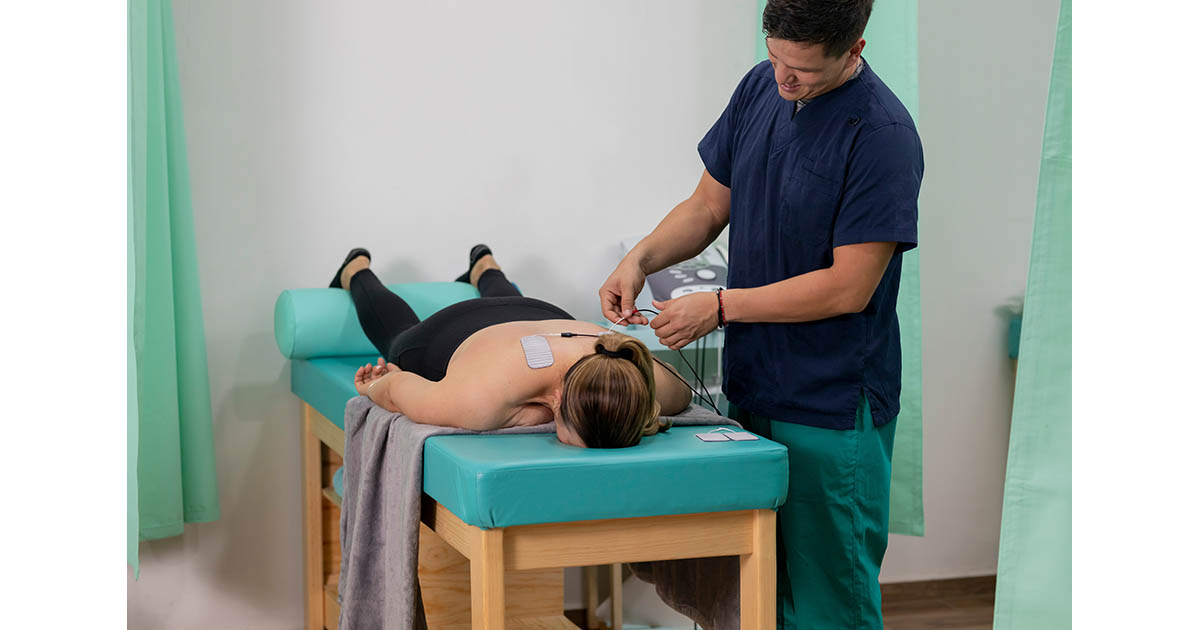
The second common combination is WBV alongside electrical muscle stimulation (EMS). Where EMS drives a targeted, isolated contraction in a specific muscle, WBV provides global stabilizer activation across the whole lower kinetic chain. The two tools address different aspects of the neuromuscular deficit. For more on where EMS belongs in a care plan, see our post on when EMS actually works.
For some neuropathy patients, WBV is added alongside Class IV laser and ReBuilder electrical nerve stimulation as part of balance work. Whether it fits depends on the exam, and results vary from person to person.
You can explore all of our WBV protocols, including who it fits, on the whole body vibration service page.
Realistic expectations: what the research actually shows
WBV has a genuine role in rehabilitation and wellness care. It also has a history of being oversold. Here is what the evidence actually supports and where honest uncertainty remains:
What the research supports
- Modest increases in lumbar spine and femoral neck bone density with consistent long-term use (strongest evidence).
- Measurable balance improvements in elderly populations after 8 to 12 weeks of training.
- Reduced fall risk in specific older adult populations.
- Re-activation of inhibited paraspinal muscles in patients with documented post-injury inhibition (strong clinical rationale, moderate research support).
- Proprioceptive stimulus benefit in peripheral neuropathy patients, particularly for balance (moderate evidence).
Where the evidence is weaker
- WBV as a standalone treatment for non-specific low back pain: results are mixed across studies. The effect, when present, is modest.
- Weight loss or metabolic improvement: the energy expenditure from WBV alone is not meaningful enough to produce weight change.
- Muscle hypertrophy: WBV can activate muscle but does not produce the progressive overload needed for meaningful muscle growth.
- Rapid pain resolution in acute presentations: WBV is not an acute pain treatment and is not appropriate in the inflammatory phase of most injuries.
The patients who respond most predictably in our experience are those who have documented paraspinal muscle inhibition on examination, are in a stable (not acute) phase, have no relevant contraindications, and are using WBV as part of a structured multi-modality program rather than in isolation. Results typically become apparent after 8 to 12 sessions, and we re-assess and modify the protocol at that point.
If you are in Lakewood Ranch or the surrounding Bradenton and Sarasota area and want to understand whether WBV fits your specific presentation, the first step is a clinical evaluation. Call us at (727) 213-2982 or book online at the link below.