

Pickleball has become one of the fastest-growing recreational sports in the country, and Lakewood Ranch is a good example of why. The courts at local parks and recreation facilities fill early and stay busy. For active adults looking for a social, moderately competitive sport that does not require the conditioning of tennis, it checks a lot of boxes.
What it also produces, at a rate we are tracking closely in our office, is shoulder pain, knee soreness, and low-back flares. Some of these are acute. Many are the slow accumulation of repetitive load on joints and discs that were already quietly dealing with age-related changes. This post explains the injury patterns we see most often, why pickleball creates them, and what the recovery path looks like.
Why Pickleball Is Harder on the Body Than It Looks
Pickleball carries a reputation as a low-impact sport. That framing is partly fair: it is not high-speed tennis. But "low-impact" gets misread as "no risk," which is where people get into trouble. A few things make pickleball distinctly demanding on the musculoskeletal system.
Hard court surfaces. Most courts are concrete or asphalt. Every lateral step, lunge, and quick direction change transfers load through the foot, ankle, and knee on a surface that absorbs essentially nothing. That surface hardness compounds over the course of a two-hour session in ways that rubberized or cushioned indoor surfaces do not.
Repetitive rotational loading. Every forehand and backhand involves lumbar and thoracic rotation under load. For players with pre-existing disc degeneration (which includes most adults over 45, even those with no prior back pain), that rotation is often the mechanism that shifts a clinically silent disc into a symptomatic one.
Shoulder stress from dink mechanics. The dink shot, which is central to pickleball strategy, requires the arm to hold a slightly extended position at roughly waist height while the wrist stays cocked. That sustained low-level shoulder tension is not explosive, but it accumulates. The rotator cuff muscles that stabilize the humeral head are doing continuous low-grade work in a position many players have never specifically conditioned for.
Overhead smash loads. Drive shots and overheads require fast, forceful extension of the shoulder and elbow. For players who have not built rotator cuff strength appropriate for this range, the supraspinatus and biceps tendon are taking loads they are not conditioned to absorb.
Demographic mismatch. Pickleball's primary demographic skews toward adults over 50. That population often carries pre-existing joint degeneration, reduced tendon elasticity, and spinal disc changes that are asymptomatic until they are not. A disc that has been quietly desiccating for a decade can become symptomatic after six weeks of pickleball played five times a week.
The Three Areas We See Injured Most Often
1. The Shoulder
Shoulder injuries are the most consistent pickleball complaint we see in new patient intakes. The mechanics of the overhead play and the sustained dink position both stress the rotator cuff, particularly the supraspinatus. That muscle runs across the top of the shoulder and keeps the humeral head centered in the socket during arm elevation.
Common presentations from our clinical experience:
- Pain at the front or top of the shoulder that worsens with overhead motion
- Soreness that appears 12 to 24 hours after a session that felt fine during play
- Aching that disrupts sleep, particularly when lying on the affected side
- Weakness when reaching across the body or lifting the arm into certain positions
- A painful arc: certain angles hurt, others do not
Mild rotator cuff tendinopathy often responds well to active rest, corrected mechanics, and targeted treatment. Shoulder injuries that go unaddressed tend to progress. What begins as supraspinatus tendinitis can develop into a partial tear, or over time into adhesive capsulitis (frozen shoulder), which is a significantly more involved recovery. For an overview of what happens when shoulder injuries are left too long, see our frozen shoulder page.
2. The Knee
Knee injuries from pickleball divide roughly into two types: sudden-onset and overuse.
Sudden-onset injuries usually occur during a lateral pivot, a lunge for a wide shot, or a hard plant-and-stop. A pop followed by immediate pain and swelling within a few hours suggests possible meniscus involvement or ligament strain. Those presentations warrant evaluation, not a wait-and-see approach.
Overuse injuries are more common and more insidious. Patellar tendinopathy (pain just below the kneecap, typically worse going down stairs or after prolonged sitting) builds over weeks of repetitive loading. Patellofemoral pain syndrome, which produces pain behind the kneecap during and after play, is often tied to hip weakness or foot mechanics rather than anything structurally wrong inside the knee itself. Lateral knee pain, particularly along the iliotibial band, is common in players doing high volumes of side-to-side movement on hard courts.
The error most players make is playing through knee discomfort for too long, assuming soreness is a normal adaptation. In active adults over 50 with some pre-existing joint changes, persistent soreness after activity is more often an early signal that a structure is overloading.
3. The Low Back and Spine
Low-back pain after pickleball typically traces to one of three drivers: a pre-existing disc issue being irritated by the rotation and extension of play; lumbar facet joint compression from the bent-knee, slightly forward-flexed ready position held continuously during points; or hip weakness that transfers excess load to the lumbar spine with each lateral push-off.
Most adults over 45 have at least mild lumbar disc degeneration visible on imaging, even without any prior back pain history. Pickleball's repetitive rotational load can move those discs into positions that compress nerve roots, producing sciatic referral patterns (pain or tingling into the glute, thigh, or calf) that catch players off guard after a session that seemed fine.
If your low-back pain from pickleball is general muscular soreness that settles within 48 hours, that is likely a recovery issue. If it is radiating into the leg, or if it returns every time you play and gets worse over weeks, that is a structural issue worth evaluating properly.
For more on how disc changes drive low-back and leg pain patterns, see our back pain overview.
Two More Areas Worth Knowing
Lateral epicondylitis (pickleball elbow). The same mechanism that produces tennis elbow applies here. Repeated forehand and backhand play stresses the extensor tendons at the outer elbow. Pain localized to the lateral elbow that is worse with gripping and wrist extension is usually lateral epicondylitis. It responds well to targeted treatment but tends not to resolve with rest alone once it has become established.
Ankle sprains. Quick directional changes, especially on outdoor courts with any surface irregularity, produce lateral ankle sprains with some regularity. An ankle sprain with significant swelling and bruising warrants imaging to rule out fracture. Repeated sprains without proper rehabilitation often lead to chronic ankle instability, which changes the load mechanics all the way up through the knee and hip.
Why Pickleball Injuries Catch People Off Guard
The players who are most surprised by their injury usually have two things in common. First, they increased their play frequency quickly, going from occasional to near-daily in a few weeks. Second, they had underlying joint or disc changes that were asymptomatic before.
Tendons adapt more slowly than muscles or cardiovascular fitness. When someone increases activity volume rapidly, the heart and muscles adjust without complaint. The tendons are still catching up when the overuse injury appears. That lag between "feeling good" and "tendon ready" is where pickleball elbow and patellar tendinopathy tend to emerge.
The disc pattern is different. A disc that has been compressed and gradually desiccating over years does not need much additional provocation to become symptomatic. Rotation under load, several times a week at increasing intensity, is often enough to push a clinically silent disc into an irritated one.
Neither pattern means pickleball is inherently dangerous. It means the ramp-up matters, and it means pre-existing structural issues are worth understanding before a flare, not after.
When to Get Evaluated vs. When to Rest at Home
Not every sore day requires a clinical visit. Here is a practical framework:
Rest and monitor at home if:
- Pain is mild general muscle soreness after an unusually active session
- It improves noticeably within 48 to 72 hours of relative rest
- There is no joint swelling, no radiating pain, no mechanical limitation
Come in for evaluation if:
- Pain has persisted for more than two weeks without significant improvement
- You have joint swelling, particularly at the knee or shoulder
- You have shoulder weakness or cannot comfortably reach overhead
- Pain is radiating from the low back into the leg, or from the neck into the arm
- There is a specific painful arc in the shoulder (some positions hurt, others do not)
- You are modifying how you play to avoid pain, which is a reliable sign that something is loading incorrectly
Seek emergency care immediately if:
- You had a fall or direct impact and cannot bear weight on the leg
- A significant pop was followed by rapid knee swelling
- You have new numbness or weakness in both legs, or any change in bladder or bowel control (these are spinal emergency signs)
How We Approach Pickleball Injuries at Spine and Wellness Center
We start with a thorough intake and orthopedic exam. Before recommending any treatment, we want to understand the mechanism of injury, the timeline, what positions or movements provoke it, and what the full structural picture looks like. For most pickleball injuries, imaging is not the starting point, but we will tell you when it is warranted and what kind.
From there, the approach is typically multimodal. Common elements for the injuries we see from pickleball:
Chiropractic adjustment and joint mobilization. For the low back, cervical spine, and shoulder, restoring proper joint motion is often a prerequisite for the injury to respond to other therapies. A joint that is not moving correctly will not heal correctly, and it will compensate in ways that produce secondary problems.
Class IV laser therapy. Photobiomodulation at therapeutic wavelengths reduces inflammation and accelerates soft-tissue healing in tendons, the rotator cuff, and the patellar tendon. In our experience, it is one of the more reliable tools in the shoulder and knee overuse toolkit. See our Class IV laser page for how it works mechanically.
Shockwave therapy. For established tendinopathy, particularly lateral epicondylitis and patellar tendinopathy, shockwave protocols stimulate healing in tissue that has become chronically irritated and is no longer self-resolving. Many patients with stubborn tendon pain who have not responded to rest and ice alone report meaningful improvement with this approach. Details are on our shockwave therapy page.
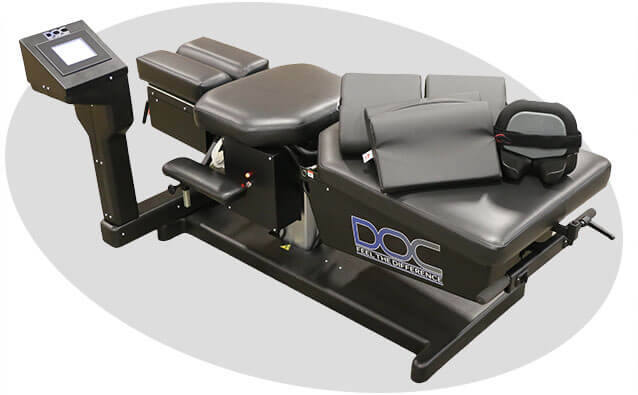
Spinal decompression. When disc involvement is contributing to low-back or leg-referral pain, our computer-guided decompression table reduces intradiscal pressure at the affected level. This is appropriate for disc-driven referral patterns, not for purely muscular low-back soreness.
Return-to-play guidance. Every evaluation includes a conversation about what to modify in your game, how long to stay off the court, and what to address mechanically to reduce re-injury risk. Getting you back on the court in good shape is the goal, not keeping you out of it.
What Actually Helps With Prevention
If you are playing pickleball regularly and want to stay in good shape for it, a few practices make a meaningful difference:
- Warm up with movement, not static stretching. Five to ten minutes of walking, arm circles, bodyweight squats, and light lateral steps prepares the tissues for play. Holding static stretches before activity does not reduce injury risk and can temporarily reduce power output.
- Build rotator cuff strength specifically. External rotation with a light resistance band (elbow at your side, rotating outward) targets the infraspinatus and teres minor directly. This is the single most effective shoulder-injury prevention exercise for paddle sports, and most players have never done it.
- Use court-appropriate footwear. Pickleball shoes are built with lateral support for the side-to-side movement pattern. Running shoes are designed for forward motion only and provide minimal lateral support, increasing ankle and knee risk with every direction change.
- Ramp up volume deliberately. If you are adding pickleball to your schedule, increase frequency over four to six weeks rather than going daily immediately. Tendons and discs adapt more slowly than your motivation.
- Know your structural baseline. If you have a history of low-back disc issues, prior shoulder injury, or arthritic knee changes, pickleball can still be part of your life. It just requires a lower threshold for evaluation when symptoms appear, and sometimes a modified approach to how and how often you play.
Staying Active Is the Goal
We are strong advocates for patients staying active as long as possible. Movement is one of the most effective tools for spinal health, joint preservation, and long-term function. The goal of evaluating a pickleball injury at our office is never to tell you to stop playing. It is to find what is actually happening, address it properly, and get you back on the court with a plan that keeps you there for years rather than months.
Dr. Banman has over 23 years of clinical experience and works directly with active adults who want to maintain an active lifestyle without trading their long-term structural health for short-term activity. If you are dealing with shoulder, knee, or back pain that seems tied to your pickleball routine, that is worth a conversation.