

Eight hours in a chair. That is the workday for a lot of people in Lakewood Ranch right now. And for most of them, the low back ache that sets in by afternoon is not a mystery to solve so much as a mechanism to understand. The pelvis tilts. The lumbar curve disappears. The discs take more load than they are built to handle. By day's end, standing up feels like a negotiation.
Posterior pelvic tilt is the specific movement that kicks off this chain. It is the opposite of anterior pelvic tilt, and it is arguably the more common problem in people who sit for work. Understanding what it does to your spine is the first step toward actually addressing the pain rather than waiting it out, which, if you have ever waited it out, you know tends not to work. For a deeper look at how these kinds of structural loading issues cause chronic lower back pain, the clinic has a full breakdown on the conditions page.
What Posterior Pelvic Tilt Actually Means
The pelvis is not a fixed structure. It tilts forward (anteriorly) and backward (posteriorly) throughout the day depending on posture, muscle balance, and load. A neutral pelvis is the position where the lumbar spine maintains its natural inward curve, or lordosis: slightly arched, roughly 40-60 degrees, enough to distribute spinal compression evenly across the front and back of each disc.
When the pelvis tilts posteriorly, the bottom of the pelvis rotates backward and the top of it rotates forward. Picture scooping a bowl: that rounding motion. The immediate effect on the lumbar spine is that the lordosis flattens. Instead of a gentle inward curve, you get a straight or even slightly rounded lower back. The lumbar spine goes into flexion when it should be in extension.
That shift changes everything about how the disc handles compression. Lumbar discs are designed to take load best in a neutral or mildly extended position. In flexion, pressure shifts to the back of the disc, the posterior annulus, which is both the thinnest and the most nerve-dense part. Sit like this for 40 minutes, and the disc starts to push fluid posteriorly. Do it for eight hours a day, five days a week, for years, and you have a reliable mechanism for disc degeneration, disc herniation, and the kind of deep low back ache that does not respond to stretching.
Why Sitting Causes It
Posterior pelvic tilt happens in a chair because sitting requires hip flexion. When your hips bend to 90 degrees, the hamstrings, which run from the base of the pelvis (the ischial tuberosity) down the back of the thigh, pull tight. Tight hamstrings tug the bottom of the pelvis backward. That is the posterior tilt.
At the same time, the hip flexors, particularly the iliopsoas, are in a shortened position and gradually lose their ability to hold the pelvis level. The glutes, which should counter the hamstring pull and support the lordosis, are in a compressed, inhibited state. They stop firing effectively. Researchers have called this gluteal amnesia, and it is a real phenomenon: the glute max can lose neural drive within 20 minutes of sustained sitting.
How Posterior Pelvic Tilt Causes Lower Back Pain
There are several distinct ways the lost lumbar curve translates into pain.
Disc loading. As described above, posterior tilt shifts compressive load to the back of the disc. Over time this can accelerate the desiccation (drying out) of the disc, reduce its height, and set the stage for bulging or herniation. Many patients who come in with an MRI showing a posterior disc bulge at L4-L5 or L5-S1 have spent years sitting in posterior tilt without realizing it.
Facet joint compression. The facet joints at the back of each vertebra take on abnormal compressive loads when the lumbar curve flattens. This can produce joint irritation, local inflammation, and the specific kind of stiffness that is worst when trying to stand up after sitting for a long time.
Paraspinal muscle fatigue. The erector spinae and multifidus muscles, which run alongside the lumbar spine and normally help maintain lordosis, have to work harder against the flattened posture. They fatigue. Fatigue leads to the dull, diffuse ache across the low back that many desk workers describe as their "normal" by 3 pm.
Sacroiliac joint stress. The SI joint depends on the normal lumbopelvic relationship for its stability. When the pelvis chronically tilts posteriorly, shear forces at the SI joint increase. Some patients with posterior pelvic tilt develop SI joint pain that mimics disc-related sciatica, which is why it matters to identify the actual driver before treating.
In 23 years of practice, I have found that the patients most frustrated by their back pain are often the ones whose pain has been treated as a muscle problem when the real driver is postural loading on the disc and facet joints. Fixing the posture alone often does not resolve it because the disc or joint is already irritated. You need to address both.
Signs Your Posterior Pelvic Tilt May Be the Issue
No single sign is definitive, but the following pattern is common enough to flag:
- Low back pain that gets progressively worse through the workday and improves with lying down or walking
- Pain or stiffness specifically when first standing after prolonged sitting, easing somewhat after a few minutes of movement
- A flat or "tucked" appearance to your lower back when you look in the mirror from the side
- Tight hamstrings that resist stretching (they tend to be chronically shortened in posterior tilt)
- Weak or "disconnected" glutes, even if you exercise regularly
- Pain that worsens when bending forward and eases slightly when you arch your back
- History of prolonged desk work, long commutes, or any occupation requiring sustained seated posture
Worth noting: posterior and anterior pelvic tilt can coexist, alternating throughout the day as muscles fatigue and posture shifts. Some people spend mornings in an anterior tilt (lumbar arch excessive) and afternoons in posterior tilt as their erectors give out. The evaluation needs to account for that.
What the Evaluation Looks Like
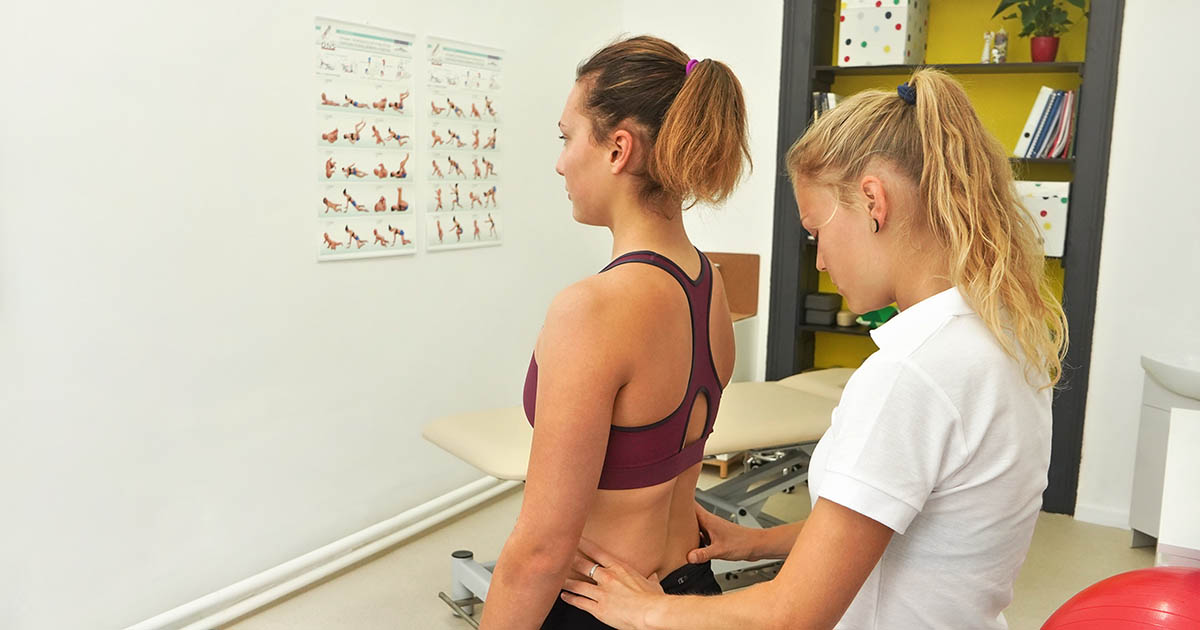
When a patient comes to us in Lakewood Ranch with chronic low back pain from desk work, the first priority is understanding where the loading is coming from, not just treating the symptom. The evaluation includes postural assessment in standing and seated positions, motion testing of the lumbar spine and pelvis, hip range of motion testing, and muscle activation screening (particularly of the glutes and hip flexors).
If there is any indication of disc involvement, such as leg symptoms, significant range of motion loss, or a history of MRI findings, we add non-surgical spinal decompression to the discussion early. Decompression creates negative intradiscal pressure that can pull herniated material back and restore disc hydration, which is relevant when years of posterior tilt have degraded the disc itself. Chiropractic adjustments alone address segmental mobility but not the intradiscal environment.
The goal is to leave the first visit with a clear picture: which structure is generating the pain, what postural pattern is driving the load, and what combination of structural correction and ergonomic change is likely to move the needle.
What Treatment Involves
There is no single fix for posterior pelvic tilt. The pattern usually requires changes in at least three areas at once.
Structural correction
Chiropractic adjustments restore segmental movement to lumbar vertebrae that have stiffened under repeated flexion loading. When specific levels have lost extension mobility, they tend to take disproportionate load. Restoring movement distributes that load more evenly. Many patients notice an immediate reduction in the deep ache after their first few adjustments, though the structural correction takes longer to hold.
If disc involvement is confirmed or suspected, spinal decompression therapy is often added. We have a decompression table at our Lakewood Ranch office used with patients who have lumbar disc issues contributing to their sitting pain. Sessions typically run 15-20 minutes and are not painful.
Muscle rebalancing
The hamstrings need to lengthen. The glutes need to relearn how to activate. The hip flexors, particularly the iliopsoas, need to be released from their shortened, inhibited state. This is not just stretching. It is a specific sequence of exercises that most patients can do in 10 minutes a day, and it takes consistent repetition over several weeks before the nervous system stops defaulting to the old pattern.
Some patients benefit from Class IV laser therapy or electrical muscle stimulation (EMS) to address the soft tissue component, particularly when the paraspinal muscles are in a chronic state of guarding. These modalities support the manual work without replacing it.
Ergonomics and sitting mechanics
The structural correction will not hold if the patient returns to the same chair, in the same position, for eight hours a day. Ergonomic guidance is part of the treatment plan. Key points:
- Seat height should allow the feet to rest flat on the floor with hips at roughly 90 degrees, not squeezed past 90 (which pulls the pelvis into posterior tilt further)
- A lumbar support roll or adjustable chair backrest that maintains the inward curve reduces posterior tilt immediately
- Standing desk intervals of 20-30 minutes per hour give the disc a chance to rehydrate and the glutes a chance to wake up
- Sitting at the front edge of the chair rather than slumping against the back activates the core slightly and resists posterior tilt
- Hip flexor release breaks (a simple standing hip flexor stretch held for 30 seconds per side) done once per hour matter more than most patients expect
What to Expect From Recovery
Most patients with posterior pelvic tilt and non-complicated disc involvement notice meaningful improvement within 4-6 weeks of consistent care and habit change. The pain that spikes at the end of the workday tends to diminish first. Morning stiffness tends to resolve more slowly. Patients who also address the ergonomic component progress faster than those who treat the spine but continue sitting identically.
If there is radiographic evidence of disc degeneration or existing disc herniation, the timeline for disc-related symptoms is longer, typically 8-12 weeks for meaningful improvement with a structured program. That is not a reason to delay starting. Posterior disc load that continues to compound over months accelerates the degeneration that lengthens the recovery window later.
The goal we work toward is a patient who understands their postural driver, has the structural mobility to maintain a neutral lumbar curve, and has the muscle function and ergonomic setup to protect it during the workday. At 23 years of practice, that outcome is achievable for the majority of patients who stick with the program. The patients who do not improve are generally those who address the structure but not the habits, or the habits but not the structure.
For a look at the companion pattern, where the lumbar curve is excessive rather than absent, see our post on anterior pelvic tilt and lower back pain. And if you are dealing with tight hip flexors as a contributor, tight hip flexors and low back pain covers that connection in more detail.