
Spondylolisthesis in Lakewood Ranch: a slipped vertebra doesn't always explain why you hurt.
Spondylolisthesis means one vertebra has slipped forward over the one beneath it, and it can show up as low back pain, stiffness, or leg pain. Here is what usually gets missed: an X-ray can measure that slip and grade it 1 through 4, but the grade on the film rarely predicts how much you actually hurt. A grade 1 slip can sit quiet for decades. So the first visit goes after one thing, what is truly generating your pain right now, and only then do we settle on what to do. Serving Lakewood Ranch, Bradenton, and Sarasota.
Not every slip is one we should be treating. Grade and stability decide it, some cases do well with what we offer, some need stabilization alone, and a few belong with a surgeon. The exam sorts that out, and if we are not the right fit, you will hear it straight.
- Non-surgicalstabilization-focused care
- Low-gradecases usually managed conservatively
- 23+ yrsDr. Banman's experience
What spondylolisthesis is, and the two main types.
The name simply means one vertebra has slipped forward on another. Which type you have, and how far it has slipped, shapes the whole plan.
Isthmic (from a stress fracture)
A small stress fracture in part of the vertebra lets it slide forward. This type often starts younger, frequently in athletes who do repeated back-bending, gymnasts, football linemen, weightlifters, and may not cause symptoms until later in life.
Degenerative (from wear)
With age, the discs and small joints wear and loosen, allowing a vertebra to drift forward. This type is more common after 50 and often shows up alongside spinal stenosis and disc degeneration.
Grades & why they matter
Slippage is graded 1 to 4 by how far the vertebra has moved. Most cases are low-grade (1-2) and respond well to conservative care. The grade and stability guide whether gentle decompression is appropriate or whether the focus should be purely on stabilization.
Why a vertebra slips.
It usually comes down to either a stress fracture earlier in life or wear-and-tear loosening later in life.
Repetitive back extension
Sports and activities with repeated arching, gymnastics, diving, football, weightlifting, are classic causes of the stress fracture behind isthmic slips.
Age-related degeneration
Worn discs and arthritic facet joints loosen the segment over time, the most common cause after 50.
Genetics
A family tendency toward thinner or weaker bony bridges in the spine raises the risk of isthmic slips.
Prior injury
An acute back injury can be the moment a previously silent stress defect finally slips.
Weak core support
The deep stabilizing muscles act as the spine's natural brace. When they're weak, a loosened segment moves more and hurts more.
General wear & load
Years of heavy lifting and high-load activity accelerate the degeneration that leads to slippage.
Stabilize first, calm the nerves, restore function.
Care is matched to your type and grade. We can't push a slipped bone back into place, but we can make the segment stable, calm the irritated nerves, and get you moving comfortably again.
Core stabilization & rehab
The foundation of care, building the deep muscles that brace the slipped segment so it moves and hurts less.
Learn more →Chiropractic Care
Gentle, targeted care to the segments around the slip restores motion where it's safe, without forcing the unstable level.
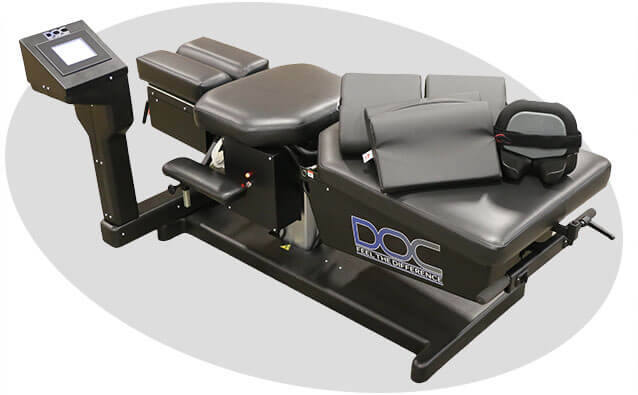
Learn more →Spinal Decompression (select cases)
For some low-grade cases, gentle traction may ease nerve-related leg pain. Suitability depends on the type and grade, decided after exam.
Learn more →Class IV Laser
Targets inflammation around irritated nerves and tissue to help calm flares.
Learn more →Quick answers.
Can spondylolisthesis be treated without surgery?
Most low-grade cases are managed successfully without surgery. Conservative care focused on core stabilization, activity modification, chiropractic care to the surrounding segments, and pain control helps the majority of people. Surgery is generally reserved for high-grade, progressive, or unstable slips with significant nerve compression that haven't responded to conservative care.
Is spinal decompression safe with spondylolisthesis?
It depends on the type and grade. For some low-grade cases, gentle decompression may help relieve nerve-related leg pain, but it isn't appropriate for every spondylolisthesis, especially unstable or higher-grade slips. That's exactly why a thorough exam comes first, to determine whether decompression is suitable or whether stabilization-focused care is the better path.
Will spondylolisthesis get worse over time?
Many low-grade slips stay stable for years, especially with good core support and sensible activity. Some degenerative cases progress slowly with age. Periodic monitoring and a strong stabilization program are the best ways to keep it from worsening and to keep you active.
What exercises help spondylolisthesis?
Core and deep-stabilizer strengthening is the foundation, because strong support muscles compensate for the slipped segment. Flexion-biased and low-impact movements are often better tolerated than repeated extension. We prescribe the specific program based on your type, grade, and exam, rather than a one-size-fits-all routine.
Why does it cause leg pain?
When a vertebra slips, it can narrow the space where spinal nerves exit, pinching them and producing sciatica-type leg pain, numbness, or tingling. Easing that nerve pressure and stabilizing the segment is how we calm the leg symptoms.
Do I need imaging?
Usually yes, at least initially. Because spondylolisthesis involves the position and stability of a vertebra, X-rays (sometimes including flexion/extension views) help confirm the type and grade, which directly shapes the plan. Dr. Banman will tell you what's needed and why.
Insurance?
Chiropractic adjustments may be covered. Spinal decompression is typically not covered by insurance. HSA/FSA accepted. Payment options →
When to come in sooner.
Most spondylolisthesis is a manage-it problem. A few symptoms mean same-day evaluation.
Loss of bowel or bladder control
A true emergency and a sign of cauda equina compression. Go to the emergency room first, then call us.
Progressive leg weakness
Legs getting weaker over days, not stronger, warrants quick evaluation to protect nerve function.
Saddle numbness
Numbness in the area that would touch a bicycle seat is another cauda equina warning sign. Emergency department first.
Rapidly worsening back or leg pain
A slip that seems to be progressing quickly, with escalating pain, should be evaluated promptly rather than waited out.
Fever or unexplained weight loss
Uncommon, but it changes the workup. We coordinate with your primary care if that picture is present.
History of cancer
New back pain in someone with a cancer history warrants imaging before a treatment plan. We don't skip that step.
Let's find out what is actually causing your pain.
An honest exam, an honest plan, and a straight answer about whether we can help. The quickest path is a phone call.