

Third morning this week. You roll over, try to sit up, and the familiar pull through the base of your skull and down into your trapezius reminds you that last night's eight hours did not help. You're not alone. In the Lakewood Ranch and Bradenton area, this scenario comes up at nearly every new patient neck evaluation. And the first question Dr. Banman asks is usually not "what exercise are you doing" but "what does your sleep setup look like."
The pillow question matters more than most people expect. Not because the right pillow cures cervical disc problems or resolves a pinched nerve, but because the wrong pillow can undo several days of progress in a single night. Eight hours is a long time to hold any position poorly. If you're being treated for neck pain in Lakewood Ranch, optimizing your sleep surface is one of the first things we discuss, because it removes a daily stressor from the equation.
Why the Cervical Spine Needs More Than "Comfortable"
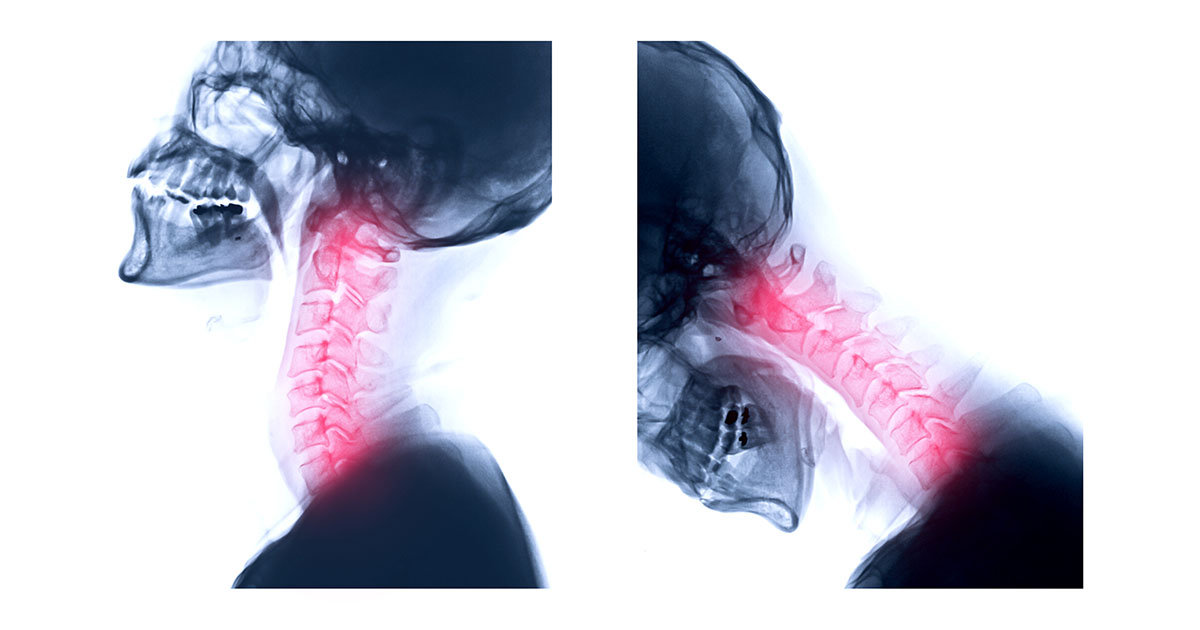
Your cervical spine has a natural lordotic curve, a gentle C-shape that faces forward when you look at the spine from the side. That curve is not decorative. It distributes compressive load evenly across the disc surfaces, keeps the facet joints in a neutral relationship, and gives the spinal cord the space it needs as it passes through the cervical vertebrae.
When you sleep, gravity and your body weight test that curve for eight hours straight. A pillow that's too high pushes the neck into flexion, compressing the front edges of the cervical discs and putting the posterior facet joints on stretch. A pillow that's too low lets the neck fall into extension, compressing the posterior disc margins and facet joints from the other direction. Either pattern, repeated nightly, can trigger or aggravate the same structures you're trying to rehabilitate during the day.
This is why "comfortable" is not a sufficient standard. Your brain adapts to familiar positions, including bad ones. The position that feels comfortable after years of sleeping the same way may be exactly what's loading the structures we're trying to take pressure off. What we're aiming for is a pillow that maintains the natural cervical curve in whatever position you spend most of your night in.
Pillow Loft: The Number That Actually Changes Things
Loft is the height of the pillow once your head is resting on it. Not the package's stated height, not the height fresh out of the bag, but the compressed loft under your actual head weight in your actual sleep position. This number matters more than material, price, or brand, and it varies by how you sleep.
Side sleepers need the highest loft, because they need to bridge the gap between the side of the head and the mattress. That gap is roughly equal to shoulder width at the point where the neck meets the shoulder. For most adults that's somewhere between 4 and 6 inches. If the loft falls short of that gap, the neck tilts toward the mattress all night, laterally flexing the cervical spine on one side and compressing the facets on the other.
Back sleepers need a lower profile pillow. The goal is to support the natural curve without pushing the chin toward the chest. A pillow that's too thick for a back sleeper is one of the most consistent contributors to upper cervical tension and morning headaches that we see. Many back sleepers do well with a low-profile contoured pillow or even a dedicated cervical roll tucked under the neck with only a thin pillow beneath the head.
Stomach sleepers face a different problem entirely. No pillow choice makes stomach sleeping cervically neutral, because the position itself requires the neck to be rotated to one side for the duration of sleep. If stomach sleeping is a habit you've had for decades, this is worth addressing with your provider directly. A pillow can blunt some of the soft-tissue strain, but it can't undo the rotational compression on the cervical facets and disc margins.
Materials: What Each Actually Delivers
Once you know your loft target, material affects how consistently that loft is maintained and how the pillow responds to temperature and position changes.
- Memory foam (solid block): Conforms closely to cervical contours, maintains loft well, tends to retain heat. Works well for side sleepers who stay in one position. Loses its shape-conforming properties in cold rooms. Latex has a similar support profile with better temperature neutrality and longer durability.
- Shredded memory foam or latex: Adjustable because you can remove or redistribute fill. Good if you're between positions or not sure of your ideal loft. Requires periodic fluffing to prevent compression zones from developing.
- Buckwheat: Firm, adjustable, and surprisingly good for back sleepers who need cervical curve support. The fill can be removed to dial in the loft. Not ideal if your partner is a light sleeper; the fill shifts audibly.
- Down and down-alternative: Compresses significantly under head weight. The stated loft is almost never the actual sleeping loft. Most patients who sleep on down pillows are effectively sleeping on a very flat surface that bottoms out under the weight of the head. Rarely the right choice for anyone with active cervical problems.
- Water-filled (adjustable base): The research base here is actually stronger than you might expect. Several small controlled trials found water-pillow designs provided better cervical alignment and reported less morning pain than standard foam pillows. The adjustability is the advantage: you dial in the water volume to your specific loft need rather than choosing from preset sizes.
The material question is secondary to the loft question. A buckwheat pillow at the wrong height is worse than a moderately good memory foam pillow at the right height. Get the height right first, then consider material.
How Your Mattress Changes Everything
Here's the variable most pillow guides skip: your mattress firmness changes the ideal pillow loft. A soft mattress lets your shoulder sink further into the surface when you sleep on your side, reducing the ear-to-mattress gap. That means you need slightly less loft than you would on a firm mattress. On a firm mattress, your shoulder sits higher relative to the mattress surface, so the gap is larger and you need more loft to fill it.
If you've tried different pillow heights and can't find one that works consistently, it's worth taking a moment to notice whether the problem changes depending on what bed you're sleeping in. Hotel mattresses are usually firmer than home mattresses, and many patients report their neck feels better or worse depending on where they slept, which is often a mattress-loft interaction rather than a location coincidence.
What We Actually See in the Clinic
After 23 years of evaluating cervical patients in Lakewood Ranch and the surrounding Bradenton area, there are a few pillow-related patterns that show up consistently.
Patients who sleep on their back with too-tall a pillow often present with chronic upper cervical tightness and morning headaches that resolve within an hour or two of being upright. The flexed cervical position compresses the suboccipital muscles and posterior facet capsules overnight, and the pain dissipates once gravity and movement decompress those structures. Changing to a flatter pillow often noticeably reduces the frequency of those morning headaches within a few weeks.
Patients who are long-term stomach sleepers frequently show asymmetric cervical rotation range of motion, tighter rotation to one side than the other. This is the accumulated effect of years of sleeping with the neck rotated in a fixed direction. The asymmetry often tracks with which way they prefer to turn their head when stomach sleeping. The pillow is less important here than the position itself.
For patients with active cervical disc herniations or a herniated disc at the cervical level, sleep position and pillow height can be the difference between a tolerable morning and one that starts with significant nerve pain. We spend real time in these evaluations on sleep ergonomics because the disc does not get a break at night unless the loading is managed correctly.
Questions to Answer Before You Buy a "Specialty" Pillow
The cervical pillow market is enormous, and many products are marketed with medical-sounding claims that outrun the evidence. Before spending significant money on a specialty pillow, work through these questions:
- What is my primary sleep position? If you genuinely don't know, you can set up your phone to record a time-lapse at low quality, or ask your partner. You may spend more time on your back than you realize, or vice versa.
- What is my shoulder-to-ear distance when lying on my side? Measure it with a ruler while lying on a firm surface. This is your baseline loft target for side sleeping.
- Is my mattress soft, medium, or firm? If soft, reduce your target loft by roughly an inch from the measurement above. If very firm, you may need to add some.
- Have I addressed the underlying cervical issue? A pillow addresses loading mechanics. It does not decompress a disc, resolve a facet syndrome, or treat a pinched nerve. If you haven't had your cervical spine evaluated, the pillow conversation is incomplete.
- Am I a hot or cold sleeper? This affects material choice more than it affects support. Memory foam sleeps warm; latex and buckwheat sleep cooler.
Spinal Decompression and Neck Pain: When Sleep Ergonomics Is Not Enough
For many patients, pillow optimization reduces nighttime loading and accelerates recovery. But for patients with cervical disc herniations, cervical spinal stenosis, or significant nerve root compression, ergonomic changes are supportive, not corrective. The structural issue needs to be addressed directly.
In our Lakewood Ranch office, we use cervical spinal decompression for appropriate disc cases. Decompression creates a negative intradiscal pressure that draws herniated material back toward center and promotes hydration of the disc tissue. It is not a first-line treatment for every neck patient, but for patients who have had a disc herniation confirmed on imaging and have not responded adequately to manual therapy alone, it changes what's possible.
We also use Class IV laser therapy for soft-tissue inflammation in the cervical region, which can reduce the inflammatory component that makes nerve compression more symptomatic. And for patients whose neck pain has a postural driver, we look at forward head carriage, thoracic kyphosis, and work ergonomics alongside the pillow question, because a single structural factor rarely explains everything.
When to Stop Experimenting and Get Evaluated
If you've changed pillows twice and still wake up with neck pain, or if your morning stiffness is accompanied by any of the following, a pillow is not the issue and you need an evaluation:
- Numbness, tingling, or weakness radiating into the arm or hand
- Pain that worsens with neck extension or rotation beyond about 45 degrees
- Morning headaches that start at the base of the skull and radiate forward
- Neck pain following any kind of trauma, even a minor one
- Symptoms that have not improved at all after three to four weeks of the same pattern
Arm or hand symptoms in particular can indicate nerve root involvement, which is a different clinical situation than pure mechanical neck pain. That needs to be identified and addressed specifically. For a deeper look at what drives different types of neck pain and what the evaluation looks for, see the overview on neck pain and headaches at our Lakewood Ranch clinic.
For many patients, the right answer is not either/or. A better pillow, the right cervical treatment plan, and an honest look at sleep position together tend to produce faster resolution than any single change alone. We work through all three in the initial evaluation so you're not guessing at which variable matters most.