

You wake up and your left foot feels like it is wrapped in a sock made of static. Or maybe it happens at your desk: two hours into the afternoon and your toes go numb. You shake the foot, it passes, and you go on with your day. Until it starts happening more often. Until it does not fully pass.
The question that matters is not "how do I make this stop for a minute?" It is "where is this signal actually coming from?" Because foot numbness and tingling are not a single condition. They are a symptom that at least four different anatomical problems can produce, and the treatment for one is completely wrong for another. Getting that right is the first step toward actually fixing it.
At our Lakewood Ranch office, Dr. Banman has evaluated nerve and numbness cases for 23 years. The differentiation below is what that kind of evaluation looks at, and why it matters which category you fall into.
Why the source matters before anything else
Foot numbness gets mismanaged constantly, mostly because people (and sometimes providers) skip the "why" and go straight to treatment. Compression socks for what is actually sciatica. Orthotics for what is actually a lumbar disc compressing the L5 nerve root. Anti-inflammatory medication for what is actually diabetic peripheral neuropathy that needs a different program entirely.
None of those approaches hurt anyone. But none of them fix the problem when the cause is wrong. The neuropathy program at Spine and Wellness Center Lakewood Ranch is built on this principle: before any treatment starts, find out what is actually driving the signal. Numbness and tingling in the feet trace back to one of four sources, and the exam findings tell you which.
Source 1: your spine (the most common reason we see in practice)
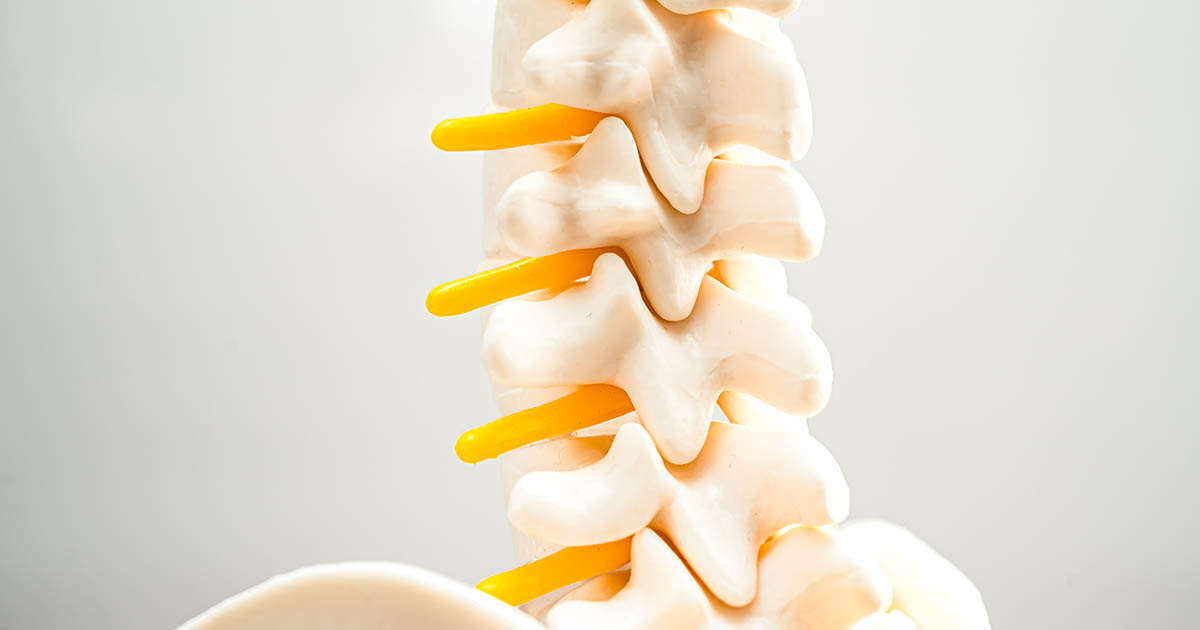
The spinal cord ends around the first or second lumbar vertebra. Below that point, the nerves that supply your legs and feet travel in a bundle called the cauda equina before branching into individual roots. The L4, L5, and S1 nerve roots specifically supply the foot and toes. When any of those roots gets compressed, the signal travels down the nerve to the foot, and you feel it there, not at the source.
Two spinal problems cause this most often:
- Herniated or bulging lumbar disc: The disc between two vertebrae pushes into the nerve root canal. L5 compression tends to affect the top of the foot and big toe. S1 compression tends to affect the outer edge of the foot and small toes. L4 affects the inner calf and inside ankle.
- Lumbar spinal stenosis: Narrowing of the spinal canal (usually from age-related bone and disc changes) squeezes multiple nerve roots. The classic sign is that the numbness and leg pain get worse when you walk or stand, and ease up when you sit or lean forward.
Sciatica is the word most people use for this category. Technically sciatica means irritation of the sciatic nerve, which is formed by the L4-S1 roots. When the sciatic nerve is involved, patients typically feel the numbness and tingling running from the lower back or buttock down the leg into the foot, not just in the foot alone. That distribution pattern is diagnostically important.
For more on how spinal nerve compression produces foot symptoms, see our page on sciatica in Lakewood Ranch and our page on the non-surgical spinal decompression program we use to take pressure off compressed nerve roots.
Source 2: the peripheral nerves themselves
The peripheral nerves are the wires that run from your spinal cord out to your extremities. Spinal nerve root compression (Source 1) happens at the beginning of that wire, inside or near the spinal column. Peripheral neuropathy is damage or dysfunction at some point along the wire itself, often far from the spine.
Several things damage peripheral nerves:
- Diabetes: High blood sugar over time damages the small blood vessels that feed the nerves. The feet and hands go first because the nerves to those areas are the longest (longer wire, more exposure). Diabetic peripheral neuropathy typically produces numbness, tingling, and burning that starts symmetrically in both feet at the same time.
- Nutritional deficiencies: B12 deficiency is the most common. People on metformin (a common diabetes medication, ironically) or with absorption issues from gut conditions can develop B12-deficient neuropathy.
- Chronic alcohol use, certain medications (some chemotherapy agents, some blood pressure drugs), and toxin exposures can all produce peripheral nerve damage with similar foot symptoms.
- Idiopathic neuropathy: In a meaningful percentage of cases, especially in people over 60, no specific cause is found. The nerves are degenerating and the trigger is either genetic or unknown. This does not mean untreatable.
The distinguishing feature of peripheral neuropathy versus spinal compression: neuropathy tends to be bilateral (both feet), starts at the toes and moves upward (a "stocking" distribution), and is constant rather than positional. Sciatica and stenosis tend to be one-sided, or if both sides are involved, one is usually more prominent, and the symptoms change with position.
In 23 years of practice, the single most important exam finding that separates spinal from peripheral nerve causes is positional change. If lying down makes the numbness better, the spine is usually involved. If the numbness is the same whether you are standing, sitting, or lying flat, peripheral nerves or circulation are more likely.
Source 3: local nerve entrapment in the foot or ankle
The nerves that supply the foot can also be pinched as they pass through tight anatomical tunnels in the ankle itself. This is not a spinal problem and not a whole-nerve problem. It is a local compression.
Tarsal tunnel syndrome is the foot equivalent of carpal tunnel syndrome in the wrist. The posterior tibial nerve passes through a narrow channel behind the inner ankle. When that tunnel is crowded, the nerve gets compressed and produces numbness, burning, and tingling along the bottom of the foot and into the toes. Flat feet, ankle injuries, and prolonged standing can all contribute.
Morton's neuroma is another local issue: a thickening of the tissue around a nerve running between the third and fourth toes. It produces a distinctive burning numbness between those specific toes, often described as feeling like a pebble under the ball of the foot. High-impact activity and narrow footwear are common triggers in the Lakewood Ranch and Sarasota area where outdoor walking and pickleball are year-round activities.
What separates these from spinal causes: the numbness stays in the foot and does not travel up the leg. There is no back or buttock pain involved. Pressing directly over the entrapment point often reproduces the symptom.
Source 4: circulation
Poor blood flow to the feet produces coldness, color changes, and sometimes a muted numbness, but circulation problems tend to look different from nerve problems. With peripheral artery disease (PAD), the foot might feel cold, look pale or mottled, and the numbness often comes on with activity and resolves quickly with rest. That pattern (claudication) overlaps with stenosis symptom patterns, which is one reason evaluation matters.
Raynaud's phenomenon, venous insufficiency, and diabetes-related microvascular damage can all produce sensory changes in the feet. Some patients have both neuropathy and circulation issues simultaneously, which makes the picture more complex and underscores why a simple "try these supplements" approach falls short when the symptoms have been present for months.
What a proper evaluation looks like
At the intake exam, Dr. Banman is looking at the symptom pattern first: which toes are affected, whether both feet or one, whether it is positional, how long it has been going on, and whether there is accompanying back, hip, or leg pain.
Neurological testing comes next. Reflex testing, dermatomal sensation testing (light touch and pinprick across specific zones that map to specific nerve roots), and muscle strength testing along the motor distribution of each nerve root. These findings tell you whether the nerve signal is being blocked somewhere and, roughly, where.
Orthopedic tests, including straight leg raise and slump test, help differentiate spinal nerve root tension from local peripheral nerve problems. Imaging review (if you have brought prior X-rays or an MRI) tells us what the structural picture is. In our office, digital X-ray is available for spinal alignment assessment; soft tissue and disc evaluation requires MRI, and we can coordinate a referral if imaging is indicated.
The goal is a working diagnosis before any treatment starts. "You have foot numbness, let us try decompression" is not the right starting point. "Your exam findings are consistent with L5 nerve root compression secondary to a left-sided disc herniation at L4-5, which is what is producing the top-of-foot numbness and great-toe weakness you are describing" is the right starting point. That specificity is what allows treatment to actually match the problem.
Treatment paths by source
Once the source is clear, the treatment makes sense:
- Spinal nerve root compression (disc or stenosis): Non-surgical spinal decompression creates a negative intradiscal pressure that can help retract disc material away from the nerve root, combined with chiropractic care aimed at restoring proper segmental motion and reducing mechanical load. Class IV laser therapy reduces nerve root inflammation. Many patients in this situation have seen significant symptom reduction without surgery when the disc is still a candidate for conservative care.
- Peripheral neuropathy: The neuropathy program we run combines ReBuilder electrical nerve stimulation, Class IV laser, nutrition support, and regular re-measurement of sensation, balance, and pain. The program is not a cure, and we will not tell you it is. Dr. Banman examines you first and tells you whether he thinks it is a reasonable fit, and results vary from person to person.
- Local entrapment (tarsal tunnel, Morton's neuroma): Decompression of the specific entrapment point, footwear modification, and in some cases custom orthotics. If conservative care does not resolve it, surgical release referral is appropriate.
- Circulation: This path is managed in coordination with your primary care provider or vascular specialist. We work alongside that team, not instead of it.
Red flags that mean see someone today
Most foot numbness is not an emergency. But a few patterns warrant same-day evaluation at an ER, not a chiropractic office:
- Sudden numbness in both feet or legs that came on in minutes, not weeks
- Numbness accompanied by weakness so severe that you cannot stand or walk normally
- Loss of bladder or bowel control alongside lower extremity symptoms (this is cauda equina syndrome and is a surgical emergency)
- Numbness after a fall, accident, or trauma to the spine
- Signs of stroke: sudden onset, one-sided face drooping, arm weakness, speech difficulty alongside the numbness
If any of those apply, go to the emergency department. Everything else, including the foot tingling you have had for three weeks that comes and goes, is a candidate for the evaluation process described above.
The next step if you are in Lakewood Ranch or Bradenton
Foot numbness that has been present for more than two to three weeks, or that is getting progressively worse, deserves a proper look, not just a "wait and see." The exam takes about 45 minutes and at the end of it you will have a clear picture of what is driving the symptom, what the realistic options are, and what the expected timeline looks like.
If you want to learn more about how nerve function and peripheral neuropathy are addressed at our practice before you come in, the neuropathy condition page has a detailed overview of how the nerve system is involved in these symptoms.