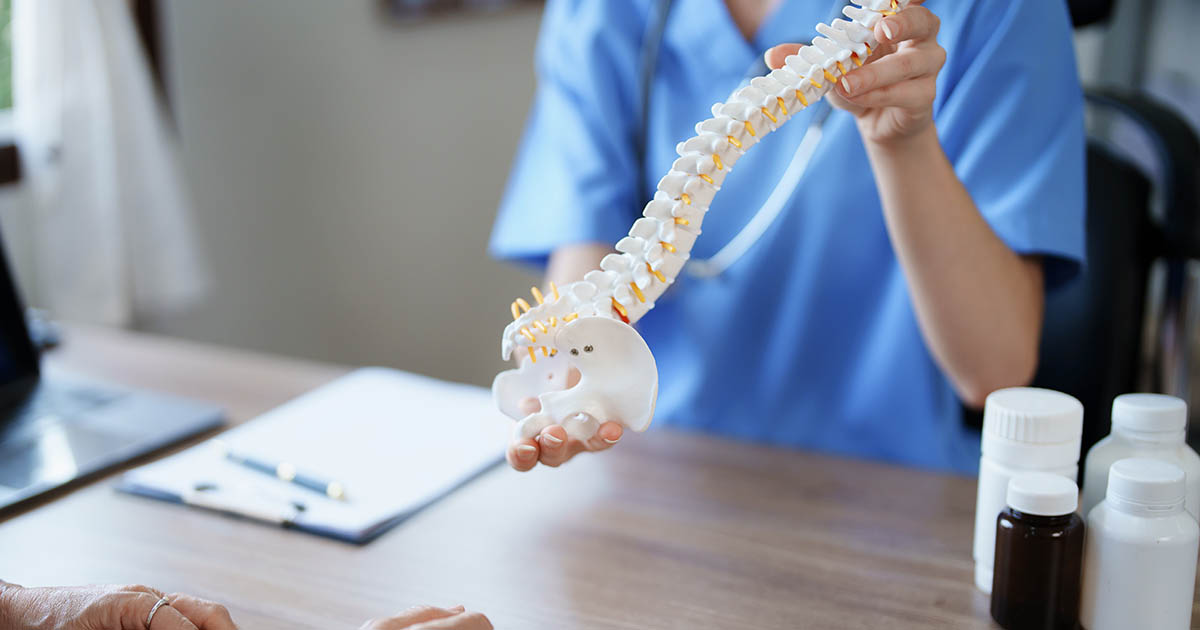


You had back surgery six months ago. The surgeon says the imaging looks good. But you are still stiff first thing in the morning, you still get that ache that travels down one leg when you sit too long, and a friend at your gym mentions that their chiropractor helped them after a similar procedure. Then comes the question almost every post-surgical patient asks us eventually: is chiropractic even safe after back surgery?
The short answer is: yes, there are things chiropractic care can do after spinal surgery. The honest answer is: it depends on what was done, when it was done, and what is still going on. Anyone who gives you a flat yes or flat no without reviewing your operative notes and post-op imaging is not giving you real information. For a complete picture of back pain care after conservative and surgical treatment, this post walks through what we actually look at.
Why this question does not have a single answer
Post-surgical spines are not off-limits for chiropractic. But the approach changes based on five things we always review before treatment:
- What procedure was done and at which levels (discectomy, fusion, laminectomy, artificial disc replacement)
- Whether hardware is present (rods, pedicle screws, interbody cages)
- How much time has passed since surgery
- What symptoms remain and whether any new symptoms have appeared since the procedure
- What post-op imaging shows about the current anatomy
A chiropractor who asks for your operative report and your most recent MRI or CT before treating you is doing their job correctly. One who does not is taking a risk you should not accept on their behalf.
The most common surgeries and what they mean for conservative care
Discectomy or microdiscectomy. A portion of a herniated disc is removed to relieve nerve pressure. The surrounding vertebral structures remain intact. Many discectomy patients do well with conservative care afterward, including gentle mobilization and non-surgical spinal decompression to address residual disc load at the same or adjacent levels. Healing time matters: most surgeons want 6 to 8 weeks of initial recovery before any manual work near the site.
Laminectomy. Part of the posterior bony arch (the lamina) is removed to create more space in the spinal canal, usually for stenosis. The posterior stabilizing structures are altered. Gentle mobilization techniques at non-surgical segments are generally appropriate once cleared. Direct high-velocity manipulation at the surgical level requires additional imaging review and clinical judgment.
Spinal fusion (ALIF, PLIF, TLIF, lateral approaches). Two or more vertebrae are joined with hardware: screws, rods, and often an interbody cage. The fused segment should not receive direct manipulation. The hardware physically prevents the motion anyway, and any significant force at that level risks disturbing adjacent soft tissue. What matters clinically is what happens above and below the fusion. Adjacent segments often become hypermobile over time because they take on the load the fused level no longer shares. That adjacent-segment stress is where a lot of post-fusion back pain originates, and it is often addressable with conservative care.
ACDF (anterior cervical discectomy and fusion). Fusion in the cervical spine. The same principle applies: fused levels off-limits for direct manipulation, adjacent cervical and upper thoracic segments often treatable once adequately healed.
Artificial disc replacement. The disc is replaced with a prosthetic that preserves segmental motion. This is different from fusion: the segment still moves, which changes what is appropriate compared to a fused level. We treat these patients more like post-discectomy cases, with careful attention to the hardware's range of motion limits.
What chiropractic actually offers post-surgically
This is where the conversation often surprises people. Chiropractic care is not only spinal manipulation. At our Lakewood Ranch clinic, the modalities most relevant to post-surgical patients are often the non-manipulative ones.
Non-surgical spinal decompression. Motorized axial traction that gently reduces intradiscal pressure. Used for residual disc issues, adjacent-segment load above or below a fusion, or post-surgical scarring that affects disc hydration. This is not the forceful thrust many patients imagine. It is a slow, precisely controlled pull along the spine's long axis. Many patients with fusion hardware in one section of the lumbar spine can receive decompression targeted at an adjacent level. We always confirm with imaging first.
Class IV laser therapy. Photobiomodulation reduces inflammation and accelerates tissue repair at the cellular level. Particularly useful in the 3 to 12 month post-surgical window when localized inflammation at or near the surgical site is still a factor in persistent pain.
EMS (electrical muscle stimulation). Muscles around a surgical site often weaken or become neurologically inhibited after the procedure and the weeks of reduced activity that follow. EMS helps re-engage those muscles in a controlled, low-load way, which supports stability as rehab progresses.
Soft tissue work. Surgical scarring and protective muscular guarding can restrict movement and create secondary pain patterns well away from the original site. Myofascial techniques address the muscles and fascia that have tightened in response to surgery, not the surgical site itself.
Hyperbaric oxygen therapy. For patients with significant nerve involvement, including those who had surgery to address nerve compression and still have residual neuropathy symptoms, hyperbaric oxygen supports neural tissue recovery and is fully compatible with any post-surgical status. There is no hardware-related contraindication.
Joint mobilization at non-surgical segments. Low-velocity, controlled articular movement to improve range of motion at levels that were not operated on. Not the same as HVLA manipulation.
When spinal manipulation is appropriate and when it is not
High-velocity, low-amplitude (HVLA) manipulation, the technique that produces the audible release most people associate with chiropractic, is the part that legitimately warrants caution in a post-surgical patient.
At the level of a spinal fusion, HVLA manipulation is not appropriate. The hardware prevents the relevant motion anyway. At adjacent segments, clinical judgment and imaging review determine what is reasonable. Post-discectomy patients without hardware, with adequate healing time and surgical clearance, are often candidates for gentle manipulation of non-surgical segments.
Some working principles, not medical advice for any individual:
- Fused segment: No direct HVLA manipulation. Full stop.
- Adjacent to a fusion: Mobilization is often appropriate with review; HVLA requires case-specific assessment.
- Post-discectomy without fusion: Gentle non-surgical segment manipulation is often appropriate once healing is confirmed and surgical clearance is in hand.
- Post-laminectomy: Conservative approach to the posterior structures. Decompression and mobilization are often the better starting point.
- Artificial disc replacement: Case-by-case; the hardware type and surgeon's protocol matter.
What does not vary: we read the operative report before we decide anything.
How Dr. Banman evaluates a post-surgical patient
In our 23 years of practice, the patients who get the most out of post-surgical conservative care are the ones whose provider takes the time to understand exactly what was done before they do anything. Here is what the first visit covers:
- Operative notes. What procedure, which levels, what hardware if any, and what the surgeon documented about the post-op prognosis.
- Post-op imaging. How the site looks now, position of hardware, any adjacent-level changes visible on MRI or CT.
- Symptom picture. What resolved with surgery, what remained, and any new symptoms that appeared since the procedure. New symptoms after spinal surgery always warrant a question about whether they are related to the site.
- Functional testing. Range of motion, neurological screen, orthopedic assessment at and around the surgical region.
- Patient goals. Some post-surgical patients want to get back to a specific sport or activity. Others want to reduce pain medication. Others want to understand what is happening in their spine. The goal shapes the plan.
Based on that, we outline a conservative care plan that respects the surgical anatomy. We are not trying to undo surgery or replace what a surgeon did. We are picking up where surgery left off: addressing what the procedure could not, from adjacent-segment mechanics to residual nerve symptoms to muscular deconditioning. For patients dealing with lingering nerve pain after surgical decompression, our herniated disc treatment page covers the overlap between surgical and non-surgical approaches in more detail.
What to bring to your first post-surgical visit
Most patients do not realize they can request their own medical records, including the operative report, from their surgeon's office. They are required to provide them. What helps us most:
- Operative report (request directly from the surgeon's office)
- Post-op imaging, ideally with the radiologist's report attached
- Current medications, especially any blood thinners or long-term anti-inflammatories
- The surgeon's post-op activity restrictions if they were written down
- A clear description of what changed after surgery and what did not
We can often work with whatever you have. But the more we know about what was done, the more precisely we can build a plan around it.
The bigger picture: surgery solves one problem
Surgery resolves a structural crisis: a disc fragment pressing on a nerve root, a canal too narrow for the cord to pass through without compression, an unstable segment that will not heal on its own. Surgery is very good at that specific job.
It is not designed to restore full function, rebuild the muscles that weakened during recovery, normalize mechanics at adjacent segments, or speed up nerve recovery, which can take months even after successful decompression. Conservative care may be part of the plan after that, depending on what the exam shows.
In our experience in Lakewood Ranch, patients who combine successful surgery with a targeted post-surgical conservative program tend to return to activity more fully, and with less recurrence, than those who consider the surgery the end of the story. That is not a knock on spine surgery. It is recognition that the two approaches are designed to handle different parts of the same problem.
If you have had a spinal procedure and are not where you expected to be at this point in recovery, a consultation is a reasonable next step. You may have more options than you think.