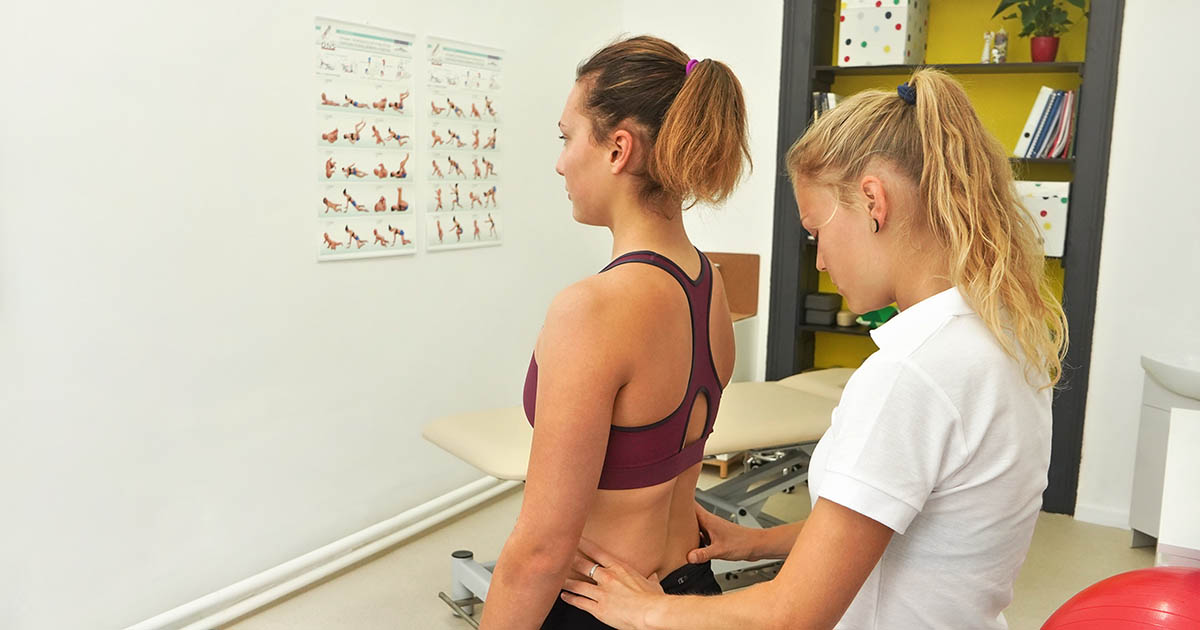


In 23 years of evaluating spine and hip complaints, one finding keeps surprising patients: a muscle they have never heard of is driving the pain they have been chasing for months. The gluteus medius, a palm-sized muscle on the outer edge of your hip, does not make the highlight reel the way hamstrings and hip flexors do. But at our Lakewood Ranch office, gluteus medius weakness shows up as a primary or contributing factor in a majority of patients who present with stubborn lower back pain, outer hip aching, and SI joint dysfunction that will not stay corrected.
The muscle gets missed for a straightforward reason: it rarely hurts where it lives. When a gluteus medius fails, the pain usually appears somewhere else. Lower back. Lateral hip. Knee. Sometimes the opposite side entirely. That gap between the source and the symptom is why patients spend months treating the wrong thing, and why rest alone does not fix it.
What the Gluteus Medius Actually Does
The gluteus medius sits on the outer surface of the ilium, the large flared bone that forms the back of your pelvis. Its main job is pelvic stability during single-leg loading. Every time you take a step, your full body weight passes through one leg for a fraction of a second. The gluteus medius on the standing-leg side fires to hold the pelvis level. Without that contraction, the opposite side of the pelvis drops.
That drop is called a Trendelenburg sign, and it is one of the first things we observe when a patient walks through the clinic door. Many people carry a mild Trendelenburg pattern without knowing it. The pelvis shifts, the trunk leans slightly toward the standing leg to compensate for balance, and that pattern repeats hundreds of times a day with every stride.
Over weeks and months, the compensations stack. The lumbar spine rotates slightly with each step. The SI joints cycle through loading patterns they were not designed for. The IT band tightens on the outside of the thigh. The hip bursa gets compressed against the greater trochanter. None of these structures are the original problem. The problem is upstream, at a muscle that fired too late, too weakly, or not at all.
How Gluteus Medius Weakness Causes Lower Back Pain
The lumbar spine is built to absorb and transfer load in a relatively straight vertical line. When the pelvis drops on one side with every step, the lower lumbar vertebrae have to accommodate a lateral tilt that compounds over thousands of steps per day. The facet joints at L4-L5 and L5-S1, the two most common levels for disc problems, end up loading asymmetrically. That pattern is a recognized contributor to disc herniation and facet joint irritation on the overloaded side.
The deeper layer of the problem involves the lumbar multifidus, a stabilizing muscle that works in coordination with the gluteus medius. When the glute underperforms, the multifidus takes on extra load. It cannot sustain that indefinitely. Multifidus fatigue produces the lower back ache that gets worse through the day, peaks after 20 to 30 minutes of walking or standing, and briefly eases when you sit down. That specific pattern, worse with sustained activity and better with brief rest, is a clinical signal that the stabilizers are the story, not just the disc.
A pattern we see regularly: a patient has imaging showing a disc bulge and has been told injections or surgery are the next step. The disc finding is real. But the disc got there because the gluteal stabilizers failed first, and addressing the disc alone leaves the loading problem intact. The disc comes back.
The Hip Side: Bursitis, IT Band, and Piriformis
Beyond the lower back, a weak gluteus medius produces a specific cluster of hip symptoms that routinely get attributed to other causes.
Lateral hip pain (greater trochanteric bursitis). The bursa that cushions the outer hip sits directly over the greater trochanter, near where the gluteus medius attaches to the femur. When the muscle is weak and the pelvis tips with each step, the bursa gets repeatedly compressed. Diagnosing the bursitis is accurate. But treating only the bursa, with a cortisone injection or rest, leaves the loading pattern that inflamed it still running. The bursa reliably returns once activity resumes.
Hip pain that mimics sciatica. The piriformis, a deep hip rotator, picks up extra stabilizing duty when the gluteus medius does not carry its share. An overworked piriformis can compress the sciatic nerve as it exits the pelvis. The result is a deep, aching buttock pain that radiates into the back of the thigh, sometimes reaching the calf, a pattern that reads exactly like disc-driven sciatica. The distinction matters because the treatments differ significantly.
IT band and outer knee pain. The tensor fasciae latae, a small hip muscle that feeds into the IT band, absorbs load the gluteus medius was supposed to handle. An overworked TFL pulls the IT band taut. You notice it as outer knee pain on stairs or during runs, and as thigh tightness that foam rolling temporarily relieves but that returns within 24 hours. Treating the band is addressing a consequence. The cause is the hip.
Signs That Point to Gluteus Medius Weakness
You do not need imaging to suspect this finding. Several patterns show up in daily activity:
- Lower back aching that worsens after 20 to 30 minutes of walking but eases when you stop or sit.
- One hip drifting outward or one shoulder dropping lower on the same side when you watch yourself walk past a mirror.
- Outer hip pain that sharpens when you lie on that side at night.
- IT band or hip flexor tightness that returns within a day of stretching or foam rolling.
- Back pain that shifts to one side, often changing based on which leg you lead on stairs.
- Outer knee pain that started when you increased your walking, running, or pickleball volume.
- Feeling unsteady or wobbly when you try to balance on one leg for more than a few seconds.
Two or more of these together, alongside a functional movement screen, is a strong indicator. One quick self-check: stand on one leg for 20 seconds. Watch in a mirror if possible. If your pelvis drops on the non-standing side, or if you lean your trunk toward the standing leg to stay balanced, the gluteus medius on that side is underperforming. That drop is the Trendelenburg sign, and it tells you a lot about what the rest of your body is compensating around.
How We Assess This at Spine and Wellness Center
The evaluation for gluteus medius function is not on an MRI report. Imaging shows the disc. It does not show you how the pelvis moves under load. That is a clinical assessment done in the room.
At Spine and Wellness Center in Lakewood Ranch, Dr. Banman looks at walking gait, single-leg stance quality, resisted hip abduction strength on both sides, and how the pelvis tracks during a single-leg squat. The lumbar spine gets assessed for secondary changes: facet loading patterns, SI joint mobility restrictions, and whether any disc findings on imaging match the loading picture the gait reveals. When they match, the management plan addresses both. When they do not match, it often means the disc finding is incidental and the load pattern is the primary target.
For patients arriving after a diagnosis of hip bursitis, labral irritation, or piriformis syndrome, the functional screen regularly identifies the gluteal weakness driving the abnormal load that produced those secondary findings. Treating the secondary diagnosis without correcting the upstream pattern is why many patients cycle through injections and feel better for a month before the symptoms return.
What Treatment Involves
There is no quick fix for gluteus medius weakness. The muscle has to be retrained to fire at the right point in the gait cycle, not just strengthened in isolation. A gluteus medius that tests strong on a table but still fires late during walking has not been corrected. The goal is functional timing, not just raw strength.
A realistic plan works on several things at once:
- Chiropractic adjustment of the lumbar spine and SI joint. Restricted SI joint mobility actively inhibits gluteal firing. Manual work on the joints and the muscle retraining need to happen in the same phase of care, not sequentially.
- Targeted activation work. Side-lying clamshells, resistance band lateral walks, and single-leg deadlift progressions are standard starting points. The emphasis is on correct firing sequence during the movement, not maximum load.
- Gait correction. Strengthening the muscle in a gym does not automatically transfer to the walking pattern. Gait observation and cueing catch compensations that persist even after the muscle has been strengthened.
- Load management. For patients who walk several miles per day, golf regularly, or play pickleball, part of the plan involves temporarily modifying volume to allow new firing patterns to become automatic before full load returns.
Where disc involvement is confirmed alongside the gluteal weakness, we may pair the above with spinal decompression therapy to reduce disc pressure at the affected segments while the loading pattern is being corrected. The two work in parallel: decompression addresses the disc-level result, and the gluteal retraining addresses the mechanical reason the disc was overloaded in the first place.
A Few Exercises to Try at Home
These are appropriate for most people with suspected gluteus medius weakness. If you have a confirmed disc herniation, recent hip surgery, or significant nerve symptoms, check with a provider before starting.
Side-lying clamshell: Lie on your side with hips bent to roughly 45 degrees and knees bent. Keep your feet stacked and rotate your top knee upward, like a clamshell opening. Hold two seconds at the top. The key is keeping your pelvis from rolling backward to compensate. Three sets of 15 per side, daily.
Resistance band lateral walk: Place a light resistance band just above your knees. Stand with feet shoulder-width apart, knees slightly bent. Step sideways, keeping the knee over the foot and the pelvis level. Twenty steps in each direction, two sets. The burn should be in the outer hip, not the thigh.
Single-leg balance: Stand on one leg for 30 seconds. The goal is a level pelvis, not simply staying upright. If your opposite hip drops or your trunk tips sideways, that is the correction cue. Two to three sets per side per day.
These exercises will reveal whether the gluteus medius is weak and give you early feedback on the pattern. They will not fully resolve the problem if secondary joint restrictions or disc irritation have developed and have not been addressed clinically. Many patients see good early progress with home exercise and then plateau, because the SI joint or lumbar facet restriction driving the gluteal inhibition is still present. That is the point where a clinical evaluation adds the most value.
If you are in Lakewood Ranch, Bradenton, or the Sarasota area and your back or hip pain has not responded to rest, stretching, or previous treatment, call our office at (727) 213-2982 or book online at celluron.janeapp.com. We assess the movement pattern alongside the imaging, and we can usually tell you within the first visit what is actually driving the symptoms and what a realistic plan looks like.