

Pickleball is the fastest-growing sport in the United States, and Lakewood Ranch may be one of its natural homes. The weather lets you play year-round. Courts at Bob Gardner Park, Greenbrook, and inside the private communities fill before 8am on weekdays. The learning curve is short enough that people pick it up who would never attempt tennis, and competitive enough that people who do play tennis want in.
The injury rate has followed the participation rate. Orthopedic and sports medicine clinics across the country have tracked a steady climb in pickleball-related presentations since 2020, and the patterns are consistent: the same joints, the same overuse mechanisms, the same patients who played through a warning for two or three weeks before coming in.
If you have been playing and something has started to feel off -- a knee that swells slightly after a long session, an elbow that aches when you reach for your coffee mug, a shoulder that talks to you the morning after doubles -- this is worth reading before you play through another month of it.
Why Pickleball Injuries Have Their Own Pattern
Most people think of pickleball as low-impact. The court is smaller than tennis, the ball is lighter, the game is social. That framing misses what the sport actually demands from your joints.
The kitchen rule -- no volleying inside the non-volley zone -- creates a constant back-and-forth between the baseline and the kitchen line. That is a lot of explosive lateral movement in a tight space, loading the knees in ways that running and walking do not replicate. The sudden stops and direction changes are where most knee injuries originate.
The paddle is lighter than a tennis racket, which turns out to be a problem, not an advantage. A lighter implement gives less fatigue feedback. Players can swing more often and for longer sessions without noticing how tired their forearm extensors are, and that is exactly how lateral epicondylitis develops: the muscle-tendon junction is under cumulative load it was never trained to handle.
Most pickleball players are not conditioning athletes between sessions. They love the game but may not be doing rotator cuff work, hip stability drills, or eccentric tendon loading. The structural vulnerabilities are already in place when they walk on the court. The game does not create fragile joints; it finds them.
The Five Injuries We See Most
In our Lakewood Ranch office, pickleball patients tend to arrive with one of these five presentations:
- Lateral epicondylitis (pickleball elbow): the leading complaint by a significant margin
- Knee pain: patellar tendinopathy or medial meniscus stress
- Shoulder impingement: from overhead smashes and lateral reaches
- Plantar fasciitis and ankle sprains from the hard court surface
- Lumbar strain or disc aggravation from rotation and forward bend
Each has a different mechanism and a different recovery arc. The main thing they share: they all respond better to early care than to waiting.
Pickleball Elbow: The Number One Complaint
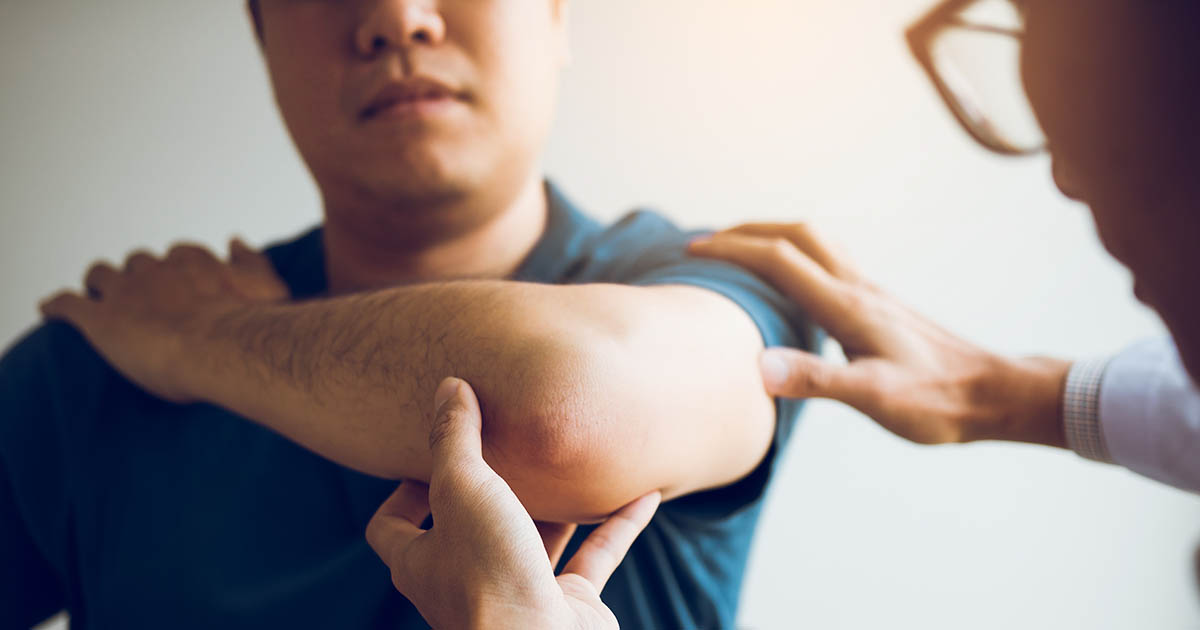
Lateral epicondylitis is named for the bony prominence on the outer elbow where several forearm extensor muscles attach. The backhand drive, the dink over the net, the flicking motion that keeps the ball low -- all of them create tension at that attachment point. Thousands of repetitions per session, multiple sessions per week, and the tendon begins to show structural changes.
In early stages, the pain is mainly during play and for an hour or two afterward. In later stages it can ache at rest, make shaking hands uncomfortable, and flare when lifting a glass. Some patients describe a burning quality along the outer forearm. Others just notice the grip strength is gone on the affected side.
The important distinction: most patients come to us when it has already become a true tendinopathy rather than just acute inflammation. Tendinopathy is a structural change in the tendon tissue, not simply swelling. Anti-inflammatories and rest address swelling; they do not fix structural tendon changes. You need the tissue loaded and stimulated to remodel -- which is the opposite of the instinct to rest it completely.
The treatments with the best outcomes for lateral epicondylitis are eccentric loading protocols, shockwave therapy (which stimulates tendon remodeling directly), and soft-tissue work on the forearm extensors. We also look at grip mechanics and paddle weight, because many cases are partly driven by a grip that is too tight or a paddle that does not match the player's forearm strength.
Pickleball Knee: Two Different Problems That Feel Similar
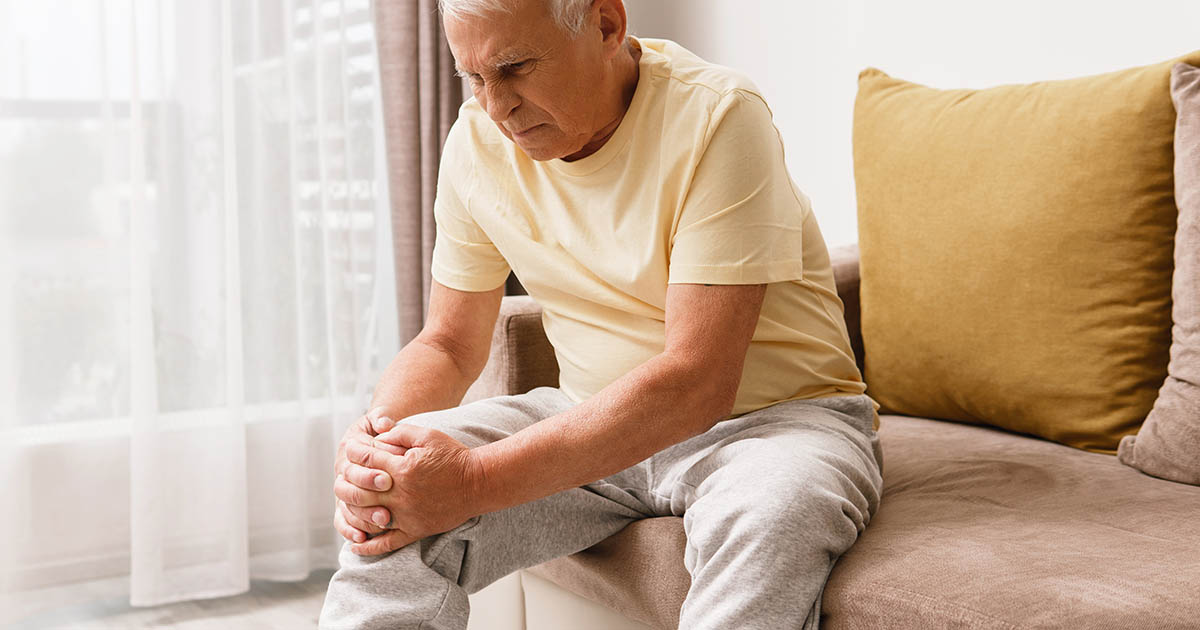
Knee pain in pickleball players usually comes from one of two places. The distinction matters because the treatment is different.
Patellar tendinopathy (sometimes called jumper's knee, even without jumping) comes from repeated quick direction changes that load the patellar tendon at the front of the knee. Pain is usually directly below the kneecap. It worsens going downstairs, squatting to pick something up, or in the first few minutes of play before the joint warms up.
Medial meniscus stress is subtler. The medial meniscus is the C-shaped cartilage pad on the inner side of the knee, and it absorbs the rotational load every time you plant and pivot. If the muscles around the knee -- especially the VMO and the glutes -- are not doing their share of that load, more of it transfers to the cartilage. Some players notice a mild catch or very slight swelling after a long session. Others just describe a "deep" ache that feels different from anything they have had before.
Neither gets better by playing through it. Playing through patellar tendinopathy accelerates the tendon changes. Playing through meniscus stress can turn a manageable irritation into a partial tear. We do a specific orthopedic evaluation at the knee before treating, because the treatment for tendinopathy (eccentric loading) is different from the treatment for meniscus stress (load modification and joint mechanics work).
For pickleball players dealing with knee pain, we often combine soft-tissue work to address the muscle imbalances driving the problem with Class IV laser therapy to reduce inflammation, and in some cases we add knee decompression for patients who also have some joint space narrowing. The goal is to resolve the current episode and, more importantly, address the mechanical reasons it started -- so it does not come back on the third session after you feel better.
The players who do best after a knee injury are not necessarily the ones who rest the longest. They are the ones who understand what drove the injury, correct that, and return to play with a modified warm-up and awareness of what the joint is telling them.
Shoulder Injuries: Overhead and Off-Speed
The pickleball overhead smash is the most demanding motion the shoulder has to perform. The rotator cuff -- four muscles that stabilize the humeral head in the socket -- has to decelerate the arm on every overhead swing. Over a long session, or over a full season without rotator cuff conditioning, those muscles fatigue and the mechanics shift.
The most common pattern is shoulder impingement: the supraspinatus tendon catches between the humeral head and the acromion during elevation. The pain tends to be at the front or top of the shoulder, sometimes radiating into the upper arm, and gets worse reaching overhead, across the body, or behind the back.
An early indicator that players often miss: waking up at 2 or 3am with a dull ache in the shoulder, on the side they play on. That nighttime symptom is a reliable sign that there is structural irritation, not just muscle fatigue, and it is worth getting checked before the next session makes it worse.
Plantar Fasciitis and Ankle Sprains
Hard court surfaces and rapid direction changes stress the foot and ankle more than players realize. Plantar fasciitis -- inflammation of the thick fibrous band running along the bottom of the foot -- often starts as stiffness in the first few steps after sitting or first thing in the morning. Players discount it because it eases up once they warm up. Then it stops easing up.
Ankle sprains, particularly lateral sprains on the outer ankle, happen when a quick stop or direction change rolls the foot inward. A straightforward lateral ankle sprain usually heals in 2 to 3 weeks with appropriate management. A poorly managed sprain leaves chronic ligament laxity that affects stability on the court for years, and may set up the knee for additional stress as the joint above compensates.
Lower Back: The Hidden Pickleball Injury
Lumbar strain and disc aggravation are underreported in pickleball patients because many players already had some back history before they started playing. The game's demands -- forward flexion at address, rotation with every swing, explosive lateral movement -- load the lumbar spine in a way that everyday activity does not.
Players with existing disc issues or facet joint problems frequently notice their symptoms worsen after a few weeks of regular play. That is not necessarily a reason to stop. It is a reason to have the spine evaluated and figure out whether the problem is disc-related compression, facet joint irritation, or a stabilization deficit in the core -- because each of those responds to a different approach.
For disc-related symptoms, non-surgical spinal decompression in Lakewood Ranch is often one component of the recovery plan, particularly if there is nerve involvement causing leg symptoms during or after play. The evaluation tells us what is actually happening before we choose the treatment.
When to See a Chiropractor and When to Wait
A muscle soreness that resolves in 3 to 5 days of rest is not a provider visit. Most players know the difference between that and something structural.
We generally recommend getting evaluated when:
- Pain has persisted more than 2 weeks despite rest
- A joint is swollen or visibly changed
- You have numbness or tingling anywhere (nerve involvement)
- Pain is waking you up at night
- Range of motion has noticeably decreased
- The injury is affecting your movement in daily activities, not just on the court
Neurological symptoms -- tingling down the arm, numbness in the hand, leg weakness -- should not be waited out. Those patterns can indicate disc pressure on a nerve root and warrant prompt evaluation.
What Evaluation and Treatment Look Like
When a pickleball player comes to our office, the evaluation starts with orthopedic testing specific to the affected joint. For the elbow, that means identifying which portion of the extensor muscle group is involved and how far the tendinopathy has progressed. For the knee, it means checking patellar tracking, assessing medial and lateral stability, and putting the joint through the range of motion that replicates playing mechanics.
The treatment plan comes from the evaluation, not from the chief complaint. Two patients with "pickleball elbow" may need substantially different approaches depending on what the exam finds.
Common tools in the plan for pickleball-related injuries:
- Soft-tissue work and chiropractic adjustment to address joint mechanics and the muscle guarding that develops around a chronically irritated joint
- Class IV laser therapy to reduce tissue inflammation and accelerate repair at the cellular level
- Shockwave therapy for chronic tendinopathy that has not responded to rest -- this is the treatment that actually stimulates tendon remodeling
- Specific loading protocols to restore the tendon or joint to a state where it can tolerate play again without re-injury
Many patients in this situation return to play within 4 to 6 weeks, depending on how long the injury was present before they came in. The patients who come in after two weeks of pain typically recover faster than the patients who waited three months and have significant tendon changes to work through.
Getting Back on the Court
The most consistent question: "Can I keep playing while I get treatment?"
The honest answer is usually yes, with modifications. Most pickleball injuries respond better to intelligent loading than to complete rest. A grip change can take significant stress off a lateral epicondylitis. A proper warm-up and footwear adjustment can make plantar fasciitis manageable during the recovery phase. Shortening session length and reducing overhead swings can allow shoulder recovery without giving up the game entirely.
We work with patients on what modification makes sense for their specific injury and where they are in recovery, so they can stay active rather than stopping entirely and losing the conditioning benefit of the game.
If you are playing pickleball in Lakewood Ranch, Bradenton, or the Sarasota area and something has started to feel off, the easiest time to address it is while it is still early. Call us at (727) 213-2982 or book directly online. We see sports-related presentations regularly and can usually get a clear picture of what is happening in the first visit.