

Your teenager comes home from football practice, gymnastics, or cheer camp complaining of lower back pain. They stretch it out. You give them ibuprofen. Practice resumes. The pain keeps coming back. Eventually you wonder: is this just growing pains, or something more?
In many cases, the answer is something more specific, and something the clinic frequently sees in young athletes here in the Lakewood Ranch and Bradenton area: a condition called spondylolysis. It is a stress fracture in the lower back that responds well to conservative care when caught early, but tends to quietly progress when ignored.
What spondylolysis actually is
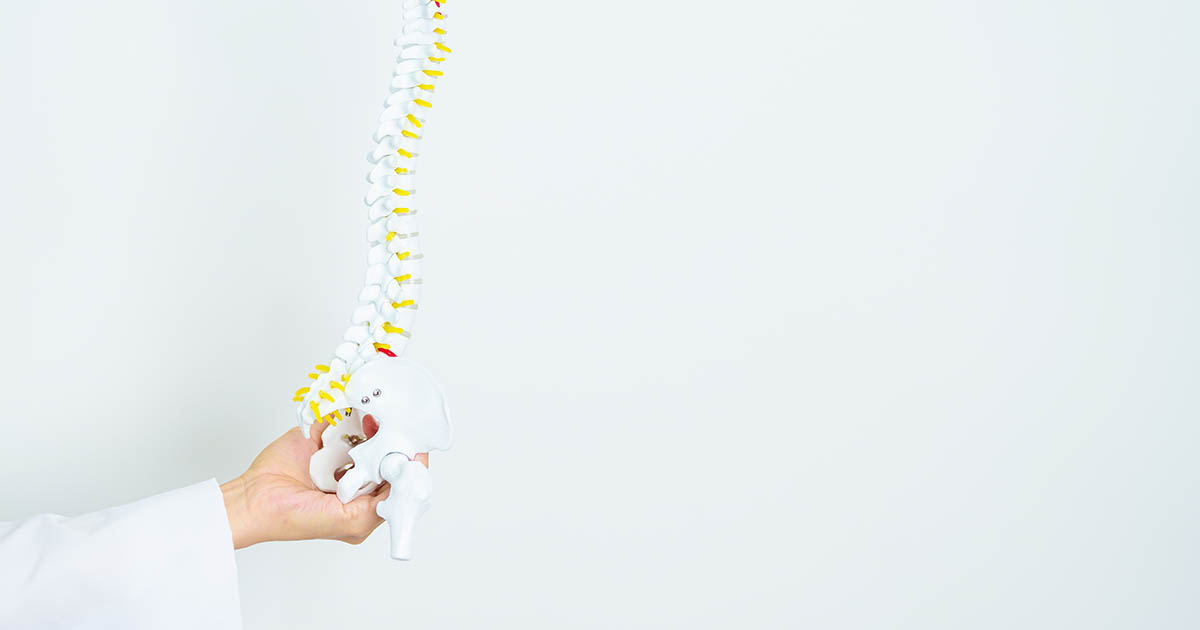
Each vertebra in your spine has a body (the thick cylinder in front), two pedicles, two laminae, and a cluster of bony projections connecting everything together. Tucked between the upper and lower facet joints on each side is a narrow bone bridge called the pars interarticularis (Latin for "between the joints"). It is not large. But it carries significant load, especially during extension movements that arch the back.
Spondylolysis is a fracture or defect in that bridge. It happens most often at L5, the last lumbar vertebra before the sacrum, and sometimes at L4. The fracture can occur on one side (unilateral) or both sides (bilateral). A bilateral pars fracture is what sets the stage for the vertebra to begin slipping forward, a related but more serious condition called spondylolisthesis.
The fracture itself is what we mean when we say spondylolysis. The slippage is what we mean by spondylolisthesis. They are often confused, even among providers, but they are not the same thing.
Why young athletes are at particular risk
The general population has a spondylolysis rate somewhere around 5 to 6 percent. Among young athletes presenting to spine clinics with back pain, the rate runs as high as 47 to 63 percent depending on the sport. That gap tells you something important: this is not a random structural quirk. It is largely a product of repeated mechanical stress at the wrong angle.
The pars interarticularis takes its worst loading during lumbar hyperextension, the movement where you arch the lower back. Sports that require repetitive hyperextension, or that load the spine at that angle under high forces, are the ones that generate this fracture:
- Gymnastics and cheerleading (back walkovers, tumbling, dismounts)
- Football linemen (blocking stance requires sustained lumbar extension under load)
- Baseball and softball pitchers (the follow-through rotation hyperextends the contralateral side)
- Volleyball (repetitive overhead swings with lumbar extension)
- Weightlifting and powerlifting (deadlifts and squats with faulty lumbar position)
- Dance (arabesque, back bends, pas de deux lifting)
- Wrestling (bridging, throw mechanics)
Age matters too. Adolescents are growing, and bone in the pars interarticularis is still maturing. The bone is more susceptible to stress fracture during growth spurts, which is why this condition peaks roughly between ages 9 and 18, right when training loads in organized sports are ramping up most aggressively.
The symptom pattern that raises a flag
Spondylolysis does not always announce itself dramatically. The onset is typically gradual, not sudden. Many young athletes describe it as a dull, achy pain in the lower back that builds over a season rather than appearing after a single incident.
The pattern that should draw attention:
- Pain that worsens with arching the back (extension), particularly when standing on one leg while arching
- Pain that eases when bending forward or sitting
- Pain that is worse after practice or competition and better with rest, at least initially
- Pain localized to the lower lumbar area, sometimes described as "deep" or on one side
- In some cases, tightness in the hamstrings without a clear reason
What is typically absent: the dramatic shooting leg pain (sciatica) that many people associate with disc problems. Spondylolysis without slippage usually stays in the low back, though it can radiate into the buttocks. Neurological symptoms, if present at all, are a sign the condition may be more advanced.
The one-leg hyperextension test is a simple clinical screen: stand on one leg, then arch your lower back. Pain that reproduces on the stance-leg side suggests a pars stress reaction on that side. It is not diagnostic on its own, but it is a meaningful flag that warrants imaging.
How spondylolysis gets diagnosed, and why X-ray often misses it
Many families come in after a pediatrician or urgent care provider looked at plain X-rays and said everything was fine. That is not a bad provider; it is a genuinely difficult diagnosis to see on standard X-rays. Studies suggest plain films miss 20 to 25 percent of acute pars fractures, and bilateral defects that are edge-on to the beam can look ambiguous.
A specialized oblique view on X-ray can reveal what is classically called the "Scotty dog" sign: the shape of a small dog visible in the vertebra, and a fracture that looks like a collar around the dog's neck. Some radiologists describe it; others do not think to look for it. When the result is ambiguous but the clinical picture is strong, the next step is typically a CT scan or a SPECT (single-photon emission computed tomography) scan.
CT shows the bony architecture most clearly, making it the gold standard for visualizing the actual defect. SPECT detects increased metabolic activity in the bone, which is most prominent in an acute or active stress reaction before a visible fracture has formed, making it the better choice when we suspect an early stress reaction rather than an established break. MRI is useful for ruling out disc pathology and other conditions, but is less sensitive for pars fractures than CT or SPECT.
The practical takeaway: if back pain in a young athlete fits this pattern and does not resolve within two to four weeks of relative rest, imaging beyond plain X-rays is usually warranted. When we see this presentation in our Lakewood Ranch office, we coordinate with the appropriate imaging center and, when needed, with orthopedic or sports medicine colleagues for a complete picture before making care decisions.
How it differs from spondylolisthesis
These two terms are often used interchangeably, but they describe different things. Spondylolysis is the fracture in the pars. Spondylolisthesis is the forward slippage of one vertebra on the vertebra below it, which can occur when a bilateral pars fracture allows the front of the vertebra to shift forward.
Not every case of spondylolysis progresses to slippage. A unilateral pars defect rarely causes listhesis. A bilateral defect can, particularly in younger athletes during growth spurts when the spine is under the most cumulative load. The degree of slippage is graded on a scale from Grade I (less than 25 percent displacement) to Grade IV or V (severe). Most cases that do progress stop at Grade I or II with appropriate management.
If you have seen spondylolisthesis mentioned in your child's imaging report, do not immediately assume the worst. What matters clinically is the degree of slippage, the stability, and whether neurological symptoms are present. Most Grade I cases, and many Grade II cases, are managed conservatively and do not require surgery. We outline the full picture of what that slippage means in our spondylolisthesis guide.
What treatment typically looks like
For an acute pars fracture, the first and most important step is activity modification. That usually means a temporary reduction in or complete break from the sport that caused the stress. This is not the answer parents or athletes want to hear during a competitive season, but it is the one that gives the bone the best chance to heal. An acute pars fracture in a skeletally immature athlete can fully heal with appropriate rest; a mature defect that has become fibrous (common in adults with longstanding spondylolysis) typically will not fully heal but can become completely asymptomatic.
Depending on the athlete's age and the acuity of the fracture, a rigid brace may be used to reduce extension loading during the healing phase. This is more common in younger adolescents and in cases with a confirmed acute fracture rather than a chronic defect. The brace is typically worn for eight to twelve weeks alongside physical activity restrictions.
Once the acute phase settles, rehabilitation focuses on:
- Core stabilization: the deep abdominals (particularly the transversus abdominis) and lumbar multifidus protect the pars under load. Many young athletes have strong superficial muscles and weak stabilizers.
- Hip flexor and hamstring flexibility, which reduces the extension demand on the lumbar spine
- Movement mechanics: how the athlete arches, lifts, lands, and throws often places the pars in repeated danger. Coaching this is at least as important as strengthening.
- Gradual return-to-sport protocol: re-introduction of sport-specific loads in a controlled sequence, not a single return-to-play decision
We also watch closely for imaging changes over time, particularly in bilateral cases in younger athletes still growing.
How we approach this at our Lakewood Ranch clinic
When a parent calls us about a teenager's back pain that has not cleared up, we start with a thorough history and movement examination. Dr. Banman has 23 years of experience assessing spinal mechanics, and the movement pattern in spondylolysis is fairly recognizable: the athlete moves well into flexion, winces on extension, and often has an asymmetric loading pattern that traces back to sport mechanics.
If imaging has already been done, we review it. If not, and the picture warrants it, we coordinate. We do not make the imaging decision on the first visit; we make it based on what the examination tells us. Many cases turn out to be muscular or facet-related, which are also common in young athletes and resolve more quickly. But when the fracture pattern is present, knowing it early matters.
Our care does not include aggressive manipulation at the fracture site. With an active pars fracture, the goal is to unload and stabilize, not to introduce additional movement at the affected segment. What we do provide is guidance on activity modification, posture and biomechanics coaching, and the kind of structured monitoring that prevents a manageable fracture from quietly progressing into something that requires surgery.
For athletes whose spondylolysis has become a chronic, stable, non-progressive finding, the focus shifts entirely to function: building the stabilizer strength and movement quality that lets them return to sport without continuing to load the damaged segment. Many high-level athletes in NFL, NFL-adjacent sports, and Olympic-level gymnastics have competed with documented bilateral pars defects for years. The condition is not a career-ending diagnosis; it is a structural reality that requires intelligent management.
When to come in and what to expect
If your athlete has had lower back pain for more than two or three weeks that is specifically worse with extension and better with rest, an evaluation makes sense. You do not need an imaging report in hand first. The examination guides whether imaging is warranted, what type, and what priority.
Red flags that move this toward an urgent evaluation rather than a wait-and-see approach:
- Pain that radiates down one or both legs, particularly with numbness or weakness
- Pain that wakes the athlete at night (night pain in a young person warrants ruling out other causes)
- A sudden acute injury that brought the pain on sharply, distinct from the usual gradual onset
- Pain that does not ease with two to three days of complete rest
- Any loss of bowel or bladder function (go to an emergency room; do not call us first)
The goal, as with any structural issue in a growing athlete, is to catch it while the biology is still on your side. A fracture diagnosed at 14 with appropriate care looks very different ten years later than one discovered at 22 after a decade of unmodified loading.
We are here in Lakewood Ranch, and we see young athletes from the surrounding Bradenton and Sarasota communities regularly. Call (727) 213-2982 to schedule, or book directly at the link below. We typically see new patients within 24 hours when the situation calls for it.